 Ferndale
 Building Exteriors for Lummi Nation's Coastal Climate
Lummi Nation sits close enough to Bellingham Bay and the Strait of Georgia that salt-laden air is simply part of daily life here. Add Whatcom County's long, wet winters and the shoulder seasons that never seem to fully dry out, and you have a climate that is unusually hard on the outside of a house. Homes in this area take on moisture, salt, and shade stress in combinations that most siding, roofing, window, and decking products were never designed to handle for the long haul. We work throughout this part of the county and see the same patterns show up on house after house — which is exactly why our approach here is built around materials and installation details suited to marine-influenced, low-sun, high-moisture conditions, not generic national averages.
What the Climate Actually Does to a House Here
Salt Air
Proximity to saltwater means airborne salt settles on exterior surfaces and gets carried further inland on wind and fog. Salt accelerates corrosion of fasteners, flashing, and hardware, and it interacts with paint films and coatings in ways that speed up chalking and fading. Metal components — nails, screws, gutter hangers, hinges — need to be rated for coastal exposure, not just "exterior grade." A lot of the premature rust and streaking we get called out to look at traces back to hardware that was fine for an inland build but undersized for salt exposure.
Driving Rain
Storms off the Strait don't just fall straight down — wind-driven rain pushes water sideways into wall assemblies, around window openings, and up under roof edges. This is a wind-loaded rain climate, not a gentle-drizzle climate, and it punishes any gap in flashing, any short lap in siding, and any window installation that skipped proper pan flashing and sill sloping. A house can look fine for years and still be taking on water behind the cladding if those details were rushed the first time.
Moss and Shade
Between tree cover and a long overcast season, north-facing walls and low-slope roof sections here can stay damp for weeks at a stretch. That's the environment moss and algae need to establish, and once moss gets a foothold on a roof or in siding laps, it holds moisture against the surface underneath it — which is worse than the moss itself. Roofs with poor ventilation or the wrong underlayment choice age fast in these conditions; siding with absorbent or unsealed edges does the same.
| Climate Factor | What It Stresses | What Matters in the Install |
|---|---|---|
| Salt air | Fasteners, flashing, coatings | Coastal-rated hardware, factory-cured finishes |
| Driving rain | Window openings, siding laps, wall penetrations | Proper pan flashing, correct laps, sealed penetrations |
| Shade and moss | North walls, low-slope roofs, ground-level decking | Ventilation, moisture-resistant materials, drainage gaps |
| Freeze-thaw swings | Caulk joints, deck boards, roof edges | Flexible sealants, proper board spacing |
Siding: Why We Standardize on James Hardie
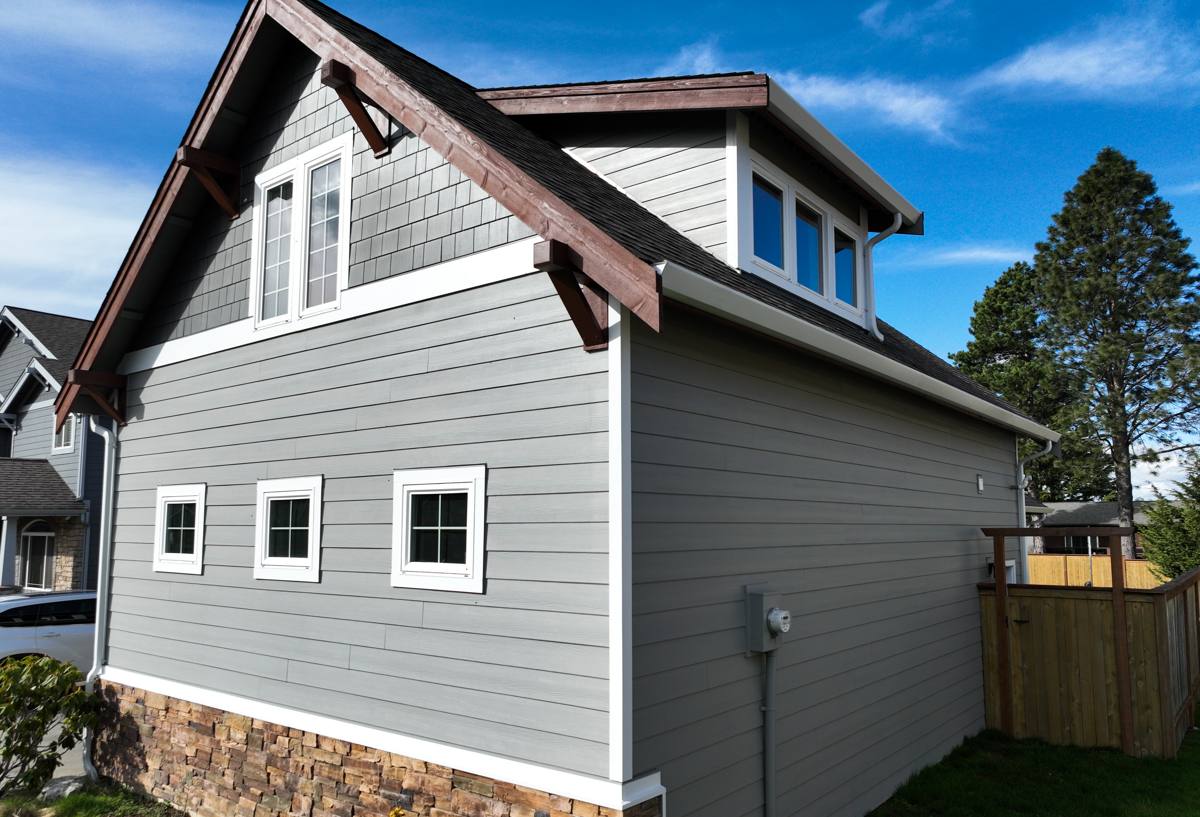
We install James Hardie fiber cement siding exclusively. That's a deliberate call, not a default. In a climate like this one, siding has to resist swelling, rot, and moisture intrusion at the plank edges over decades, not just look good on install day. Fiber cement doesn't absorb water the way wood-based or wood-adjacent products do, and it doesn't provide the organic material that moss and mildew feed on the way untreated or lightly primed products can. Hardie's ColorPlus factory-applied finish is baked on under controlled conditions rather than field-painted, which matters a lot here — a factory finish holds up to salt air and UV exposure noticeably better than site-applied paint, and it means fewer repaint cycles over the life of the siding.
Hardie also builds region-specific HZ product lines engineered for different climate zones, which is relevant on the Washington coast where moisture exposure is a bigger variable than temperature extremes. Combined with a strong transferable warranty, that's the combination we've chosen to stand behind on every siding job we take on in this area.
What We Won't Install, and Why
We don't install vinyl, LP SmartSide, Cemplank, Allura, or primed wood siding like spruce or cedar — not because these products have no merit, but because our standard for this climate is higher than what they reliably deliver over time. Vinyl can warp and fade under UV and doesn't hold paint if a homeowner ever wants to change color. LP SmartSide and similar engineered wood products perform well in drier climates but rely on edge sealing and maintenance discipline that's harder to guarantee in a place this wet for this long. Cedar and primed spruce are beautiful but need active upkeep — refinishing, sealing cut edges, watching for rot at grade — that most homeowners don't want to sign up for indefinitely. We'd rather tell you honestly why we chose Hardie than sell you something we don't believe will hold up here.
Roofing Built for Moss Season and Wind-Driven Rain
Roofing in this area has to manage two problems at once: shedding wind-driven rain at every edge, valley, and penetration, and resisting the slow damage that comes from moss holding moisture against roofing material for months at a time. That means correct underlayment selection, properly lapped flashing at every roof-to-wall transition, and attention to ventilation so the roof deck itself isn't trapping moisture from underneath. We also pay attention to which roofing materials and treatments resist moss growth in the first place, since prevention is far cheaper than the repeated cleaning and repair that comes from letting moss take hold on a low-slope or shaded roof section.
Windows: Keeping Wind-Driven Rain Out
Most window leaks we investigate in wet coastal climates aren't failures of the window unit itself — they're installation failures. Wind-driven rain will find any shortcut in the flashing sequence around a window opening. Proper installation means pan flashing at the sill so any water that does get past the window sheds back outside the wall assembly, correct shingle-lap sequencing of flashing tape and building wrap, and sealant at the right joints (and no sealant where it would trap water instead of shedding it). Energy performance matters too — this area doesn't see extreme heat, but consistent damp cold and wind mean drafts and condensation on interior glass are common complaints, which better-performing glass packages and tight installation both help address.
Decks: Standing Up to Rain and Shade
Decking here deals with a slightly different version of the same moisture problem — standing water, shaded ground-level framing, and organic debris (needles, leaves) that hold dampness against boards and framing connectors. Board spacing, proper drainage beneath the deck surface, and corrosion-resistant fasteners and structural connectors all matter more here than they would in a drier climate. We also pay attention to ledger board flashing where a deck attaches to the house, since that's a common spot for slow water intrusion into the wall assembly behind it.
Why a Local Crew Matters
A crew that works Whatcom County regularly knows which details actually matter in this specific climate versus which ones are boilerplate from a national install manual. We know how far salt air's effects reach inland from the water, which sides of a house need the most attention for moss and shade exposure, and how aggressively wind-driven rain behaves during a Pacific storm system moving through. That local knowledge shows up in the small decisions — flashing laps, fastener selection, product line choice — that determine whether an exterior lasts fifteen years or forty.
A Practical Checklist for Homeowners in This Area
- Check north-facing and shaded walls for early moss or algae growth at least once a year
- Inspect caulking around windows and doors for cracking or gaps before winter storm season
- Look at roof valleys and low-slope sections for moss buildup, especially under tree cover
- Check deck ledger boards and fasteners for rust staining or soft spots
- Have gutters cleared before the fall rains so water isn't backing up against fascia and siding
- Ask any contractor bidding exterior work what fastener and flashing materials they use, and why
What to Expect When You Work With Us
We assess the specific exposure of your home — how much direct salt air it gets, which walls stay shaded and damp, how wind typically drives rain against the structure — before recommending a scope of work. For siding, that means James Hardie fiber cement, matched to the right HZ product line and ColorPlus finish for your home. For roofing, windows, and decks, that means correct flashing, ventilation, and material choices suited to a wet, salt-influenced, moss-prone climate rather than a one-size-fits-all approach. We'd rather walk a homeowner through the honest trade-offs of each material than oversell a product that won't hold up here.
If you're weighing a siding, roofing, window, or deck project near Lummi Nation, we're glad to take a look and talk through what your home actually needs. Reach out for a free, no-pressure estimate using the form below.