 Ferndale
 Siding Built for Life on Sandy Point
Sandy Point sits right up against the water in Whatcom County, and that location shapes everything about how a home ages out here. Homes on this stretch of coastline take a different kind of beating than houses just a few miles inland in Ferndale or Bellingham. Salt-laden air, near-constant moisture, and a moss season that can stretch most of the year all work on exterior surfaces in ways that inland siding simply doesn't have to deal with. We've been doing exterior work throughout Whatcom County long enough to know that what holds up on a dry, sheltered lot doesn't necessarily hold up a few hundred yards from open water.
This page isn't a sales pitch dressed up as an article. It's meant to walk through what we actually see on Sandy Point homes, what tends to fail first, and how we approach siding, roofing, windows, and decks differently when a house sits this close to salt water.
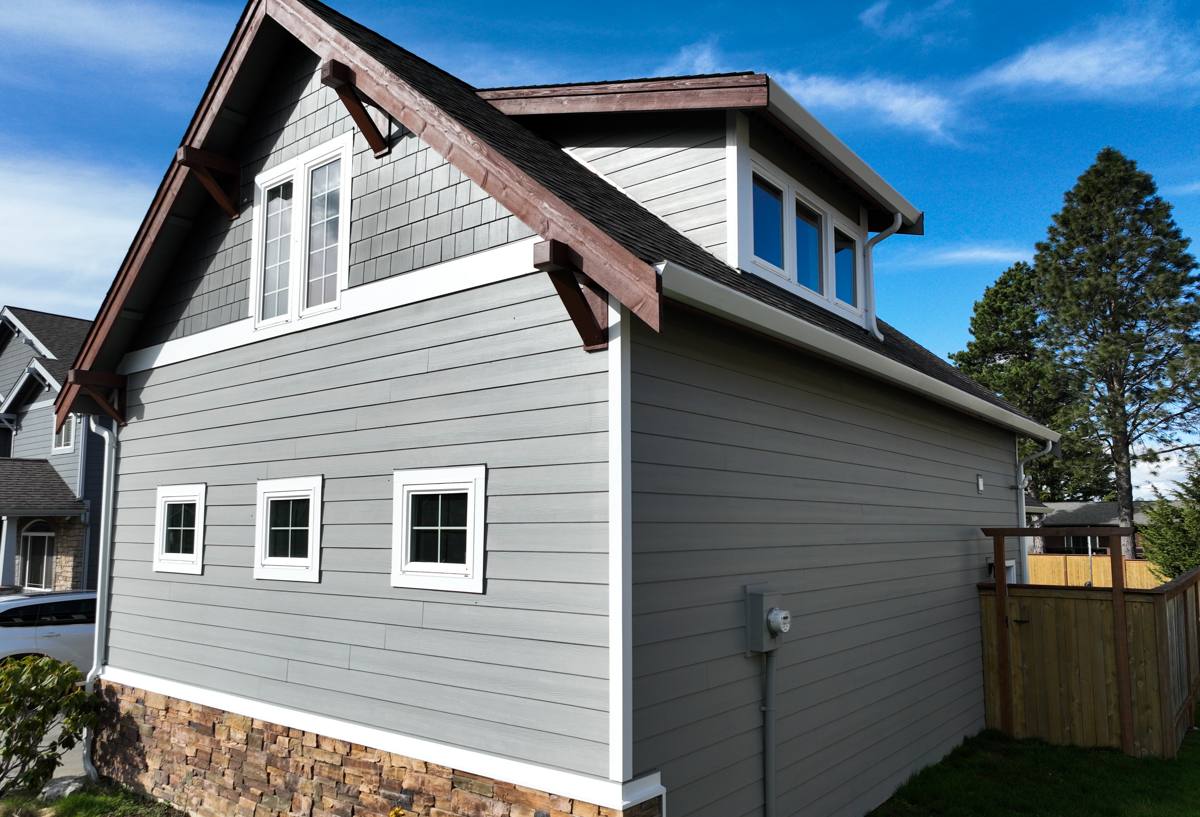
What the Coastal Environment Does to a House
Three things drive most of the exterior wear we see on Sandy Point properties:
Salt Air
Airborne salt doesn't just affect metal fasteners and hardware — it accelerates the breakdown of paint films, caulking, and any wood-based siding product. Salt is hygroscopic, meaning it actually pulls moisture out of the air and holds it against a surface longer than it would otherwise sit there. On painted wood or composite siding, that means more frequent cracking, peeling, and edge failure than you'd see on the same product a few miles inland.
Driving Rain
Storms coming off the water tend to hit this stretch of coastline with wind-driven rain rather than straight-down rain. That matters because wind-driven moisture gets forced sideways into laps, seams, and trim joints that were never designed to handle water pressure from that angle. A siding system's water management — not just its surface finish — is what determines whether that moisture stays out of the wall assembly.
A Long Moss and Algae Season
Cool, damp conditions for a large part of the year make north-facing walls, roof valleys, and anything shaded by trees or neighboring structures prone to moss and algae growth. Beyond the cosmetic issue, sustained moisture retention from moss buildup is one of the more common causes of premature rot and coating failure we find when we're called out to look at a failing exterior.
Why We Only Install James Hardie Fiber Cement
We install James Hardie fiber cement siding exclusively. We don't install vinyl, LP SmartSide, Cemplank, Allura, primed spruce, or cedar — not because those are bad products in every application, but because after years of exterior work in this climate, we don't think they're the right long-term answer for homes that take the kind of coastal exposure Sandy Point sees. Here's the honest reasoning:
- Non-combustible core: Hardie's fiber cement composition doesn't burn, which matters more every year as wildfire smoke and ember exposure become a bigger regional concern, even in wetter parts of Western Washington.
- Factory-applied ColorPlus finish: The color and coating are baked on at the factory under controlled conditions, which holds up better against UV and salt exposure than field-applied paint, and it's backed by its own finish warranty separate from the substrate.
- Climate-engineered HZ product line: Hardie makes region-specific formulations for wet, humid climates like ours, engineered to resist moisture-related damage better than a general-purpose fiber cement or composite product.
- Dimensional stability: Fiber cement doesn't swell, warp, or split the way wood-based products can when they take on repeated moisture cycling — which is exactly what happens on a coastal lot through fall and winter.
- Strong transferable warranty: A warranty that survives a change of ownership matters on waterfront property, where homes change hands more often and buyers are paying close attention to exterior condition.
None of that means other products can't be installed correctly and last a reasonable amount of time. It means that when we weighed maintenance burden, moisture performance, and long-term cost against the way this coastline actually treats a house, Hardie was the product we were willing to put our name behind.
The Full Exterior Picture: Roofing, Windows, and Decks
Siding rarely fails on its own — it's usually one piece of a bigger exterior envelope problem. That's why we handle roofing, windows, and decks alongside siding rather than treating them as separate jobs.
Roofing
A roof that's shedding granules, holding moss, or has failing flashing at valleys and penetrations is going to send water somewhere, and on a coastal lot that "somewhere" is often behind the siding at the roof line. We look at roof condition as part of any siding conversation, because new siding installed under a compromised roof edge is a short-term fix.
Windows
Window flashing and the seal between the window unit and the siding is one of the most common points of water entry we find during tear-off. Salt air also accelerates the breakdown of window seals and hardware, so window condition and siding condition tend to go hand in hand on older coastal homes.
Decks
Decks facing the water get the same driving rain and salt exposure as the siding above them, plus standing water and UV on the horizontal surface. Ledger board connections and any wood-to-wall junctions are worth a close look whenever siding work is happening nearby, since that's a common spot for hidden rot.
What Correct Installation Looks Like Here
Fiber cement performs well when it's installed to spec — and performs poorly when it isn't, regardless of climate. In a salt-air, high-moisture environment, a few details matter more than usual:
- Proper clearance between the bottom of the siding and grade, decks, roof lines, and any horizontal surface where water can pool or splash back
- Correctly sized and spaced fasteners, driven flush rather than overdriven, to avoid cracking the board or compromising the water-resistive barrier
- A continuous, properly lapped weather-resistive barrier behind the siding, with flashing integrated at every window, door, and penetration
- Caulking only where Hardie's installation instructions call for it — not as a substitute for correct flashing and lap technique
- Adequate rainscreen or drainage gap in exposed, wind-driven-rain locations, which helps the assembly dry out between storms
These aren't exotic requirements — they're the manufacturer's published installation standards. But we see them skipped often enough on older homes and rushed jobs that it's worth spelling out plainly.
Comparing Exterior Siding Options for a Coastal Lot
| Factor | Vinyl | Wood / Primed Spruce / Cedar | James Hardie Fiber Cement |
|---|---|---|---|
| Salt air resistance | Can become brittle and discolor over time | Prone to accelerated moisture damage and paint failure | Engineered for high-moisture, coastal climates |
| Fire performance | Combustible | Combustible | Non-combustible |
| Finish durability | Color molded in, can fade unevenly | Requires repainting/staining on a recurring cycle | Factory-applied ColorPlus finish with its own warranty |
| Moisture-driven maintenance | Low, but seams and moisture behind panels can go unnoticed | High — repainting, caulking, spot repairs | Low when installed and maintained to spec |
| Typical warranty structure | Varies widely by manufacturer | Limited, often finish-only | Strong, transferable substrate and finish warranties |
Signs a Sandy Point Home May Need a Closer Look
A lot of exterior damage on coastal properties starts small and stays hidden until it isn't. Worth checking for:
- Soft or spongy siding, especially near the bottom courses or around window and door trim
- Persistent moss or dark streaking on north- or shade-facing walls and roof planes
- Paint that's peeling, bubbling, or chalking faster than it should for its age
- Visible gaps, cracking, or separation at siding laps and trim joints
- Corroding or rust-staining fasteners and hardware
- Musty smell or visible staining on interior walls near exterior corners — often a sign of long-term moisture intrusion
- Deck ledger areas or wood-to-wall connections that feel soft when probed
Any one of these on its own isn't necessarily an emergency, but on a coastal lot they tend to compound faster than homeowners expect.
Why a Local Crew Matters
Whatcom County's coastline isn't uniform — a house tucked behind a tree line handles moisture very differently than one standing exposed to open water and prevailing wind. A crew that works this specific area regularly knows which details to prioritize on a given lot: where rainscreen matters most, which elevations take the worst of the driving rain, and how much moss pressure to expect on the shaded side of a house. That local pattern recognition is hard to substitute with a general checklist, and it's part of why we keep our crews working consistently across Ferndale and the surrounding coastal communities rather than spreading thin across a much wider territory.
Get a Free, No-Pressure Estimate
If you're noticing early wear on a Sandy Point home, planning ahead for an aging exterior, or just want an honest read on what your siding, roofing, windows, or deck actually need, we're happy to take a look. There's no pressure and no obligation — just a straight assessment from a crew that knows this coastline. Use the form below to request your free estimate.