 Ferndale
 Why Siding Costs Are So Hard to Pin Down Online
Search "siding replacement cost" and you'll get a dozen national averages that mean almost nothing once you're standing in front of your own house in Ferndale. National cost calculators are built around averages pulled from every ZIP code in the country, blending cheap vinyl re-sides in dry climates with full tear-offs on wet, moss-covered homes in the Pacific Northwest. Your project isn't an average. It's a specific house, on a specific lot, facing a specific set of weather conditions that Whatcom County throws at it every year.
What actually drives your number is a combination of the size and shape of your home, what's underneath your current siding, how much of it has to be removed and disposed of, the product you choose, and the amount of carpentry needed to get the walls ready before a single piece of new siding goes up. This page walks through each of those factors honestly, so you can read a quote and know whether it's realistic — or whether something important got left out.
The Big Cost Drivers, One at a Time
Square Footage and Home Shape
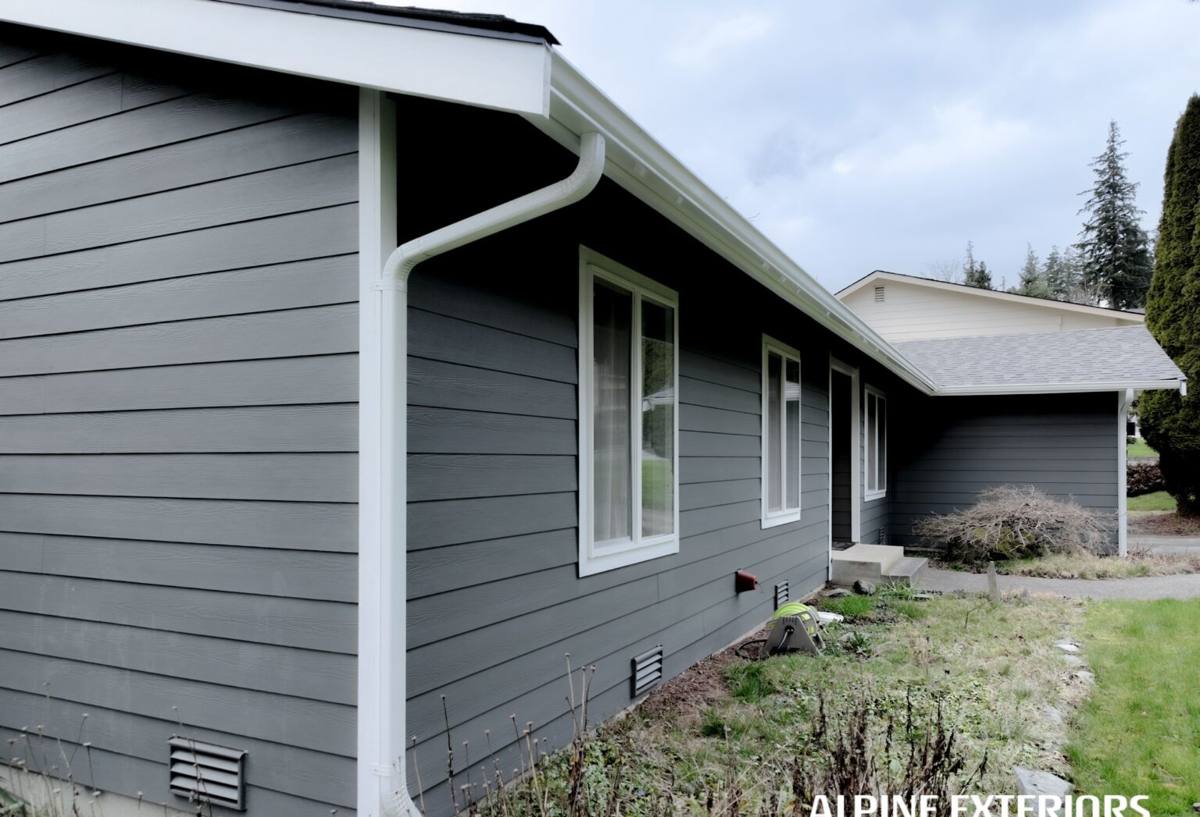
Bigger homes cost more, obviously, but shape matters almost as much as size. A simple rectangular ranch with few corners and a low roofline installs faster per square foot than a two-story home with dormers, bump-outs, and multiple roof pitches. Every inside corner, outside corner, window, and door opening adds cutting, fitting, and flashing time. Two houses with the same square footage can land tens of thousands of dollars apart because one is a box and the other is a collection of angles.
Tear-Off vs. Overlay
Removing old siding down to the sheathing costs more upfront than installing new siding over the old material, but in this climate we don't recommend overlay in most cases. Covering old siding also covers whatever moisture damage, rot, or trapped water is already happening behind it — and with the amount of driving rain Ferndale sees off the Strait of Georgia, that hidden damage is common enough that we'd rather find it now than let a homeowner discover it in five years when it's spread into the framing.
What's Under There
This is the line item that surprises people most. Nobody knows exactly what condition the sheathing, house wrap, and framing are in until the old siding comes off. Soft spots, rot around window openings, and water-damaged sheathing happen on homes of every age here, especially on north-facing walls and anywhere gutters have been clogged or missing. A fair contractor builds a contingency allowance into the estimate and shows you the damage before repairing it — not after the invoice arrives.
Product Choice
Vinyl sits at the low end of the price range. Fiber cement sits in the middle to upper-middle range. Engineered wood products land somewhere in between, and real wood siding — cedar or primed spruce — can cost as much or more than fiber cement once you account for the finish work and ongoing maintenance it demands. Price per square foot only tells part of the story, though, because the products don't have the same lifespan or maintenance cost, which we'll get into below.
Trim, Corners, and Accessories
Siding is rarely just siding. Fascia, trim boards, corner posts, soffit work, and freeze blocks all add up, and on an older Whatcom County home some of that trim is often rotted or undersized by current standards. A quote that doesn't specify what's included in trim and accessory work is a quote that's easy to lowball on paper and expensive to true up once work starts.
A Realistic Cost-Factor Table
| Factor | Lower Cost | Higher Cost |
|---|---|---|
| Home shape | Simple rectangle, single story | Multiple stories, dormers, many corners |
| Removal method | N/A — we recommend full tear-off in this climate | Full tear-off with sheathing inspection and repair |
| Substrate condition | Dry, sound sheathing | Rot, moisture damage, framing repair needed |
| Product | Vinyl | Fiber cement, engineered wood, real wood |
| Trim scope | Reuse sound existing trim | Full trim, corner, and soffit replacement |
| Access | Single story, clear yard access | Steep roof lines, tight lot, second-story work |
Why "Cheap" Siding Often Isn't Cheaper
The sticker price on a siding job is only half the financial picture. The other half is what you spend on it over the next 20 to 30 years — paint, caulking, moisture repairs, and eventual replacement. Vinyl needs no painting but is prone to cracking and fading, and it's difficult to repair a damaged section without the color slightly mismatching the rest of the wall. Cedar and primed spruce look excellent when new but need repainting or restaining on a cycle of roughly five to seven years in a climate as wet as ours, and any gap in that maintenance schedule invites moisture in fast.
Fiber cement, particularly with a factory-applied finish, sits at a different point on that curve. It costs more than vinyl at installation but doesn't need repainting on the same aggressive cycle, holds its shape and color under UV and moisture exposure, and is not a food source for the moisture and organic growth that this region's long moss season promotes. When we run the numbers over the realistic ownership period of a home rather than just the installation invoice, the total cost of ownership often favors fiber cement even though the upfront number is higher.
What a Fair, Honest Estimate Should Include
- A written scope specifying tear-off vs. overlay, and why
- An allowance or process for sheathing repair if rot is found once old siding comes off
- House wrap or weather-resistive barrier replacement, not reuse of old wrap
- Flashing details around every window, door, and roof intersection
- Specific product, line, and color — not just "fiber cement" or "vinyl" as a category
- Trim, corner, and soffit scope spelled out, not lumped into "siding"
- Disposal and cleanup of old material
- Manufacturer warranty terms and whether they're transferable to a future buyer
- Payment schedule tied to project milestones, not front-loaded before work starts
If a quote is missing several of these, it's not necessarily dishonest — but it is incomplete, and incomplete quotes are exactly where surprise change orders come from mid-project.
Comparing Quotes That Aren't Actually Comparable
The hardest part of shopping siding estimates is that two bids for "the same job" are often bidding two different jobs. One contractor may be quoting overlay while another is quoting full tear-off. One may include a sheathing repair allowance and one may not. One may be specifying a builder-grade vinyl and another a climate-engineered fiber cement line. Before comparing dollar figures side by side, line up the scope, product, and warranty terms first — the price comparison only means something once you know you're comparing the same actual project.
It's also worth asking every bidder directly what happens if they find rot once the old siding is off. A contractor who has a clear, pre-agreed process for that situation is telling you something about how they run a job site. A contractor who seems surprised by the question is telling you something too.
Whatcom County Climate: Why It Shows Up in the Price
Ferndale sits close enough to the water that homes here take a real beating from salt air, driving rain off the Strait, and a moss season that can run most of the year on shaded or north-facing walls. That combination accelerates two things: the rate at which lower-grade siding materials degrade, and the odds that sheathing behind older siding has taken on moisture damage nobody could see from the outside. Both of those realities push a fair, honest estimate for a Whatcom County home a bit higher than a national average calculator would suggest — not because contractors here are padding bids, but because the work genuinely requires more inspection, more moisture-management detail, and a product that can actually hold up to what this climate does to a wall over a few decades.
Financing and Timing Considerations
Siding is a large enough expense that most homeowners look at financing options, and many contractors offer or can point you toward third-party financing plans. Beyond financing, timing your project can also affect price — contractors are often more flexible on scheduling, and sometimes on cost, during shoulder seasons when the calendar isn't packed with peak-summer work. It's reasonable to ask a contractor directly whether their pricing or availability shifts by season.
Getting a Number You Can Actually Trust
The only way to get a real number for your home is to have someone walk your property, look at your current siding condition, measure your walls, and talk through the product options with you directly. Anything before that is a rough range at best. If you're in Ferndale or elsewhere in Whatcom County and want an honest look at what your specific project would involve, we're happy to come out, walk the house with you, and put together a straightforward, itemized estimate — no pressure, no sales script, just a clear look at what the job actually needs.