 Ferndale
 Why Color Choice Is a Bigger Decision Than It Looks
Picking a siding color feels like the fun part of a project, right up until you realize you're also picking how that color is going to behave for the next fifteen or twenty years. In most of the country, that's mostly a fading question. In Ferndale, it's a fading, salt, moisture, and moss question all at once. Whatcom County sits close enough to the Strait of Georgia and Bellingham Bay that airborne salt is a real factor on siding finish, and our rain season is long enough that any paint film with weak adhesion is going to show it — chalking, streaking, or peeling at the laps first.
James Hardie's ColorPlus Technology is a factory-applied finish, not a paint you choose off a fan deck at the hardware store. That distinction is the whole reason we standardized on it. This page walks through how the system actually works, how to think about color selection for a coastal Whatcom County home, and what to expect from the finish over time.
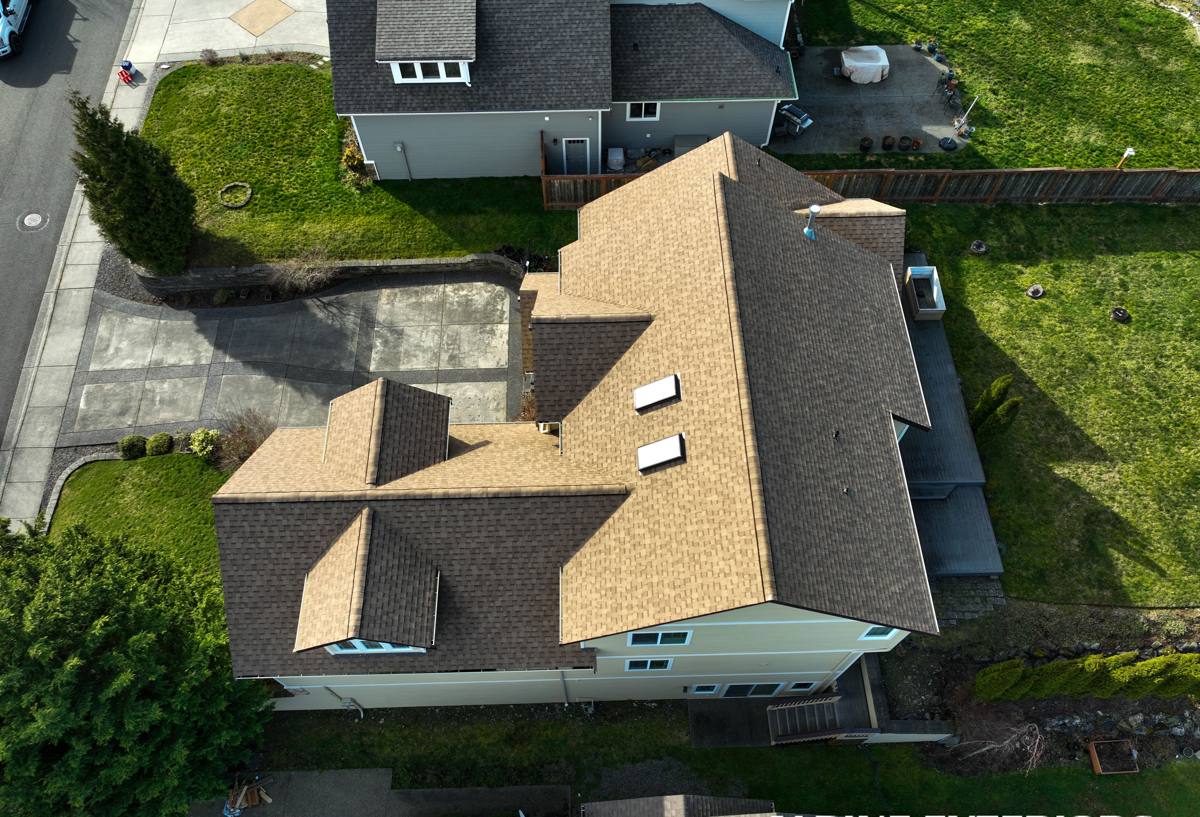
What ColorPlus Technology Actually Is
ColorPlus is a multi-coat color finish that's baked onto the fiber cement board in a controlled factory environment before it ever reaches the jobsite — not brushed, rolled, or sprayed onto the wall after installation. The board goes through multiple coating and curing cycles, which produces a finish that's more uniform and more tightly bonded to the substrate than anything applied on site, in the wind, in variable temperatures, on a ladder.
Why the Factory Setting Matters
Field-applied paint depends heavily on the conditions on the day it goes on — humidity, temperature, how much time the crew has before the light fades. A factory finish removes almost all of that variability. Every board gets the same coating thickness, the same cure cycle, and the same quality check before it's boxed up. That consistency is what lets Hardie back the finish with a real limited warranty instead of leaving color durability entirely up to the installer and the weather.
Why That Matters More Here Than in a Dry Climate
A house in eastern Washington deals with UV and heat cycling. A house in Ferndale deals with UV, plus months of driving rain, plus a marine layer that keeps siding damp longer than it would be inland, plus enough salt content in the air near the water to accelerate finish breakdown on lower-quality coatings. Factory-cured finishes resist that combination better than field-applied paint because the coating has fully cross-linked before it's ever exposed to weather — a field coat is often still curing when the first real rain hits it.
The Practical Difference Between ColorPlus and Standard Painted Siding
| Factor | ColorPlus Factory Finish | Field-Applied Paint |
|---|---|---|
| Application environment | Controlled factory, consistent cure | Job site, weather-dependent |
| Coating consistency | Uniform across every board | Varies by crew, weather, coat count |
| Typical repaint interval | Often 15+ years before touch-up needed | 5-8 years in wet coastal climates |
| Warranty on finish | Separate limited finish warranty from Hardie | Warranty (if any) tied to paint brand only |
| Color match on repairs | Matched touch-up product available | Depends on retained paint records |
None of this means field-applied paint is a scam — it's a normal, well-understood product. It just carries more of the durability burden on the application and the local climate, and Whatcom County's climate is not an easy one for a field coat to sit in year after year.
How the Color Lineup Is Organized
Hardie doesn't sell one universal color chart. Colors are organized by product line and by region, and the palette available to a Pacific Northwest home is engineered around this climate — muted, weather-appropriate tones that read well against evergreen backdrops and grey coastal light rather than colors optimized for high-sun, high-contrast climates elsewhere in the country.
Standard vs. Designer-Level Palettes
Most homeowners choose from the standard ColorPlus palette, which covers the range from classic whites and warm neutrals through deeper blues, greens, and charcoals. There are also Statement Collection and premium options in some markets with expanded color depth for homeowners who want something less common on the street. Availability varies by product line and distributor stock, which is worth confirming early rather than falling in love with a color before checking it's actually available for the board profile you want.
Matching Trim and Accent Boards
Hardie trim boards come in a coordinated set of ColorPlus finishes designed to pair with the field colors, so window trim, fascia, and corner boards can be ordered in a factory-matched tone instead of guessing at a field-mixed paint match. This is one of the underrated advantages of staying inside the ColorPlus system — the trim and the field siding are formulated to actually go together, not approximated by a painter with a swatch book.
Choosing a Color for a Ferndale Home
A few things are specific to this area and worth thinking through before you commit:
Light Quality
Whatcom County's overcast season is long. Colors that look crisp and bright in a showroom under direct light can read flatter and cooler under our typical grey sky. Lighter neutrals and warm-toned whites tend to hold their character better under cloud cover than stark, cool whites, which can look almost blue-grey on a rainy November afternoon.
Surroundings
Homes near the water, near farmland, or tucked against evergreen tree lines all read differently. Deep greens and blue-greys tend to sit naturally against fir and cedar tree cover. Warmer neutrals and clay tones stand out more against open farmland lots. There's no wrong answer, but it's worth actually looking at your lot's backdrop, not just a paint chip on a white background.
Moss and Algae Visibility
Given our moss season, very dark colors on north-facing walls or heavily shaded elevations can show streaking and organic growth more visibly over time than mid-tone colors, simply because contrast makes it easier to see. This isn't a reason to avoid dark colors — plenty of dark-sided homes in this area look great — but it is a reason to think about which elevations get the least sun and plan gutter and roof overhang maintenance accordingly.
Texture and Profile Change How a Color Reads
The same ColorPlus color can look noticeably different depending on the board profile it's applied to. A smooth lap board reflects light more evenly, while a cedar-textured profile creates shadow lines that deepen the apparent color, especially in shade. Shingle-style panels read differently again, since the repeating pattern breaks up the surface more than a straight lap run. If you're set on a specific color, ask to see it on the actual profile you're planning to install, not just a generic color chip — the difference is bigger than most people expect.
Things Worth Checking Before You Commit to a Color
- View the color sample outdoors, in Ferndale's actual daylight, not under indoor lighting
- Look at the color on the specific board profile and texture you're installing
- Check how the color reads against your roof, trim, and any brick or stone already on the house
- Consider which elevations get the least direct sun and how a dark color will show organic growth there
- Confirm the color is in current production for the product line you're ordering, not a discontinued or limited option
- Ask what the matched touch-up and trim options are for that color before you finalize it
What the ColorPlus Warranty Actually Covers
Hardie backs ColorPlus finishes with a separate limited finish warranty in addition to the substrate warranty on the fiber cement board itself. The finish warranty is specifically about coating performance — cracking, peeling, and fading within specified limits — not just the physical board. That's a meaningful distinction from typical field-painted siding, where any paint warranty is usually shorter, tied to the paint manufacturer rather than the siding manufacturer, and contingent on maintenance the homeowner has to track themselves. Warranty terms and transferability have specifics worth reading in full, and we go over the actual document with homeowners rather than just summarizing it, since it's the kind of thing you want to understand before you're relying on it.
Touch-Up and Long-Term Color Care
Even a strong factory finish will eventually need attention at cut edges, fastener heads, and any spot where the board gets nicked during a repair or a remodel. Hardie sells matched touch-up product specifically for this, so small repairs don't turn into a mismatched patch. The bigger-picture maintenance is straightforward: keep gutters clear so water isn't sheeting down the siding face, keep vegetation trimmed back from walls so airflow can dry the surface after our wet stretches, and rinse off accumulated grime or moss growth periodically rather than letting it sit for years. None of that is unique to Hardie — it's just good practice for any siding in a wet coastal climate, and it goes a lot further toward keeping a factory finish looking right than most people expect.
Getting the Color Decision Right the First Time
Color is one of the few parts of a siding project that's genuinely hard to change your mind about after installation — repainting a factory finish defeats the purpose of choosing it in the first place. We'd rather spend extra time up front looking at real samples on your actual lot, in actual Ferndale light, than have a homeowner second-guessing the color a year in. If you're weighing colors, product lines, or just want to see samples against your home's trim and roofline, we're happy to walk through it with a free, no-pressure estimate.