 Ferndale
 An Exclave With Its Own Exterior Climate
Point Roberts sits in a category of its own. It's part of Whatcom County, but geographically it's cut off from the rest of the U.S. mainland, sitting on a peninsula that hangs south from the Canadian mainland. Getting there means driving through British Columbia and crossing the border twice. That geography shapes everything about how homes here age, and it shapes how exterior contractors need to plan a project. Add in the fact that Point Roberts is surrounded on three sides by open water, and you've got a community where salt air, wind-driven rain, and a long, wet moss season aren't occasional nuisances — they're the baseline condition your siding, roof, windows, and deck have to survive year after year.
We're a Ferndale-based crew, and we've been working exterior projects throughout Whatcom County long enough to know that a house in Point Roberts doesn't age the same way as a house twenty minutes inland. The materials that hold up fine in a more sheltered spot can fail early out here. That's the lens we bring to every estimate in this area.
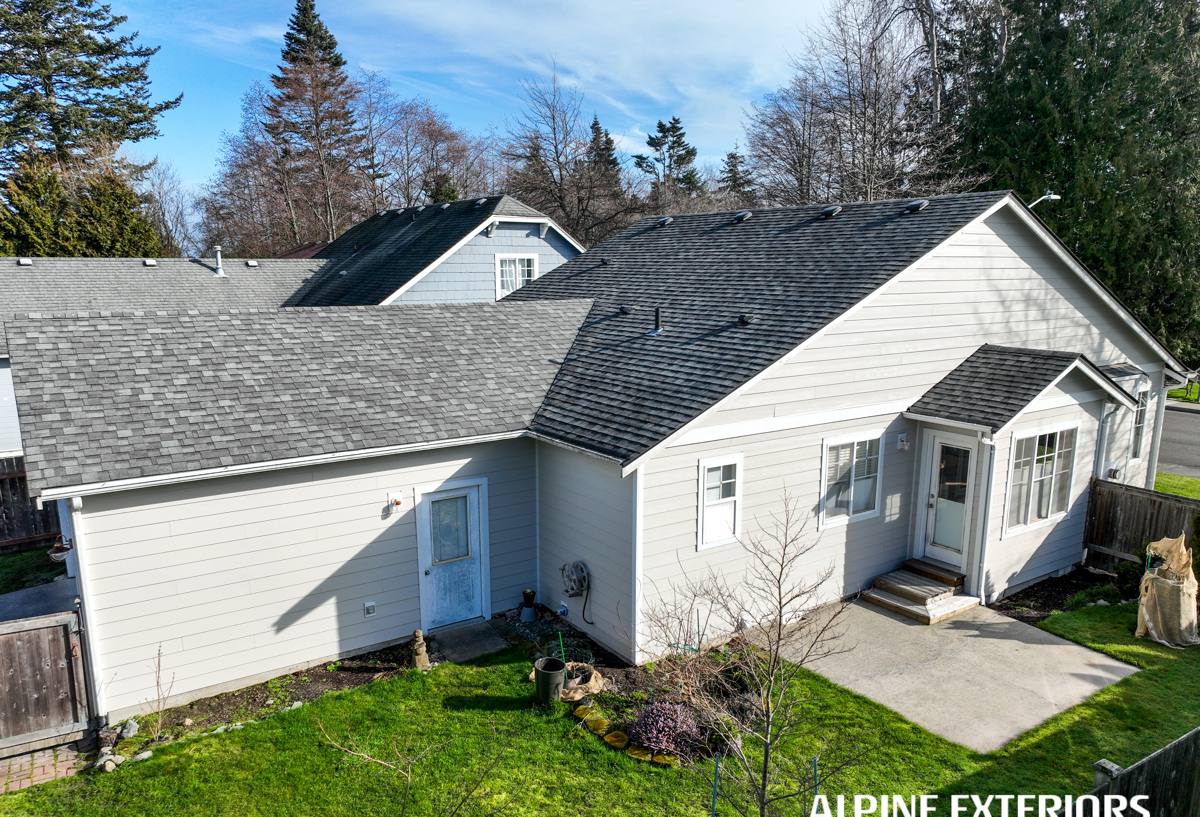
What Salt Air, Driving Rain, and Moss Season Actually Do
Each of these three conditions attacks a house in a different way, and Point Roberts gets all three at once.
Salt Air
Airborne salt from the surrounding water settles on every exterior surface. It's mildly corrosive to metal fasteners, flashing, and hardware, and it accelerates the breakdown of paint films and coatings that aren't formulated to resist it. Over years, a siding product with a thin or field-applied finish will chalk, fade, and lose its protective layer faster on a waterfront or near-waterfront lot than it would fifteen miles inland.
Driving Rain
Point Roberts catches wind off open water with little to break it up. That means rain doesn't just fall — it drives sideways into wall assemblies, seams, and trim joints. Any weakness in a siding system's water-shedding design, or any installation shortcut around flashing and joint treatment, shows up here faster than it would in a calmer microclimate.
Moss and Sustained Moisture
Like most of coastal Whatcom County, Point Roberts holds moisture for long stretches of the year. Shaded north-facing walls, tree-lined lots, and roofs with limited sun exposure stay damp long enough for moss and mildew to take hold. On wood-based products, sustained dampness is exactly the condition that leads to swelling, delamination, and rot at the edges.
Why a Local Crew Matters Here Specifically
Because of the border, a Point Roberts project isn't a casual in-and-out job for a contractor unfamiliar with the area. Crews need to plan material deliveries, crew crossings, and scheduling around the reality that this is, logistically, its own small peninsula. A crew that already works this corner of Whatcom County regularly can plan around that instead of treating it as a surprise mid-project.
Local familiarity also matters for the housing stock itself. Point Roberts has a mix of long-time residences, waterfront and near-waterfront homes, and seasonal properties. Each of those has a different exposure profile depending on how close it sits to the water and which direction it faces. We factor that into the product and installation approach for every estimate rather than applying a one-size-fits-all plan.
Full Exterior Services for Point Roberts Homes
We handle siding, roofing, windows, and decks. Treating the exterior as one connected system, rather than four separate projects, matters even more in a climate this demanding — a gap in flashing between the roof and the siding, or a deck ledger board that isn't properly sealed against the wall, gives driving rain and moisture exactly the entry point it's looking for.
Siding
Our siding work is James Hardie fiber cement only — more on why below. Correct installation includes proper clearances, flashing at every penetration and joint, and fastening to manufacturer spec, all of which matter more in high wind-driven-rain conditions than in a sheltered inland lot.
Roofing
A roof in this climate needs underlayment and flashing details that account for sustained wet periods and wind-driven rain, not just a shingle that looks good on day one. Roof and siding transitions are one of the most common failure points we find on older coastal homes.
Windows
Window flashing and sealant integration with the siding system is critical anywhere, but especially where rain is being pushed sideways into the wall. Poorly integrated window flashing is one of the more common sources of hidden water intrusion we find behind older siding.
Decks
Exterior decks in a wet, salt-exposed environment need hardware and fasteners rated for that exposure, and ledger connections that are properly flashed against the house. We build and repair decks with that exposure in mind rather than treating them as an afterthought.
Why We Install Only James Hardie Fiber Cement Siding
We made a deliberate decision as a company to install James Hardie siding exclusively, and we don't install vinyl, LP SmartSide, or other fiber cement brands. That's not a marketing position — it's based on what actually holds up in this region.
- Non-combustible material. Fiber cement doesn't burn, which matters as a baseline safety consideration regardless of climate.
- Factory-applied ColorPlus finish. The finish is baked on at the factory under controlled conditions rather than applied on-site, which gives it more consistent coverage and better resistance to fading and chalking than a field-applied paint job — a real advantage in a salt-air environment that's hard on painted surfaces.
- Climate-engineered product lines. James Hardie makes region-specific formulations (their HZ product lines) engineered for different moisture and freeze conditions across the country, rather than a single one-size-fits-all board.
- Transferable, substantial warranty. Hardie backs the product with a long non-prorated warranty that can transfer to a new owner, which matters for resale in a market with a fair number of second-home and vacation properties.
- Track record in wet coastal climates. Fiber cement doesn't swell, delaminate, or rot the way wood-based sidings can when they stay damp for extended periods, which is the exact condition Point Roberts produces for a large part of the year.
We're upfront that Hardie isn't the cheapest option on the market and it isn't a DIY-friendly product — it's heavier, requires specific fastening and clearance details, and needs to be cut and installed correctly to perform as designed. We think that trade-off is worth it for a house that's going to sit through decades of Point Roberts weather.
Matching the Product Line to This Exposure
James Hardie's HZ5 product line is engineered for climates with more freeze-thaw cycling and moisture exposure, which fits the Pacific Northwest generally and coastal Whatcom County specifically better than a formulation built for a milder or drier region. On a Point Roberts project, that's the starting point for the product spec, along with attention to which elevations of the house take the most direct weather so we can be deliberate about trim, flashing, and joint details on those faces.
How Common Siding Materials Compare in This Climate
| Material | Moisture/Salt Air Behavior | Maintenance | Typical Lifespan Here |
|---|---|---|---|
| Vinyl | Can warp or become brittle under temperature swings; seams can allow water behind the panel | Low, but limited repair options if damaged | Moderate, shorter in high-exposure spots |
| Cedar/primed spruce | Absorbs moisture; prone to swelling, cupping, and rot in sustained damp conditions | High — regular refinishing and moisture monitoring | Shorter without diligent upkeep |
| LP SmartSide (wood-strand) | Engineered to resist moisture better than raw wood, but still wood-based and dependent on intact caulking/paint at every cut edge | Moderate — edge sealing and repainting over time | Moderate, installation-sensitive |
| James Hardie fiber cement | Doesn't swell, rot, or support moss growth; factory finish resists salt-air fading | Low — periodic washing, no refinishing cycle needed | Long, with a strong transferable warranty |
Signs Your Point Roberts Home's Exterior Needs a Look
- Moss or dark streaking building up on siding, especially on shaded or north-facing walls
- Paint that's chalking, peeling, or fading noticeably faster on the water-facing side of the house
- Soft or spongy spots on wood siding or trim, particularly near ground level or under windows
- Visible gaps, cracking, or separation at siding joints and corner trim
- Rust staining around fasteners or flashing
- Musty odor or discoloration on interior walls that back up to exterior siding
- Roofing granule loss or curling shingles near roof-to-wall transitions
What to Expect Working With a Ferndale-Based Crew
Because we're not local to Point Roberts itself, we plan projects there with the logistics in mind — sequencing material deliveries and crew days so the work moves efficiently once we're on-site, rather than making multiple partial trips. We pull permits through the appropriate Whatcom County process, and we walk every property in person before quoting so the estimate reflects the actual exposure and condition of that specific house, not a generic number.
If your siding, roofing, windows, or deck are showing wear from years of salt air and driving rain, we're happy to take a look and give you an honest, no-pressure estimate. There's a form below to get started.