 Ferndale
 Bellingham's Climate Is Harder on Siding Than It Looks
Bellingham sits on the shoulder of Bellingham Bay, tucked between the Salish Sea and the foothills of the Cascades, and that geography shapes what happens to a house's exterior over time. Homes near the water pick up salt-laden air that settles into seams, fasteners, and any exposed wood grain. Homes further up the hillsides and out toward the county's rural edges deal more with driving rain that comes in sideways during fall and winter storms, finding every gap in poorly lapped siding or under-flashed trim. Add in a moss season that can run from October through May in a shaded, tree-lined neighborhood, and you have a climate that's quietly demanding on building materials, even when nothing looks obviously wrong from the curb.
None of this is unique to Bellingham, but Whatcom County gets a concentrated version of it. Marine air, persistent moisture, and long stretches without direct sun mean siding here doesn't fail the way it does in a drier climate. It fails slowly, from moisture cycling, trapped humidity, and organic growth, often well before a homeowner sees a hole or a crack.
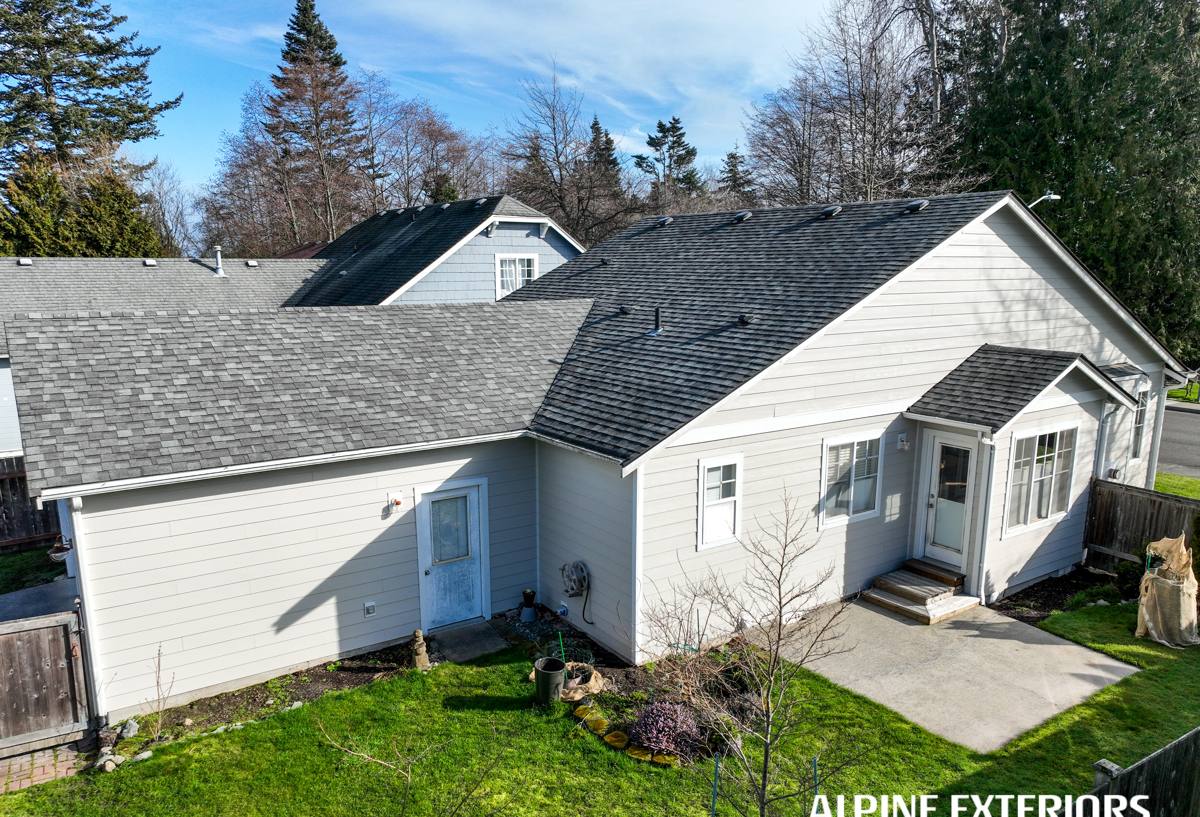
What Constant Moisture Actually Does to a House
Moisture Cycling
Wood-based and some fiber products absorb moisture during the wet months and release it as temperatures shift. Over years, that swelling and drying cycle stresses paint film, joints, and fasteners. Caulked seams that looked fine at installation open up. Paint that looked good for the first few winters starts to crack and peel from the inside out, not just the surface.
Moss, Algae, and Organic Growth
Bellingham's tree cover and marine humidity are ideal conditions for moss and algae to take hold on north-facing walls, under eaves, and anywhere airflow is limited. Left alone, that growth holds moisture against the siding surface, which accelerates whatever underlying moisture problem already exists. It's also a maintenance burden most homeowners underestimate when they choose a product.
Salt Air Near the Water
Closer to Bellingham Bay, airborne salt accelerates corrosion on fasteners and metal flashing, and it can degrade certain finishes faster than the manufacturer's inland test data would suggest. It's a real factor in material selection for homes within a few miles of the water.
Why We Install Only James Hardie Fiber Cement
We made a decision as a company to install one siding system: James Hardie fiber cement. We don't install LP SmartSide, vinyl, Cemplank, Allura, primed spruce, or cedar. That's not a marketing gimmick; it's a standard we hold because of what we've seen play out on homes in this exact climate over years of installs and repairs.
Fiber cement is cement, sand, and cellulose fiber, and it doesn't absorb and release water the way wood-based products do. It's non-combustible, which matters increasingly in a region with longer, drier wildfire seasons even though our wet months dominate the calendar. James Hardie's HZ5 product line is engineered specifically for climates like ours, cold, wet, and prone to freeze-thaw swings, rather than a general-purpose product sold everywhere.
The factory-applied ColorPlus finish is also a meaningful difference for a climate like Bellingham's. Field-applied paint on any siding product is only as good as the prep, primer, and weather conditions on installation day, and it will need repainting on a cycle regardless of the substrate. ColorPlus is baked on in a controlled factory environment and backed by its own finish warranty, which matters when you're trying to avoid a repaint every several years on a house that gets this much rain.
Comparing Siding Materials for a Whatcom County Climate
| Factor | James Hardie Fiber Cement | Vinyl | Cedar / Primed Wood | LP SmartSide (engineered wood) |
|---|---|---|---|---|
| Moisture behavior | Doesn't swell or rot; engineered for wet climates (HZ5) | Doesn't absorb water, but can trap moisture behind panels | Absorbs moisture; needs consistent maintenance to prevent rot | Wood-based; vulnerable at cut edges and joints if not sealed properly |
| Moss/algae resistance | Non-organic surface, doesn't feed growth | Can host surface growth in shaded areas | Organic material, prone to moss and mildew | Organic wood fiber core, sensitive to sustained moisture |
| Fire rating | Non-combustible | Combustible (melts/burns) | Combustible | Combustible |
| Finish durability | Factory ColorPlus finish, warrantied | Color molded in, can fade and become brittle over time | Field-applied paint/stain, regular recoat needed | Field or factory finish varies by product |
| Typical maintenance | Occasional wash, caulk checks | Low, but cracks/warps are not repairable in place | Frequent: recoating, caulking, spot repairs | Moderate: edge sealing, moisture monitoring |
Every product on that list has a legitimate place in the market, and each has trade-offs worth understanding before you buy. Our position isn't that the alternatives are junk, it's that in a climate that punishes moisture cycling and organic growth as consistently as ours does, we've chosen to stand behind one system rather than sell whatever a homeowner asks for.
Full Exterior Protection, Not Just Siding
Siding doesn't work in isolation. On a house exposed to Bellingham's rain and wind patterns, siding, roofing, windows, and decking all need to work together to keep water moving away from the structure instead of into it.
Roofing
A roof that's shedding water properly, with intact flashing at valleys, chimneys, and wall intersections, is what keeps water from ever reaching your siding in the first place. We look at roof condition as part of any siding evaluation, because a leak at the roofline will undermine even a perfect siding install.
Windows
Window flashing and sealant are common failure points on older homes in this region. Poorly integrated window trim is one of the most frequent sources of hidden moisture intrusion we find behind siding during replacement work.
Decks
Decks take the same driving rain and moss exposure as siding, often with less protection. Ledger board connections and any point where a deck ties into the house wall are worth checking whenever exterior work is being planned, since that's where water most often finds its way into framing.
Signs a Bellingham Home Needs Exterior Attention
- Dark green or black streaking on north- or shade-facing walls
- Paint that's cracking, bubbling, or peeling in sheets rather than just fading
- Soft spots or visible warping around window and door trim
- Caulk lines that have shrunk, cracked, or pulled away from joints
- Persistent moss buildup at the base of walls or along horizontal trim
- Musty smell or visible staining on interior walls that share an exterior wall
- Fascia or trim boards that feel spongy when pressed
Any one of these on its own isn't necessarily an emergency, but they're worth a professional look rather than a wait-and-see approach, especially heading into another wet season.
Why a Local Crew Matters in Whatcom County
A crew that works this area regularly understands things that don't show up in a national installation manual: how far Bellingham Bay's salt air reaches inland, which neighborhoods hold moisture longest into spring, and how local permitting and inspection processes actually run day to day. That local knowledge shows up in small decisions, flashing details, fastener spacing, ventilation gaps, that determine whether a siding job holds up through its first several wet seasons or starts showing problems early.
It also matters for accountability. A local company is still here, in the same county, years after the install, which is part of why manufacturer warranty terms and installer reputation both matter when you're choosing who does the work.
What to Expect From Our Process
We start with an on-site inspection of the existing siding, trim, and any related roofing or window issues, since siding problems rarely show up in isolation. From there we walk through product options, always centered on James Hardie's HZ5 line for this climate, and provide a written estimate with a realistic timeline. Installation follows Hardie's fastening and clearance specifications closely, since correct installation is what makes the manufacturer's warranty terms meaningful in the first place. We also handle debris removal and site cleanup as part of the job, not as an add-on.
Cost Factors Worth Understanding Upfront
| Factor | Why It Affects Price |
|---|---|
| Home size and wall complexity | More corners, dormers, and trim details mean more labor and cutting |
| Existing siding removal | Tear-off and disposal costs vary by material and how many layers exist |
| Underlying damage | Rot or moisture damage found during tear-off requires repair before new siding goes on |
| Product line and profile | Lap width, texture, and trim style all affect material cost |
| Access and site conditions | Steep lots, limited access, or multi-story walls add labor time |
We don't quote exact numbers without seeing the house, but these are the variables that move a price up or down, and we walk through each one during the estimate so there are no surprises later.
If your Bellingham home is due for new siding, or you're just not sure whether what you're seeing is a maintenance issue or something bigger, we're happy to take a look. Fill out the form below for a free, no-pressure estimate.