 Ferndale
 Exterior Work Built for Marietta's Conditions
Marietta sits low along the water in Whatcom County, and that location shapes everything about how a house ages here. Homes in this area take on a steady combination of salt-laden air, wind-driven rain off the bay, and the kind of prolonged damp that keeps moss and algae active for most of the year. It's a different exposure than you'd see a few miles inland, and it calls for exterior materials and installation details that are matched to it, not just whatever is cheapest to order.
We're a local crew that works throughout Ferndale and the surrounding Whatcom County communities, including Marietta. That matters for more than convenience — it means we've actually stood on roofs and ladders in this specific microclimate, seen how siding and trim hold up (or don't) after a few winters of salt air and standing moisture, and adjusted our approach accordingly. We handle siding, roofing, windows, and decks, and on most projects those trades overlap: a siding job often uncovers trim or flashing issues, a roof replacement affects how the top course of siding gets tied in, and a deck rebuild almost always touches the siding behind it.
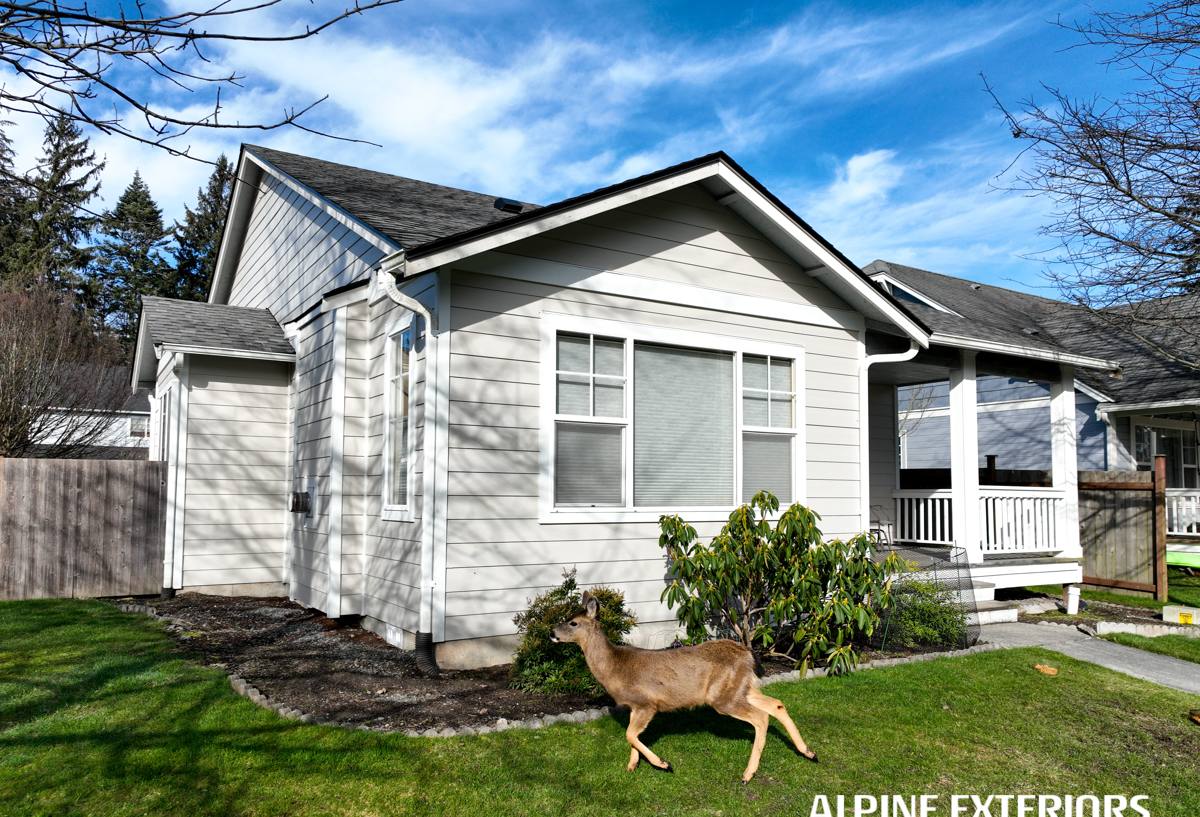
What Salt Air and Rain Actually Do to a House
It's worth being specific about the damage mechanisms, because they're different from what you'd worry about in a drier inland town.
Salt Air
Airborne salt is corrosive to exposed metal — fasteners, flashing, gutter hardware, and hinges take the brunt of it. Over years, uncoated or poorly finished metal components can pit and corrode faster than they would elsewhere in the county. Salt exposure also accelerates the breakdown of some paint films and caulks, which is one reason we pay close attention to what fastener and flashing materials we spec on jobs close to the water.
Driving Rain
Wind off the water doesn't just fall straight down — it drives rain sideways into wall assemblies, which puts a lot of pressure on siding laps, window flashing, and butt joints. A siding system that's fine in a sheltered inland yard can leak at Marietta if the water-resistive barrier, flashing tape, and lap details aren't done correctly. This is an installation issue as much as a materials issue.
Moss and Algae
Cool, moist, shaded conditions here support moss and algae growth for a long season — often close to year-round on north-facing walls and roof planes. Moss holds moisture against a surface, which is bad news for any material that isn't dimensionally stable or that can absorb water into its core. On roofs, moss lifts shingles and creates channels for water to work backward under the roofing. On siding, sustained moss and algae growth stains the surface and, on the wrong substrate, can contribute to slow moisture damage at seams and edges.
Quick Reference: Climate Stress by Component
| Exterior Component | Primary Stress | What We Watch For |
|---|---|---|
| Siding | Driving rain, moisture cycling | Lap details, flashing, substrate stability |
| Roofing | Moss, wind-driven rain | Underlayment, valley flashing, moss growth patterns |
| Windows | Wind-driven rain, seal fatigue | Flashing integration, sealant condition |
| Decks | Standing moisture, salt air on fasteners | Ledger flashing, fastener corrosion resistance |
Siding: Why We Install James Hardie, Full Stop
We install James Hardie fiber cement siding exclusively. We don't offer vinyl, LP SmartSide, Cemplank, Allura, or wood siding like primed spruce or cedar as alternatives on our jobs, and that's a deliberate standard, not an oversight. Here's the honest reasoning, particularly as it applies to a location like Marietta.
Moisture and Rot Resistance
Fiber cement doesn't have the wood fiber that engineered wood products like LP SmartSide rely on, so it isn't vulnerable to the same fungal decay pathway if moisture gets past a seam or a poorly caulked joint. In a spot with this much sustained dampness, that difference matters more than it would in a dry climate. Wood-based siding products can perform well for years when detailing is perfect, but perfect detailing over decades, through re-caulking cycles and eventual homeowner turnover, is a hard bar to clear.
Dimensional Stability
Vinyl siding expands and contracts significantly with temperature swings, and in wind-driven rain it relies heavily on lap geometry rather than sealant to shed water — laps that can also work loose over time. Fiber cement is dimensionally stable across our temperature range and doesn't warp, ripple, or loosen the way vinyl can after repeated wet-dry and hot-cold cycling.
Finish Durability
James Hardie's ColorPlus finish is baked on at the factory under controlled conditions, which gives it better fade and moisture resistance than field-applied paint, and it holds up well against the kind of algae and mildew staining that's common on north and shaded walls here. That factory finish also means fewer repaint cycles over the life of the siding, which is a real cost consideration over 15-20 years, not just an aesthetic one.
Fire Resistance
Fiber cement is non-combustible. That's a genuine safety advantage over wood and vinyl siding regardless of region, and it's a factor more Whatcom County homeowners are weighing given regional wildfire seasons in recent years.
None of this means the alternatives are junk — vinyl and engineered wood siding are legitimate, widely used products, and plenty of homes wear them fine. Our position is narrower: for the installation quality and long-term performance we want to stand behind on every job, especially in a moisture- and salt-exposed area like Marietta, Hardie is the material we trust enough to install and warranty.
Roofing in a Moss-Heavy Environment
A roof replacement or repair near Marietta needs to account for moss pressure from day one, not as an afterthought. That means attention to valley and eave flashing, adequate ventilation to reduce the moisture buildup that feeds moss growth, and material choices suited to a shaded, damp roof plane. We also flag when a roof issue is actually a siding or trim issue in disguise — water that's tracking down behind fascia boards or top-course siding can look like a roof leak when the real fix is at the wall-roof intersection.
Windows: The Flashing Matters More Than the Glass
In a driving-rain environment, most window water intrusion problems trace back to flashing and integration with the wall assembly, not the window unit itself. When we replace windows, we treat the flashing and water-resistive barrier tie-in as the critical part of the job — a great window installed with sloppy flashing will leak, and a modest window installed correctly usually won't. We also make sure new window trim and casing integrate cleanly with Hardie siding and trim boards, so the whole assembly sheds water as one system rather than a collection of separate parts.
Decks: Built to Handle Standing Moisture
Decks near the water deal with two things at once: near-constant dampness underfoot and salt-exposed hardware. Ledger board flashing is one of the most important — and most commonly shortcut — details on any deck attached to a house, and it's especially critical here, since a poorly flashed ledger behind a deck is a slow, hidden path for water into the wall framing. We also spec fasteners and hardware with corrosion resistance appropriate to the salt exposure, rather than defaulting to standard-grade hardware that may not hold up as long this close to the water.
Why a Local Crew Matters for a Community Like Marietta
A national-brand contractor working off a generic spec sheet doesn't know that a north-facing wall in Marietta needs different moss and moisture handling than a south-facing wall three miles inland. We do, because we've done the work here repeatedly. Being local also means we're accountable in the ordinary sense — we're not driving in from out of the area for one job and disappearing. If a warranty question or a maintenance question comes up two years down the road, we're still working in the same Ferndale-area communities and easy to reach.
What to Expect From an Estimate
- An on-site walk-around to look at current siding, trim, roofing, and any moisture or moss patterns specific to your lot and sun exposure
- A straightforward explanation of what's driving any existing damage, not just a quote for replacement
- Clear scope on what's siding work, what's roofing work, and what's flashing/detailing work, since they often overlap
- Honest guidance on whether full replacement is needed or whether targeted repair makes sense for now
- A written estimate with material specifics — no vague "siding allowance" line items
Get a Local, No-Pressure Estimate
If you're dealing with moss buildup, staining, soft spots, or just an aging exterior on a Marietta-area home, we're happy to take a look and walk you through what we're seeing and why. Use the form below to request a free estimate — there's no pressure and no obligation, just a straight assessment from a crew that knows this stretch of Whatcom County.