 Ferndale
 If you're re-siding a home in Ferndale or anywhere else in Whatcom County, you'll eventually land on the same two finalists almost everyone considers: vinyl siding and James Hardie fiber cement. Both are widely available, both have decades of track record, and both get installed on homes up and down Portal Way and Main Street every year. But they are not interchangeable products, and the differences matter more here than they would in a drier, milder climate. This guide walks through how they actually compare — not marketing claims, but the practical trade-offs that show up on a house exposed to Pacific storms, salt air off Bellingham Bay, and a moss season that can run half the year.
Two Very Different Materials
Vinyl siding is an extruded PVC plastic panel, formulated with pigment mixed through the material and shaped into interlocking panels that hang on a wall. It's lightweight, relatively inexpensive, and has been the default budget choice in the Pacific Northwest for a long time.
James Hardie siding is fiber cement — a mix of Portland cement, sand, and cellulose fiber, cured and then finished at the factory with a baked-on ColorPlus finish or left ready for field painting. It's heavier, denser, and behaves structurally more like a rigid board than a flexible plastic sheet. That single difference in material chemistry is the root of almost every performance gap between the two products.
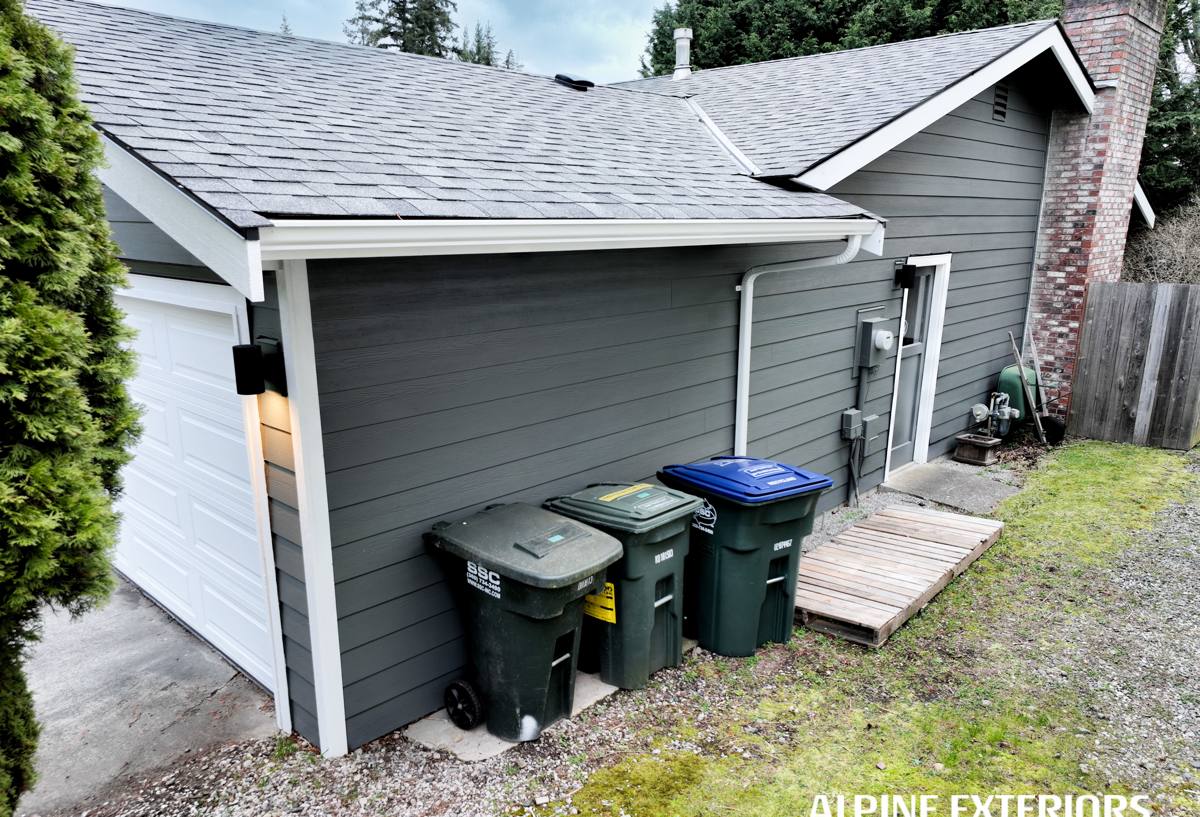
How They Handle Ferndale's Climate
Rain and Moisture
Whatcom County gets a lot of driving, wind-blown rain, especially in the fall and winter storm cycles that roll in off the Strait of Georgia. Vinyl siding isn't watertight on its own — it relies on the water-resistive barrier and flashing behind it to do the real work, because vinyl panels are designed to shed bulk water while still allowing some moisture to pass through gaps and laps. That's a legitimate system when installed correctly, but it puts a lot of weight on the installer getting every flashing detail right, since the siding itself isn't the primary defense.
James Hardie's fiber cement panels are non-porous and dimensionally stable when properly primed and finished, so they resist moisture intrusion at the panel itself rather than depending entirely on what's behind it. Hardie's HZ5 product line is specifically engineered for climates like ours — freeze-thaw cycling, sustained damp conditions, and high humidity — and is the version we install on every Ferndale project.
Salt Air and Coastal Exposure
Ferndale sits close enough to Bellingham Bay and the Strait that salt-laden air is a real factor, especially on homes with west or northwest exposure. Salt air accelerates the breakdown of a lot of exterior materials over time. Vinyl doesn't corrode, but it does become brittle with UV and temperature cycling faster in coastal exposure, and its color — which is mixed through the material rather than applied as a finish — will fade and chalk over the years, especially on darker colors facing the water. Fiber cement's factory-applied ColorPlus finish is baked on in a controlled environment and holds pigment more consistently over time, which matters on a coastal lot where you're not repainting every few years.
Moss and Organic Growth
Anyone who's owned a home in this part of Washington knows moss season isn't really a season — it's most of the year. Moss and algae need sustained moisture and shade to establish, and north-facing walls or homes tucked under tree cover get hit hardest. Vinyl's textured surface and the small gaps at its laps give moss and algae spores places to take hold, and once established, it's difficult to fully clean without risking damage to the panel's UV coating. Fiber cement's harder, smoother factory finish is less hospitable to organic growth and holds up better to the periodic pressure washing that Ferndale homes typically need.
Durability and Physical Performance
| Factor | Vinyl Siding | James Hardie Fiber Cement |
|---|---|---|
| Impact resistance | Cracks or punctures under hail, debris, ladder contact | Resists impact damage; won't dent like vinyl cracks |
| Wind rating | Can rattle, bow, or blow off in high wind if not fastened correctly | Heavier panel, less prone to wind lift when installed to spec |
| Fire performance | Combustible plastic; can melt or ignite near heat sources | Non-combustible; carries a Class A fire rating |
| Expansion/contraction | Significant — requires loose-hung installation to avoid buckling | Minimal — dimensionally stable across temperature swings |
| Color longevity | Pigment fades and chalks with UV exposure over years | Baked-on ColorPlus finish resists fading longer |
| Typical lifespan | 20-30 years before replacement is common | 30-50+ years with proper maintenance |
The expansion and contraction point is worth understanding, because it explains a lot about why vinyl looks the way it does. Vinyl panels have to be hung loosely, with slotted nail holes, so they can move as temperatures shift — that's normal and by design. But it also means vinyl can never be face-nailed tight, can bow visibly in direct summer sun, and will never have the flat, substantial look of a rigid board. Fiber cement doesn't have that constraint, so it installs tight and stays flat.
Cost: Upfront vs. Life-Cycle
Vinyl is the lower upfront cost option, generally by a meaningful margin, and that's a real advantage for a homeowner on a tight budget or handling a smaller project like an addition or a detached garage. There's no dishonest way to spin that — vinyl material and installation costs less per square foot than fiber cement, and we tell every customer that up front.
Where the comparison shifts is over the ownership period. Vinyl that fades, cracks, or loosens tends to get replaced rather than repaired, because color-matching an old panel or patching a cracked section rarely looks right. Fiber cement holds its finish longer, resists the kind of damage that forces a full re-side, and when it does eventually need attention, individual boards can be replaced without redoing the whole wall. For someone planning to stay in their Ferndale home long-term, the higher upfront cost of Hardie often gets offset by not facing a second full re-siding job in twenty years.
Maintenance Realities
- Vinyl: Low routine maintenance, but limited repair options — cracked or faded panels are usually swapped, not fixed, and exact color matches get harder to find as products age out of production.
- Vinyl: Requires periodic washing to keep moss and algae from taking hold, and pressure washing has to stay gentle to avoid forcing water behind panels.
- Fiber cement: Needs occasional caulking checks at joints and trim, and a repaint cycle if using a field-painted (rather than ColorPlus factory-finished) product.
- Fiber cement: Individual damaged boards can be cut out and replaced without disturbing the rest of the wall.
- Both: Depend heavily on correct flashing, house wrap, and trim work — the siding material is only part of a weatherproof wall system.
Where Vinyl Genuinely Makes Sense
We're not going to pretend vinyl is a bad product across the board — it isn't. It's a reasonable, proven choice for budget-driven projects, rental properties, or situations where a homeowner needs the lowest possible upfront cost and understands the trade-offs. Millions of homes across the country, including plenty in Whatcom County, are sided in vinyl and perform fine for their owners' needs. Our position isn't that vinyl is defective — it's that after years of doing exterior work in this specific coastal, wet, moss-prone climate, we decided our crews, our warranty, and our reputation would stand behind one product system rather than several.
Why We Standardized on James Hardie
We install James Hardie exclusively — not LP SmartSide, not vinyl, not Cemplank or Allura, not primed spruce or cedar. That's a deliberate business decision, not a lack of options. Hardie's HZ5 line is engineered for exactly the freeze-thaw, high-moisture climate zone Ferndale sits in. It's non-combustible, which matters more every year as wildfire smoke and dry-season risk become a bigger part of Pacific Northwest summers even in wetter counties like ours. The ColorPlus factory finish holds up to salt air and UV better than field-applied paint on other substrates. And Hardie's transferable warranty is backed by a manufacturer with a long track record specifically in fiber cement, not a secondary product line.
Installing one product system well, with crews who know its fastening patterns, clearance requirements, and joint treatment in detail, produces better results than installing five different products adequately. That's the trade-off we made, and it's why every quote we write is a Hardie quote.
Questions to Ask Before You Decide
- Is the contractor certified or specifically trained on the product they're proposing, or do they install "whatever the customer wants"?
- What warranty applies to the material itself, and separately, what warranty covers the labor?
- How is the wall's water-resistive barrier and flashing detailed behind the siding — this matters as much as the siding choice itself?
- What's the realistic maintenance schedule for the product over the next 10-20 years?
- Does the quote specify which Hardie product line (HZ5, ColorPlus vs. primed) or which vinyl gauge/warranty tier is being installed?
If you're weighing siding options for a home in Ferndale or elsewhere in Whatcom County, we're happy to walk your property, talk through what our approach would look like, and give you a free, no-pressure estimate.