 Ferndale
 Why Decks Near Sandy Point Wear Out Faster Than Most
Sandy Point sits close enough to the water that its decks live a harder life than a deck a few miles inland in Ferndale or Bellingham. Salt-laden air corrodes fasteners and hardware years before they'd fail on a dry, protected lot. Driving rain off the Strait doesn't just wet the surface boards — it drives into end grain, joints, and the framing underneath if the deck wasn't detailed to shed water properly. And Whatcom County's long, wet, low-sun season means moss and algae get a running start every fall and don't let go until late spring, coating boards in a film that holds moisture against the wood far longer than a quick rain would on its own.
None of that means a deck at Sandy Point is doomed — it means the deck has to be built and maintained with those specific conditions in mind. A deck design and material list that works fine in a dry inland climate can look tired and unsafe here in under half the time. When we replace a deck in this neighborhood, we're not just swapping old boards for new ones; we're correcting the details that let salt air, rain, and moss win in the first place.
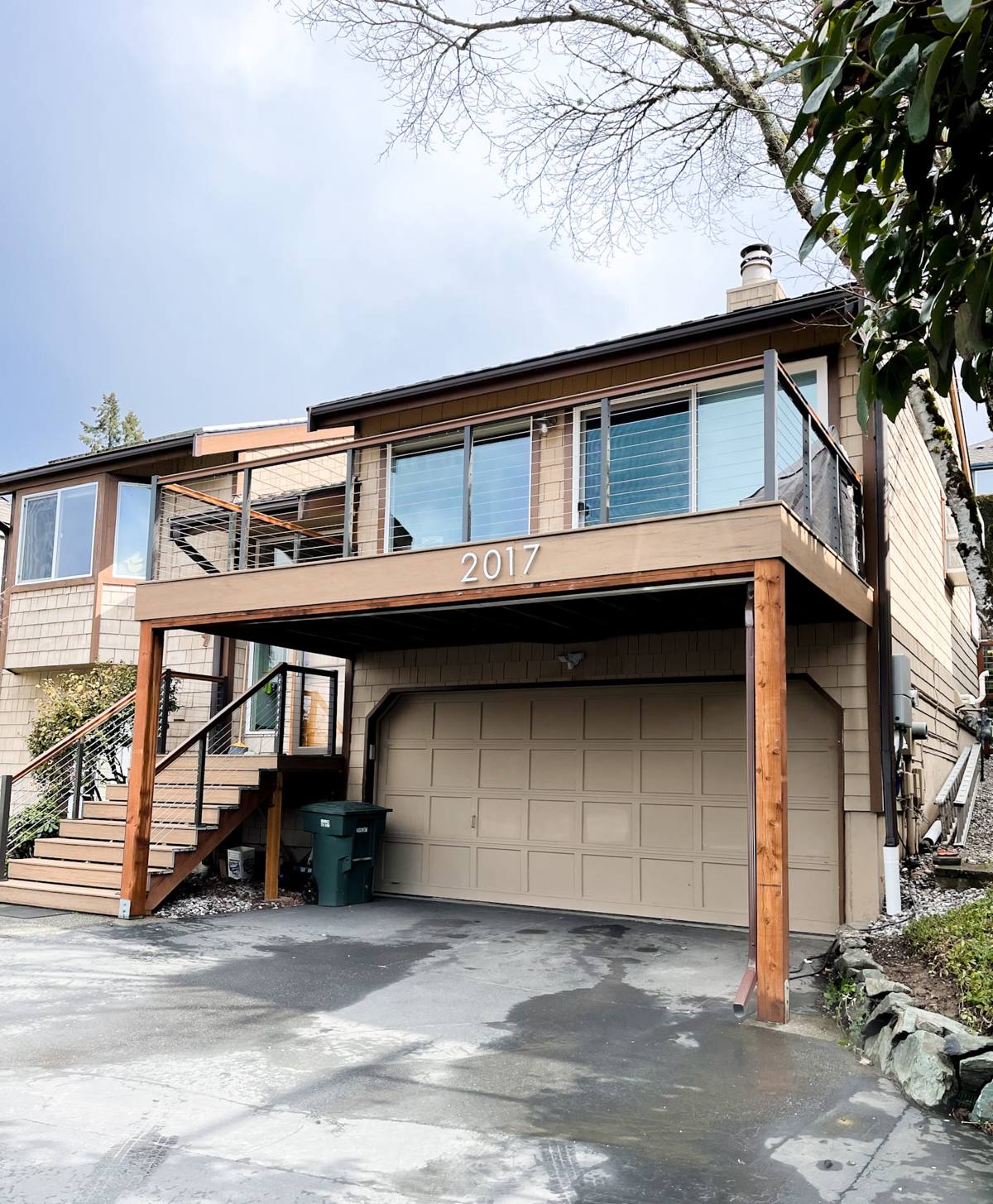
Signs a Sandy Point Deck Has Reached Replacement, Not Repair
A lot of decks get patched for years past the point where patching still makes sense. Repair is the right call when the framing is sound and only a handful of boards or fasteners have failed. Replacement is the right call once the problems are structural, widespread, or rooted in how the deck was originally built. Here's how we tell the difference on a walk-through:
- Soft, spongy, or spalled decking boards in more than a few isolated spots, especially near the house or at board ends
- Rust streaking or corrosion visible on joist hangers, bolts, and fasteners — a strong sign salt air has been working on hardware you can't fully see
- A ledger board (where the deck attaches to the house) that's soft, stained, or separating slightly from the siding or rim joist
- Persistent green-black moss or algae film that returns within weeks of cleaning, even after a good scrub
- Visible sag, bounce, or movement in the deck surface when walked on
- Railings or posts that wiggle at the base — often a sign the post-to-frame connection has been compromised by rot
- Stairs that feel unsteady or show gaps opening between stringers and treads
If what you're seeing is limited to a couple of boards and the framing underneath tests solid, a repair can buy real time. If it's several of these at once, or the framing itself is soft, a full replacement is usually the more honest — and more cost-effective — answer, since patching a structurally tired deck just means paying for the same repair again in a year or two.
What a Correct Deck Replacement Actually Involves
Starting With What's Underneath
The parts of a deck nobody sees — footings, posts, beams, joists, and the ledger connection to the house — matter more than the decking boards on top. A deck can have brand-new, good-looking decking and still be unsafe if the framing underneath is undersized, poorly fastened, or rotting from years of trapped moisture. A proper replacement means opening up the structure, not just resurfacing it, so we can evaluate footings for frost depth and bearing, check posts and beams for rot or insect damage, and confirm the ledger board is properly flashed and bolted (not just nailed) to the house structure.
Flashing and Water Management
Given how much rain this area sees, how water is directed away from the structure is one of the most important — and most often skipped — parts of the job. That includes ledger flashing that tucks properly behind the house's weather-resistive barrier or siding, joist tape or cap flashing on top of framing members to keep fasteners from sitting in standing water, and gaps between boards sized to let water drain rather than pool. A deck built without this detailing will look fine for a season or two and then start failing from the inside out.
Fasteners and Hardware
In a salt-air environment, hardware choice isn't a minor spec — it's often the difference between a deck that lasts fifteen years and one that starts rusting through in five. We use fasteners and structural connectors rated for coastal or treated-lumber exposure, since standard hardware corrodes noticeably faster this close to the water.
Choosing the Right Decking Material for This Location
There's no single "best" decking material for every home — the right choice depends on budget, maintenance tolerance, and how much sun or shade the deck gets. What we can tell you honestly is how each common option tends to hold up under Sandy Point's specific combination of salt air, rain, and moss:
| Material | How It Handles Salt Air & Rain | Moss & Algae Behavior | Maintenance Burden |
|---|---|---|---|
| Pressure-treated wood | Good if fasteners and flashing are corrosion-resistant; wood itself handles moisture reasonably well when finished | Textured grain holds moss film unless cleaned and sealed regularly | Highest — needs periodic cleaning, sealing, and fastener checks |
| Cedar | Naturally rot- and insect-resistant, but softens over time without upkeep | Similar to treated wood; benefits from regular cleaning | High — finish needs reapplication every few years |
| Composite decking | Doesn't absorb moisture into the board itself; won't rot | Smoother, denser surface sheds moss film more easily than wood | Low — occasional washing, no sealing or staining |
| PVC / capped polymer decking | Fully moisture-resistant surface, holds up well to salt exposure | Easiest to keep clean; low surface porosity | Lowest — wash as needed, no finish required |
We install all of these depending on what the homeowner wants. Where we push back is on skipping the substructure upgrades above regardless of decking choice — even the best composite board will underperform if it's fastened with the wrong hardware or sitting over a ledger connection that isn't flashed correctly.
Our Deck Replacement Process, Start to Finish
- On-site evaluation. We walk the existing deck, check framing and footings where accessible, and talk through what you want out of the new one — material, layout, railing style, budget.
- Written estimate and material plan. You get a clear scope: what's being demolished, what's being rebuilt, what materials and hardware are specified, and a firm price before any work starts.
- Demolition and disposal. The old deck comes out, including any hidden framing that's compromised, and debris is hauled off the site.
- Footings and framing. New or reinforced footings, posts, beams, and joists go in to current structural standards, sized for the deck's actual use (furniture, hot tub, entertaining, etc.).
- Ledger connection and flashing. The ledger is properly bolted and flashed against the house before anything else attaches to it.
- Decking, railing, and stairs. Surface material goes down with proper fastening and drainage gaps, followed by code-compliant railings and stair construction.
- Final walk-through. We inspect the finished deck with you, cover basic care for the material you chose, and answer any questions before calling the job done.
Permits and Local Code in Whatcom County
Most deck replacement work in Ferndale and unincorporated Whatcom County requires a building permit, particularly when framing, footings, or railings are being rebuilt rather than just cosmetically refreshed. Permit requirements exist for good reason near the water — they cover things like railing height, guard spacing, stair geometry, and structural load, all of which matter more, not less, on a deck exposed to this area's weather. We handle the permitting process as part of the job so you're not left tracking down inspections or paperwork on your own, and so the finished deck is documented as built to code — which matters both for safety and for resale down the road.
Keeping a New Deck Ahead of Salt Air and Moss
A deck built correctly for this location will still need some seasonal attention — no material is fully maintenance-free in a marine climate. What changes with a proper replacement is how much that upkeep actually accomplishes, since you're no longer fighting a structure with hidden moisture problems.
- Sweep debris and standing organic matter off the deck regularly, especially in fall when leaves and needles accumulate
- Rinse or lightly scrub moss and algae buildup before it has a chance to establish, rather than after it's thick
- Check that drainage gaps between boards stay clear of debris so water keeps moving through instead of pooling
- For wood decks, plan on cleaning and re-sealing on a regular schedule rather than waiting until the finish visibly fails
- Periodically check railings and stair connections for looseness, particularly after winter storms
- Keep an eye on the ledger area where the deck meets the house — it's the spot most prone to hidden moisture issues
Why It Matters to Hire a Crew That Already Works This Neighborhood
A deck built by a crew that hasn't dealt with this stretch of coastline before often looks fine on completion day and then reveals its shortcuts over the following few winters — corroding hardware, moss that won't stay off, a ledger that starts weeping moisture into the siding. A crew that regularly works Sandy Point and the surrounding Ferndale area already knows which fastener grades hold up, how aggressive the flashing detailing needs to be, and which decking materials are worth the added cost here versus which ones perform fine without it. That's not a marketing claim — it's the practical result of building and repairing decks in this specific environment repeatedly, rather than treating every coastal job as a one-off.
It also means fewer surprises during the estimate. We're not guessing at how salt air and moss will treat a given material or design choice on your property — we've seen how it plays out on decks like yours nearby, and we build accordingly from day one.
Get a Straightforward Estimate
If your deck at Sandy Point is showing soft spots, rusting hardware, stubborn moss, or just isn't holding up the way it should, we're happy to take a look and give you an honest read on repair versus replacement — no pressure, no upsell. Fill out the form below to schedule a free estimate.