 Ferndale
 Roofs Take a Different Kind of Beating in Sandy Point
Sandy Point sits right up against the water, and that changes what "storm damage" actually means for a roof out here. Homes just a few miles inland in Ferndale deal with wind and rain like everywhere else in Whatcom County. Homes in Sandy Point deal with all of that plus near-constant exposure to salt-laden air coming off the water, wind that isn't slowed down by much of anything before it hits the roofline, and a moss season that runs longer than it does on more sheltered lots. Storm damage here rarely shows up as one dramatic event. More often it's wind that lifted a few shingle tabs during a fall blow, rain that found its way under a compromised flashing over the winter, and moss that's been quietly working into the shingle mat since spring — all showing up as one leak by the time a homeowner calls us.
We repair storm-damaged roofs throughout Ferndale and the surrounding Whatcom County coastline, and Sandy Point gets its own approach because the roofs out there age differently. A repair plan that works for a roof three miles inland can miss the actual cause of the problem on a waterfront lot.
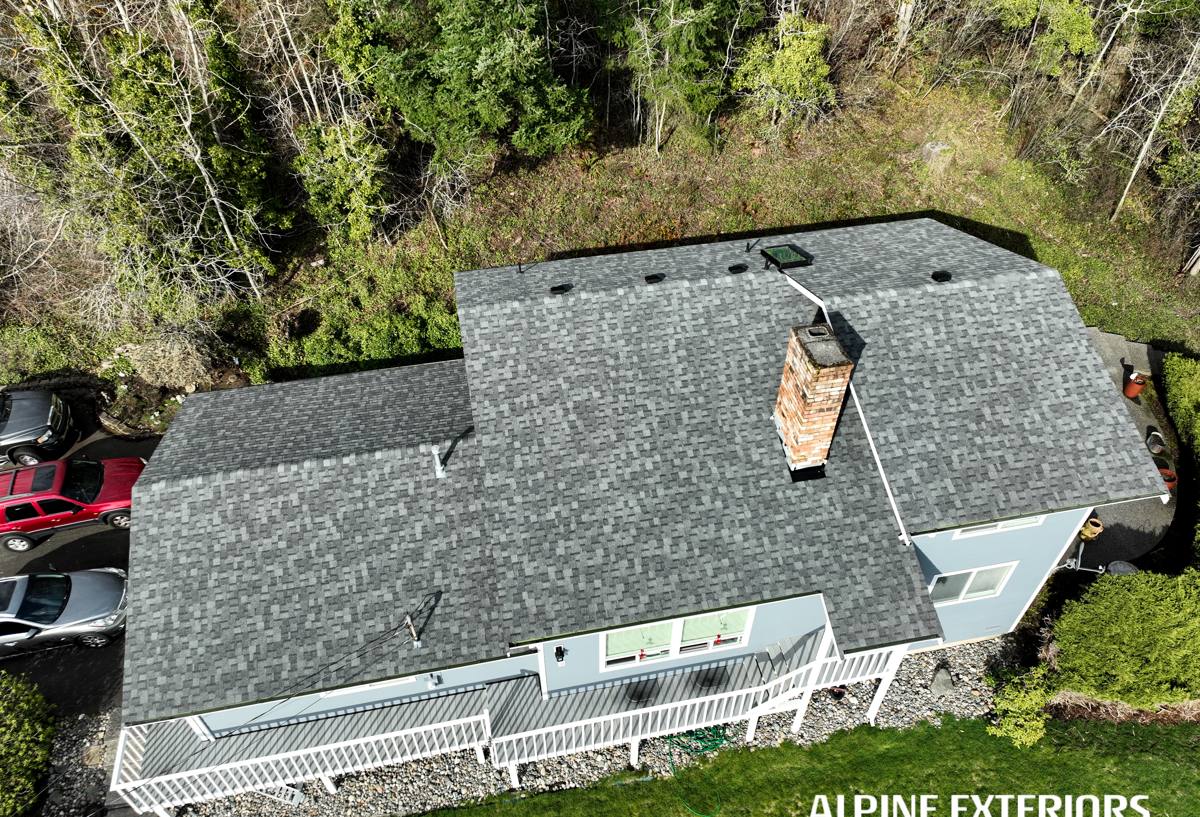
What Driving Rain and Salt Air Actually Do to a Roof
Wind-Driven Rain
On an open, waterfront lot, rain doesn't fall straight down as often as it gets pushed sideways. That matters because shingle roofing is designed to shed water moving downhill, not water being driven horizontally under laps and up under ridge caps. After a windy system moves through, we typically find water intrusion starting at the same handful of spots: ridge caps that have lost their seal, laps along hips and valleys where the wind can get underneath, and any penetration (a vent, a chimney flashing, a skylight curb) where the flashing wasn't detailed for a high-wind exposure in the first place.
Salt Air and Metal Fatigue
Salt air accelerates corrosion on anything metal on the roof — flashing, fasteners, vent caps, gutter hangers. A fastener that would last decades on an inland roof can start showing rust streaks and losing grip years earlier out here. Once a fastener backs out or a flashing edge corrodes and lifts, that's an open door for the next storm to push water underneath.
Moss and Trapped Moisture
Whatcom County's damp, mild winters grow moss on almost any north-facing or shaded roof, but Sandy Point's humidity and salt spray keep shingles damp longer between dry spells, which moss loves. Moss doesn't just look bad — it holds water against the shingle surface, lifts shingle edges as it grows, and works its way into nail heads and laps. A roof with a moss problem going into storm season is a roof that's already primed for wind and rain to do more damage than they otherwise would.
Signs of Storm Damage Worth Checking After a Blow
- Shingle tabs that look lifted, curled, or are missing outright, especially along ridges and edges facing the water
- Granules collecting in gutters or at downspout outlets — a sign of shingle wear accelerated by wind and salt exposure
- New or worsening moss growth along shaded slopes, valleys, or the north side of the roof
- Rust streaking below metal flashing, vent caps, or fasteners
- Soft spots, discoloration, or a musty smell in the attic or ceiling below the roof after a storm
- Flashing around chimneys, skylights, or vent stacks that looks bent, lifted, or separated from the roof deck
- Gutters pulling away from the fascia, which is often a sign of wind stress on the whole roof edge, not just the gutter
Any one of these on its own might just need a small repair. Several at once usually means the roof took on more wind and water than it looks like from the ground, and it's worth a real inspection before the next system rolls in.
What a Correct Storm Damage Repair Actually Involves
A lot of storm repair work in coastal areas gets done as a patch — a smear of sealant over a lifted shingle, a quick recaulk around a flashing. That buys a little time but doesn't address why the damage happened, and on a lot exposed the way Sandy Point is, it tends to fail again within a season or two. Our approach starts with figuring out the actual failure point, not just the visible symptom.
Our process
- Inspection from the roof, not just the ground. Wind and salt damage often starts at flashing seams and ridge laps that aren't visible from a ladder at the eave. We walk the roof to check every penetration, hip, valley, and ridge line.
- Trace water intrusion to its source. Where there's an active leak, we confirm the entry point rather than assuming it's directly above the interior stain — wind-driven water can travel several feet under the roofing before it shows up inside.
- Assess the roof deck. If water has been getting in for a while, the sheathing underneath may be softened or delaminating. Repairs done over damaged decking don't hold.
- Replace, don't just reseal, damaged flashing. Corroded or bent flashing gets re-flashed with material and fasteners suited for salt air exposure, not just caulked back down.
- Match shingle repairs to the existing roof. We replace damaged shingles and tabs with matching material, properly laced into the surrounding courses so the repair sheds water the way the rest of the roof does.
- Clear moss and treat the area. Where moss contributed to the damage, we remove it from the repair area and the surrounding slope so it isn't undermining the new work within a year.
Repair vs. Replacement: What Actually Determines the Call
Not every storm-damaged roof needs to come off. But on a waterfront lot, the math on repair-versus-replace is a little different than it is inland, because the underlying roof has usually been aging faster the whole time.
| Factor | Leans toward repair | Leans toward replacement |
|---|---|---|
| Roof age | Under 12-15 years, roof otherwise in good shape | Approaching or past typical service life for this exposure |
| Extent of damage | Isolated to one section, flashing, or a handful of shingles | Damage spread across multiple slopes or repeat leaks in different spots |
| Deck condition | Solid, dry sheathing under the damaged area | Soft, delaminated, or repeatedly wet sheathing |
| Moss history | Light, manageable growth, no shingle lifting | Heavy moss with granule loss and lifted shingles across the roof |
| Fastener/flashing condition | Isolated corrosion at one or two points | Widespread rust or fastener failure across the roof |
We'll always tell you honestly which side of that table your roof falls on. A repair that's likely to hold for years is the right call more often than not — we don't push replacement on a roof that doesn't need it.
Materials and Fasteners We Use for This Exposure
Where a repair involves new flashing, fasteners, or vent components, we favor corrosion-resistant materials suited to a salt-air environment over the standard-grade hardware that's fine further inland. It costs a little more up front and saves a callback in three years when standard fasteners start rusting through. That's a standard we hold ourselves to, not a knock on any particular product — different materials just perform differently a few hundred yards from saltwater.
Why It Matters That We Already Work in Sandy Point
A crew that mostly works roofs a few miles inland will fix what's in front of them, but they're not necessarily thinking about the next windstorm off the water or the moss that's going to come back on a shaded, damp slope. Working Sandy Point regularly means we already know which roof lines in this kind of exposure tend to fail first, which flashing details hold up and which don't, and how much moss growth is normal versus a sign of a bigger problem. That local pattern recognition is the difference between a repair that solves the actual problem and one that just covers it up until the next storm.
It also means we're realistic about timing. Storm season scheduling in Whatcom County fills up fast once the weather turns, and a roof with active water intrusion doesn't wait well. We prioritize active leaks and structural exposure over cosmetic requests, and we're upfront when a repair should happen now versus when it can reasonably wait for a dry stretch.
Keeping a Sandy Point Roof Ahead of Storm Season
- Have moss removed and treated before it has a chance to lift shingle edges over a wet winter
- Check flashing and fasteners for early corrosion signs during a calm-weather inspection, not after a leak shows up
- Keep gutters and downspouts clear so wind-driven rain has somewhere to go instead of backing up under the roof edge
- Address small shingle damage — a lifted tab, a cracked shingle — as soon as it's noticed rather than waiting for it to become an active leak
- Get a post-storm check after any significant wind event, even if nothing is visibly wrong from the ground
None of this requires a full roof overhaul most years — it's mostly about catching small, cheap fixes before a storm turns them into expensive ones.
Get an Honest Look at Your Roof
If your Sandy Point home took on wind or rain damage recently, or you just want a straight answer on where your roof stands going into the next storm season, we're glad to come take a look. The estimate is free, there's no pressure attached to it, and you'll get a clear explanation of what we find and what it would take to fix it. Fill out the form below to get started.