 Ferndale
 Siding Replacement for Sandy Point Homes
Sandy Point is a waterfront community, and living directly on the water changes what a home's siding has to deal with every single day. Homes just a mile or two inland get a milder version of Whatcom County weather. Homes at Sandy Point get the full version — salt-laden air blowing straight off the water, wind-driven rain that hits walls sideways instead of falling straight down, and a moss season that starts earlier and lasts longer than it does on a sheltered inland lot. We work in Sandy Point regularly, and the siding replacements we do here are planned around that exposure from the start, not treated like a standard in-town job that happens to have a different address.
We install James Hardie fiber cement siding exclusively, and for a property with this kind of coastal exposure, it's the material we recommend without hesitation.
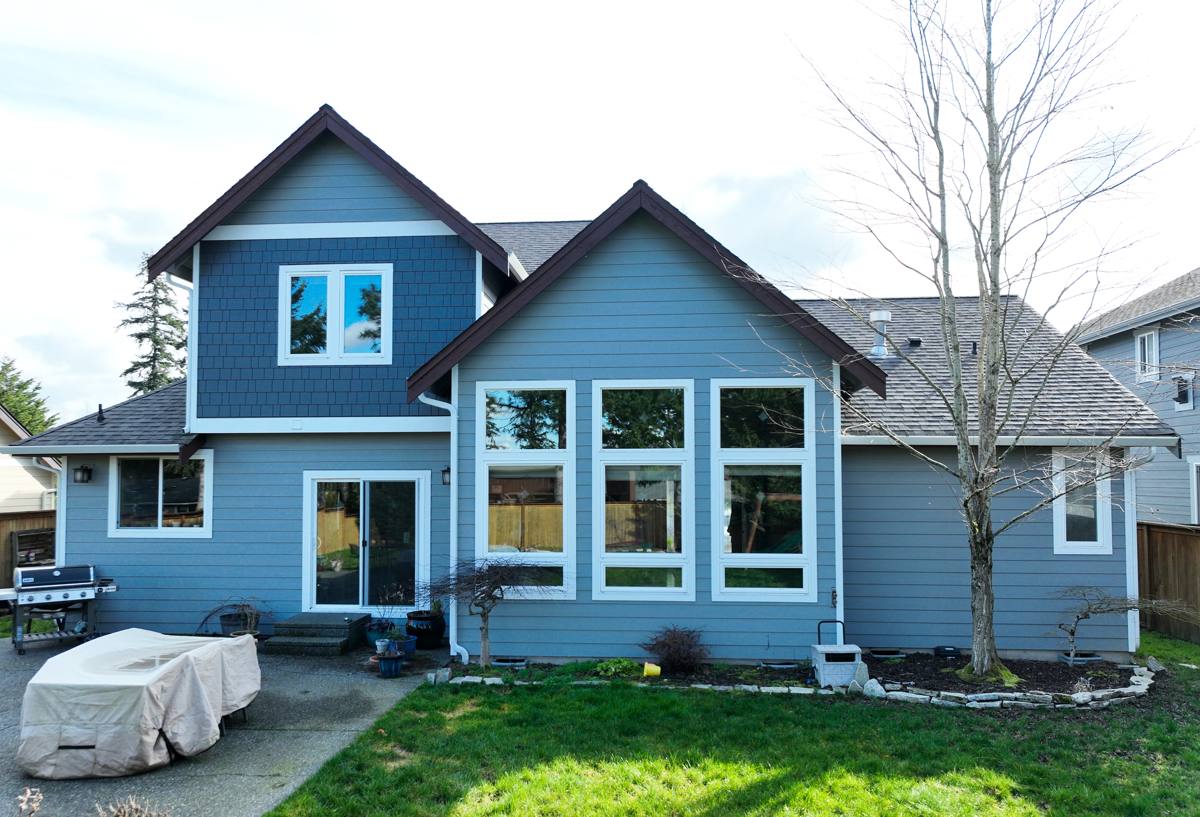
What Salt Air, Driving Rain, and Moss Actually Do to Siding
Salt Air and Finish Breakdown
Airborne salt is more than a nuisance film on windows. It settles on siding, trim, and fasteners, and over years it accelerates the breakdown of paint finishes, corrodes exposed metal fasteners and flashing, and works its way into any seam or gap in the wall assembly. Siding products that depend on a site-applied paint job for their weather protection tend to chalk, fade, and lose their seal faster here than the same product would a few miles inland, simply because there's more salt in the air landing on the wall every day.
Wind-Driven Rain at a Waterfront Exposure
A waterfront lot doesn't get the benefit of trees, hills, or neighboring structures breaking up wind the way an inland property does. Storms come off the water and push rain directly into the wall, often sideways, which means water gets tested at every seam, corner, and penetration far more aggressively than it would on a sheltered site. Siding and trim that aren't detailed to shed wind-driven rain — rather than just rain falling straight down — show water problems first at these joints, and on an exposed waterfront home those problems tend to show up sooner rather than later.
A Moss Season That Starts Early and Runs Long
Persistent dampness, mild temperatures, and salt spray keeping surfaces moist add up to a moss and mildew season that runs longer at Sandy Point than it does on drier, more sheltered lots elsewhere in the Ferndale area. It shows up as staining or green growth, especially on north-facing and shaded walls, and it does real damage beyond the cosmetic problem — sustained moss growth holds moisture directly against the siding and the wall behind it, which is exactly the condition that leads to hidden rot if it's left alone.
Signs a Sandy Point Home Needs Replacement, Not Just Repair
Not every issue on a coastal home means a full re-side. But there's a real difference between a problem that can be patched and one that means the siding has reached the end of what it can protect. Some signs point clearly toward full replacement:
- Soft or spongy spots when you press on the siding, especially near the bottom courses or around window and door trim
- Paint or finish that's chalking, peeling, or bubbling across large sections rather than one isolated spot
- Persistent staining, streaking, or moss growth that comes back within weeks of cleaning
- Visible gaps, warping, or cupping at panel seams and corners
- Rusted or corroded fasteners showing through the surface
- Rising energy bills with no other obvious explanation, which can point to a wall assembly that's no longer sealing properly
If you're only seeing one of these in an isolated spot, a repair may genuinely be the right call. If you're seeing several of them, or the home still has an older, non-Hardie product that's simply aged out, replacement is usually the more honest answer — and we'll tell you which situation you're actually looking at rather than defaulting to the bigger job.
What a Correct Siding Replacement Involves Here
On a waterfront property, the material is only half the job. The installation detail underneath the visible siding is what actually determines whether a home stays dry through its next twenty winters. A correct replacement at Sandy Point includes:
- Full tear-off, not overlay: Old siding comes off so the sheathing underneath can actually be inspected, not covered up.
- Sheathing and framing inspection: Any hidden rot from years of trapped moisture gets found and repaired before new siding goes on, not discovered later as a callback.
- A proper weather-resistive barrier: A correctly lapped and sealed house wrap does the real work of keeping bulk water out, with the siding itself as the first line of defense rather than the only one.
- Correct window and door flashing: This is where wind-driven rain finds its way in fastest if it's rushed, so flashing gets integrated with the water barrier in the right order, not caulked over as an afterthought.
- Grade clearance: Siding kept clear of grade and hard surfaces so it isn't wicking up ground moisture or sitting in standing water after a storm.
- A fastening schedule built for wind exposure: An open waterfront lot takes more wind load than a sheltered one, and fastening patterns should reflect that instead of using a generic inland spec.
Skipping or rushing any one of these steps tends to show up faster on an exposed waterfront home than it would on a sheltered inland lot — sometimes within a single wet season.
Why We Install Only James Hardie Here
We narrowed to one siding system after years of jobs across Whatcom County, watching which products actually held up under sustained salt exposure, wind, and moisture and which ones quietly turned into maintenance problems a few years after installation. For a property at Sandy Point specifically, the case for fiber cement is about as clear as it gets.
- Non-combustible core: Fiber cement doesn't feed a fire the way wood-based or wood-derived products can.
- Factory-applied ColorPlus finish: The finish is baked on under controlled conditions rather than brushed on in the field, so it holds up against salt air, UV, and moisture far longer than site-applied paint.
- Climate-engineered HZ product lines: Hardie builds different formulations for different exposure levels, including versions engineered for sustained moisture — a real match for a waterfront lot.
- Dimensional stability: Fiber cement doesn't swell, cup, or warp the way engineered wood siding can after repeated wet-season moisture cycles.
- Strong transferable warranty: Backed properly when installation follows spec, giving a homeowner real protection instead of a marketing claim.
We don't install LP SmartSide, vinyl siding, Cemplank, Allura, primed spruce, or cedar. Each has its place in the broader market, and plenty of homeowners elsewhere are satisfied with them. But on a lot that takes this much salt air and wind-driven rain directly off the water, we made a professional call that one system we trust completely is worth more than a cheaper option that quietly shifts maintenance risk back onto the homeowner a few years down the road.
How Coastal Exposure Changes the Material Comparison
| Material | Salt Air / Corrosion Behavior | Moisture & Moss Resistance | Coastal Maintenance |
|---|---|---|---|
| James Hardie fiber cement | Non-combustible core, factory finish resists salt-driven fading and chalking | Engineered HZ formulations for sustained moisture exposure; doesn't swell or rot | Occasional washing; finish holds up without repainting for many years |
| Vinyl siding | Can warp or become brittle under repeated UV and temperature swings near open water | Won't rot, but seams and J-channels can trap moisture behind the panel | Low, but damage often means full panel replacement rather than a spot repair |
| Engineered wood (e.g. LP SmartSide) | Wood-based substrate is more moisture-sensitive in a sustained damp, salty environment | Prone to swelling and edge deterioration if moisture reaches the substrate | Requires diligent caulking and finish upkeep to keep water out |
| Cedar or primed wood | Salt air accelerates finish breakdown; needs frequent refinishing near the water | Natural material absorbs moisture and is highly susceptible to moss and rot | High — regular refinishing and moisture monitoring |
This isn't a knock on any single product line so much as an honest look at what open, salt-exposed water frontage does to different material categories over time. It's a big part of why we standardized on one system rather than offering several and letting exposure sort out the winners after the fact.
Our Process for a Sandy Point Project
Every waterfront property is a little different in how it's oriented to the water and the wind, so we start with an actual walk-through rather than a phone estimate.
- On-site inspection: We look at the current siding, trim, flashing, and any visible moisture or moss issues, and we check the areas that take the most direct wind and salt exposure.
- Honest assessment: We'll tell you plainly whether you're looking at a repair, a partial re-side, or a full replacement, and why.
- Written estimate: A clear, itemized proposal with no pressure to sign on the spot.
- Tear-off and prep: Old siding comes off, sheathing is inspected and repaired as needed, and the weather-resistive barrier and flashing go in correctly before anything new is installed.
- Installation: Hardie siding, trim, and fastening go in to a spec built for this exposure, not a generic inland pattern.
- Final walkthrough: We go over the finished work with you before calling the job done.
Cost Factors for Sandy Point Siding Replacement
| Factor | What It Affects | Why It Matters Here |
|---|---|---|
| Tear-off vs. overlay | Labor scope and access to the sheathing | A full tear-off is the only way to find and fix moisture damage that's common under older siding on a waterfront lot |
| Substrate condition | Repair costs before new siding goes on | Years of salt-laden moisture can quietly rot sheathing and framing behind failing siding |
| Wind exposure and fastening spec | Material quantities and labor time | An open waterfront lot takes more direct wind load than a sheltered inland property |
| Grade and drainage | Siding clearance and moisture management near the foundation | Low, exposed lots near the water can hold ground moisture longer after a storm |
| Site access | Staging, equipment, and labor time | Waterfront lots can have tighter or less conventional access than a typical in-town property |
Exact numbers depend on the specific home and how it's oriented to the wind and water, which is why we walk the property in person before quoting a real number instead of working off a generic price sheet.
Why Hiring a Crew That Already Works Sandy Point Matters
A crew that works this stretch of the Whatcom County coastline regularly has seen how salt air, driving rain, and a long moss season actually behave on real homes here, not just how a product performs on a spec sheet. That experience shapes decisions on install day: which elevations take the worst of the wind and spray, where extra flashing attention earns its keep, and which fastening details are worth the added time so you're not dealing with a callback after the next winter storm off the water. A crew unfamiliar with waterfront exposure can install a technically correct siding job that still underperforms here simply because it was built to an inland standard rather than this one.
What to Ask Before Hiring
- Do you carry current Washington state contractor licensing and insurance?
- Have you worked on waterfront or high-exposure properties in this area before?
- What weather-resistive barrier and flashing details do you use, specifically?
- Will you show me the sheathing before it's covered back up?
- What does your warranty actually cover, and for how long?
If your Sandy Point home needs new siding, or you just want an honest look at what's happening behind an aging wall, we're glad to take a look. Reach out using the form below to schedule a free, no-pressure estimate.