 Ferndale
 Marietta's Climate Is Harder on Siding Than Most Homeowners Realize
Marietta sits low and close to the water, tucked between the Nooksack River delta and Bellingham Bay in Whatcom County. That location is part of what makes it a beautiful place to live, but it also means homes here take a different kind of beating than a house fifteen minutes inland. Salt-laden air moves off the bay and settles on siding, trim, and fasteners. Wind-driven rain comes in sideways during winter storms instead of falling straight down, which pushes moisture into laps, corners, and butt joints that a drier climate would never test. And the heavy tree cover and near-constant dampness that define this part of Whatcom County give moss and algae a long season to establish themselves on north-facing walls and anywhere shade lingers.
None of that is a reason to avoid siding your home well — it's a reason to be deliberate about what goes on the wall and how it's installed. Some siding products tolerate this environment. Others slowly lose the fight against it. That distinction is the entire reason we standardized on James Hardie fiber cement and stopped installing the alternatives.
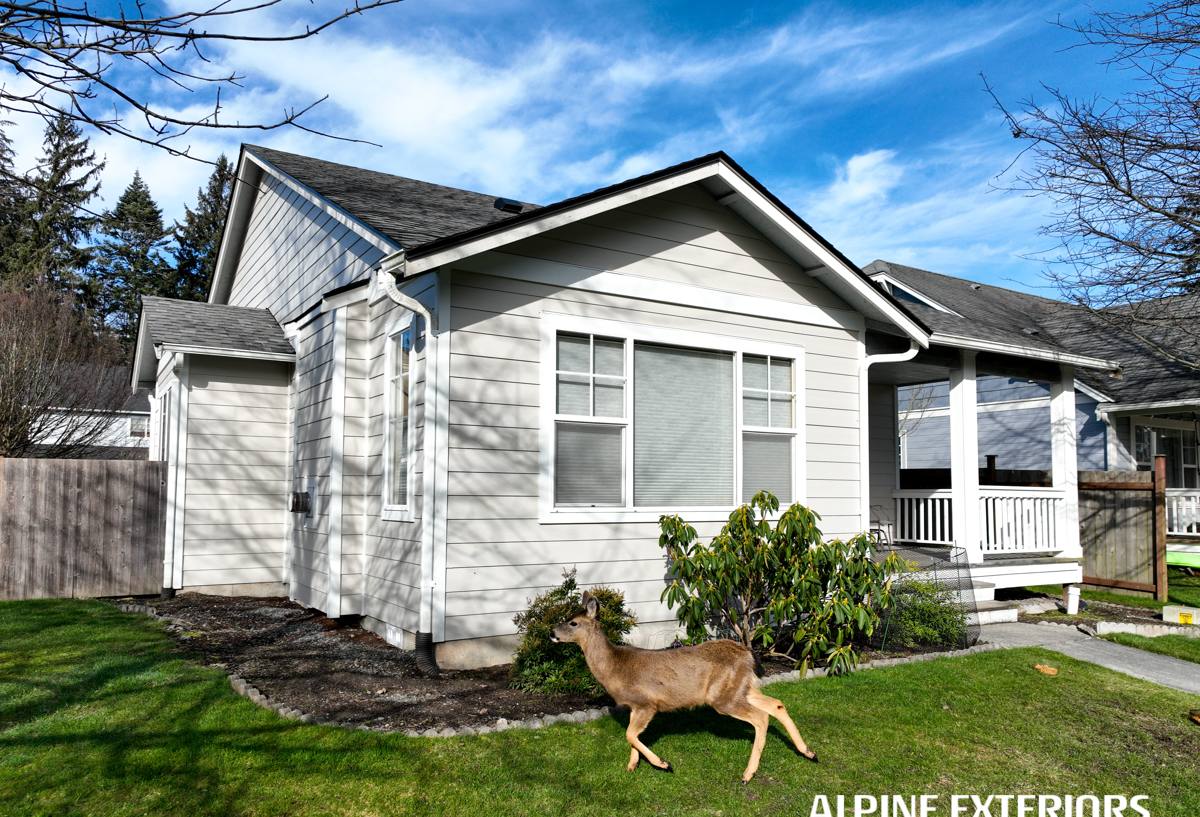
Why We Install Only James Hardie in This Area
We don't carry vinyl, LP SmartSide, Cemplank, Allura, or wood siding like primed spruce or cedar. That's a deliberate professional standard, not a sales pitch, and it's worth explaining honestly.
- Vinyl handles rain fine but becomes brittle in cold snaps and can warp or fade under UV exposure over years — and it can't be painted to refresh its look without specialized prep.
- LP SmartSide and other wood-strand products perform reasonably well when installation and caulking are perfect and stay perfect, but any breach in that seal lets moisture into the substrate, and a damp, shaded, salt-exposed site like Marietta gives that breach every chance to happen.
- Cedar and primed spruce are genuinely attractive but are organic material — they need ongoing refinishing, and in a climate this wet, they're the most vulnerable to rot and moss colonization of anything on this list.
James Hardie fiber cement is cellulose fiber, sand, and Portland cement — a non-combustible, dimensionally stable material engineered specifically to resist moisture intrusion and hold a factory finish. It's not immune to a bad install, but it gives a careful crew a much wider margin for error in a climate like this one, and it gives homeowners a product that isn't fighting the environment from day one.
HZ5 Engineering: Product Built for the Pacific Northwest
James Hardie makes climate-specific product formulations, and homes in Whatcom County fall into the HZ5 zone — engineered for cold, wet, moisture-heavy climates rather than the hot, humid Southeast or dry Southwest formulations. That matters more in Marietta than in a lot of inland towns, because the combination of salt air and sustained damp conditions is exactly the stress profile HZ5 is built to resist. The fiber cement itself doesn't absorb water the way wood does, doesn't corrode the way some metal trims do, and doesn't become brittle the way vinyl can in a hard freeze.
The factory-applied ColorPlus finish is the other half of the equation. It's baked on in a controlled environment with better adhesion and UV resistance than field-applied paint, which means the color holds up longer against the fading and chalking that salt air and constant moisture tend to accelerate on painted wood or lower-grade siding.
What a Correct James Hardie Install Actually Involves
The product is only half the story — how it goes on the wall determines whether it delivers on that engineering. In a location like Marietta, a few details matter more than usual:
Water Management Behind the Siding
Every Hardie install we do starts with a proper weather-resistive barrier and a rain screen or drainage gap where conditions call for it, so any moisture that does get past the siding has somewhere to go instead of sitting against the wall. This is standard best practice everywhere, but it's not optional in a spot that catches this much wind-driven rain.
Fastener and Flashing Choices
Salt air accelerates corrosion on the wrong hardware. We use corrosion-resistant fasteners and properly integrated flashing at windows, doors, and roof-to-wall transitions — the exact places where a rushed install lets water sneak in behind the siding rather than shedding off the face of it.
Clearances and Gaps
James Hardie's own installation specs call for clearance from grade, roofing, decks, and other surfaces, plus small gaps at butt joints and trim rather than tight, caulked-shut seams. Skipping these clearances is one of the most common ways an otherwise good product fails early — trapped moisture doesn't care how good the siding itself is.
Caulking and Sealant Discipline
Used correctly, sealant is a backup, not the primary defense — the flashing and drainage plane do the real work. We follow Hardie's fastening and joint treatment guidelines rather than relying on caulk to compensate for shortcuts, because caulk is the first thing to fail in a climate that alternates between soaking rain and salt exposure.
Signs Marietta Homes Show When Siding Is Losing the Battle
If your current siding is starting to lose ground against the local climate, a few signs tend to show up before anything looks seriously wrong:
- Persistent moss or algae streaking on north- or shade-facing walls that comes back within weeks of cleaning
- Soft spots, bubbling paint, or a chalky texture on wood or engineered wood siding
- Visible gaps opening up at butt joints, corners, or trim where caulk has cracked or pulled away
- Rust staining below fasteners or metal flashing
- A musty smell or visible staining on interior walls that back up to exterior siding
Any one of these is worth a look before it becomes a bigger repair. Catching moisture intrusion early is almost always cheaper than catching it late.
Our Process, Start to Finish
- Walk-through and assessment — we look at your home's exposure, existing siding condition, and any problem areas (shaded walls, water-facing sides, existing rot or moisture damage) before quoting anything.
- Product and color selection — HZ5 panel or lap siding in the profile and ColorPlus finish that fits your home, plus trim and accessory selections.
- Tear-off and substrate check — old siding comes off and we inspect sheathing for hidden rot or damage before anything new goes on, since covering a compromised wall defeats the purpose of a good product.
- Weather barrier and drainage plane installation — the unglamorous layer that does most of the long-term work.
- Siding, flashing, and trim installation to manufacturer spec, with attention to fastening pattern, clearances, and joint treatment.
- Final walk-through so you understand what was done and what basic upkeep, if any, is worth doing going forward.
What Affects Cost on a Marietta Siding Job
| Factor | Why It Matters Here |
|---|---|
| Home size and wall complexity | More corners, gables, and dormers mean more cutting, flashing, and labor time |
| Existing siding removal and substrate repair | Homes with hidden moisture damage from prior siding need sheathing repair before new siding goes on |
| Siding profile and finish selection | Lap width, panel style, and ColorPlus color all affect material cost |
| Trim and accessory scope | Corner boards, fascia, and window trim replacement add scope but improve the finished water management |
| Site access | Waterfront and low-lying lots can affect staging and equipment access |
We give straightforward, itemized estimates so you can see exactly what's driving the number rather than a single lump figure.
Why It Matters That We Already Work in Marietta and Ferndale
A crew that's worked this area knows which walls take the worst of the wind-driven rain, which lots stay shaded and damp long enough to grow moss fast, and how salt exposure off the bay tends to show up on hardware and trim over time. That's not something you learn from a spec sheet — it's something you learn from doing the work here repeatedly. It shapes small decisions on every job: where we pay extra attention to flashing, which sides of the house get discussed with the homeowner before we finalize a plan, and what maintenance advice actually applies to this specific location versus generic advice that doesn't account for a coastal, tree-covered Whatcom County lot.
Simple Maintenance That Keeps Hardie Siding Performing
- Rinse siding annually, and more often on shaded or north-facing walls, to keep moss and algae from establishing
- Keep gutters clear so overflow doesn't run down the face of the siding
- Trim back vegetation and tree limbs that keep walls damp and shaded longer than necessary
- Inspect caulking at trim and penetrations every year or two and touch up as needed
- Address any small chip or crack in the ColorPlus finish promptly rather than letting exposed edges sit
None of this is heavy maintenance — that's part of the point of choosing a material built for this climate in the first place.
If you're weighing a siding project on a Marietta home, we're happy to take a look and give you a straightforward, no-pressure estimate — just fill out the form below.