 Ferndale
 Why Bellingham-Area Siding Wears Out Faster Than the Manual Says
Homes on the Bellingham side of Whatcom County take a different kind of beating than siding manufacturers assume when they write their coverage and maintenance guidelines. You've got proximity to Bellingham Bay and the broader Puget Sound, which means a steady low-grade dose of salt-laden air working on fasteners, trim, and any exposed wood. You've got driving rain that comes in sideways off the water during fall and winter storms, testing every seam, joint, and piece of flashing on a wall. And you've got a moss season that, realistically, runs most of the year in this climate — shaded north walls, tree-lined lots, and persistent dampness give moss and algae exactly what they need to take hold on siding that isn't holding up its end of the bargain.
None of this is exotic weather. It's just Whatcom County. But it adds up differently than it does for a siding job in a drier, sunnier market, and it's why we treat every siding replacement in this area as a climate problem first and a cosmetic upgrade second.
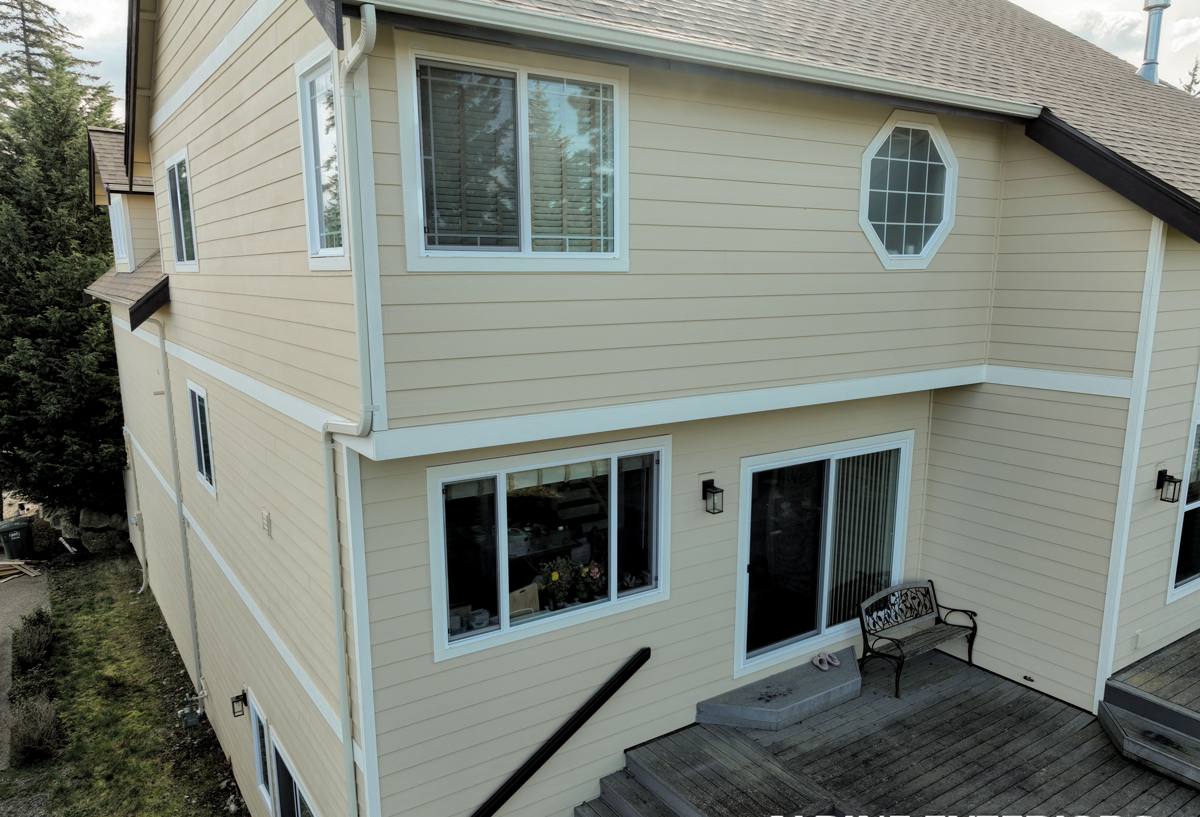
Signs a Bellingham Home Actually Needs Replacement (Not Just Paint)
Homeowners often call us thinking they need a paint job, and sometimes that's true. But paint can't fix what's happening underneath if the siding material itself has broken down. Here's what tells us replacement, not repainting, is the right call:
- Soft or spongy spots when you press on the siding, especially near the bottom courses and around window trim
- Paint that won't hold — it blisters, peels, or fails again within a year or two of a fresh coat
- Visible gaps, warping, or buckling in panels, particularly on walls that face prevailing wind and rain
- Persistent moss or algae staining that comes back within months of cleaning, even after a wash
- Rot at butt joints, corners, or anywhere siding meets a window, door, or roofline
- A musty smell in an exterior-facing room, which often points to moisture already inside the wall assembly
- Siding that's simply reached the end of its practical service life — old cedar, aging LP SmartSide, or vinyl that's chalked, cracked, or faded past what cleaning can fix
If you're seeing two or more of these, it's worth a real inspection rather than another maintenance cycle. Moisture problems behind siding don't stay contained — they spread into sheathing and framing, and the cost of ignoring them grows every wet season they go unaddressed.
What a Correct Siding Replacement Actually Involves
A siding replacement is not just pulling off old panels and nailing up new ones. Done right, it's a full envelope job, and skipping steps here is exactly what causes the same failures to show up again in five or ten years — sometimes faster, since a new problem hidden behind new siding is harder to catch early.
Tear-off and inspection
Old siding comes off in full, not patched around. That's the only way to actually see the sheathing underneath. In this climate, we routinely find soft or delaminated sheathing at the bottom few feet of a wall, around old window flashing, and at any point where a previous installer skipped proper flashing details. Any compromised sheathing gets replaced before anything else happens — new siding over bad sheathing is a warranty problem waiting to happen.
Weather-resistive barrier and flashing
This is the layer that actually keeps a house dry — the siding itself is really the second line of defense. We install a proper weather-resistive barrier with correctly lapped seams (water sheds down and out, never in), and we pay close attention to flashing at every window, door, deck ledger, and roof-to-wall intersection. Given how much driving rain this area sees, sloppy flashing is the single most common cause of the rot we find when we tear off old siding.
Installation to manufacturer spec
James Hardie fiber cement has specific nailing patterns, gap and clearance requirements, and butt joint treatments that have to be followed exactly to keep the product warranty valid and to perform as designed. Ground clearance, deck and patio clearance, and proper caulking at joints all matter more here than in a drier climate, because any shortcut becomes a moisture entry point during the next atmospheric river event.
Trim, caulking, and finish detail
The finish work — corner trim, window and door trim, caulking at penetrations — is where a lot of jobs get rushed. It's also where salt air and constant damp cycling will find any weak point fastest. We finish these details the same way regardless of whether it's a highly visible front elevation or a side wall nobody sees.
Why We Install Only James Hardie Fiber Cement
We don't install vinyl, LP SmartSide, Cemplank, Allura, primed spruce, or cedar. That's a deliberate standard, not a lack of options. Each of those products has genuine strengths — vinyl is inexpensive and low-maintenance in mild climates, engineered wood products install quickly, cedar looks the way a lot of homeowners want a Pacific Northwest home to look. But in a climate with this much sustained moisture exposure, salt air, and shade-driven moss growth, the trade-offs on those products — moisture sensitivity at cut edges, seam and caulk maintenance, or the ongoing upkeep that wood-based siding demands to stay ahead of rot — are trade-offs we're not willing to build a warranty around.
James Hardie fiber cement is non-combustible, dimensionally stable, and doesn't feed moss or absorb moisture the way wood-based products can. It's factory-finished with ColorPlus technology, which means the color coat is baked on under controlled conditions rather than field-applied, so it holds up more consistently against UV and salt air than a job-site paint job. Hardie also engineers specific product lines — HZ5 among them — for regions with heavier moisture exposure, which describes Whatcom County accurately. Backed by a strong transferable warranty and a track record of holding up when installed to spec, it's simply the product we're comfortable standing behind on every home we touch.
How the Common Siding Options Compare in This Climate
| Material | Moisture behavior here | Maintenance burden | Typical lifespan in this climate |
|---|---|---|---|
| Vinyl | Doesn't rot, but seams and J-channels trap moisture; can warp under heat, brittle in cold snaps | Low, but limited repair options once damaged | 15–25 years |
| Cedar | Absorbs moisture, needs consistent sealing to resist rot and moss | High — recoating and inspection every few years | Highly variable, often 15–20 years if well maintained |
| LP SmartSide / engineered wood | Wood-strand core is vulnerable at cut edges and joints if moisture gets in | Moderate — caulk and paint upkeep matters a lot here | 20–30 years with diligent maintenance |
| James Hardie fiber cement | Non-combustible, doesn't absorb moisture like wood, doesn't feed moss growth | Low — occasional wash and caulk check | 30+ years with correct installation |
Our Process, From Estimate to Finished Job
- Free on-site inspection. We walk the exterior, check for soft spots, look at existing flashing and trim, and talk through what we're seeing with you directly.
- Written estimate. You get a clear scope — what's being replaced, what sheathing repair (if any) is anticipated, product and color selection, and a real price, not a ballpark that changes once work starts.
- Scheduling around the weather. Tear-off exposes your home's sheathing to the elements, so we plan around forecasted dry windows where possible and protect open walls if conditions turn.
- Tear-off, sheathing repair, and barrier install. Full removal, inspection, and correction of anything compromised before a single piece of new siding goes up.
- Hardie installation to spec. Correct nailing, clearances, and joint treatment throughout — not just on the elevations that are easiest to see from the street.
- Final walkthrough. We go over the finished job with you before we consider it done.
What Drives the Cost of a Siding Replacement
Every home is different, so we don't quote broad numbers until we've seen your walls — but these are the factors that actually move the price:
| Factor | Why it matters |
|---|---|
| Extent of sheathing repair needed | Rot found during tear-off has to be addressed before new siding goes up — this is the biggest variable |
| Home size and wall complexity | More corners, dormers, and trim details mean more labor and material |
| Siding profile and color selection | Lap width, board-and-batten, or shingle-style Hardie products vary in material and install time |
| Existing siding type | Some materials (like old cedar or multiple layers) take longer to remove than others |
| Site access | Tight lots, second-story work, or landscaping that limits staging area affects labor time |
We'd rather give you an honest, itemized number after seeing your home than a phone estimate that doesn't survive tear-off day.
Why a Crew That Already Works Bellingham Matters
Siding installation isn't just a spec sheet — it's judgment calls made on-site, house by house. A crew that regularly works this area already knows which wall orientations take the worst of the driving rain, where moss tends to establish first, and what flashing details tend to fail on homes built in different eras around Whatcom County. That local pattern recognition shows up in small decisions throughout a job — an extra bead of sealant at a joint that's going to face years of wind-driven rain, a flashing detail done slightly more conservatively than the minimum spec because we've seen what happens when it isn't.
It also means we're not learning this climate on your house. We're applying what we've already confirmed works here, on a product we trust enough to install exclusively.
After Installation: What Upkeep Actually Looks Like
One of the real advantages of correctly installed James Hardie siding in this climate is how little it asks of you afterward. That said, "low-maintenance" isn't "no-maintenance" — a periodic soft wash to keep moss and algae from establishing, a visual check of caulking at joints and trim every year or two, and prompt attention if you ever notice a soft spot or gap will keep your siding performing for its full service life. Compared to the sealing and recoating schedule that wood-based siding demands in this climate, it's a fraction of the ongoing effort.
If your siding is showing its age, holding onto moisture, or just isn't standing up to another Bellingham winter the way it should, we're happy to take a look and give you a straight answer about what it needs. Reach out for a free, no-pressure estimate — there's a form below to get started.