 Ferndale
 Blaine's Marine Climate Is Hard on a Deck
Blaine sits about as close to the water as a Whatcom County home can get, and that location comes with a specific set of decking problems. Salt-laden air off the water accelerates corrosion on anything metal. Rain here isn't occasional — it's a season, and it drives sideways as often as it falls straight down, which means water finds its way into joints, fastener heads, and end grain that a drier climate would never test. Add the shaded, humid stretches common on this part of the coast and you get moss and algae establishing themselves on decking within a year or two if the surface and drainage aren't built to shed water fast.
A deck built without those conditions in mind doesn't fail dramatically — it fails slowly. Boards cup, fasteners bleed rust streaks into the surface, and a green film builds up in the shaded corners no one thinks to scrub. Composite decking, installed correctly, is the most practical way to get ahead of all three problems at once. But "composite decking" covers a wide range of products and installation quality, and in a climate like Blaine's, the details matter more than they would somewhere dry.
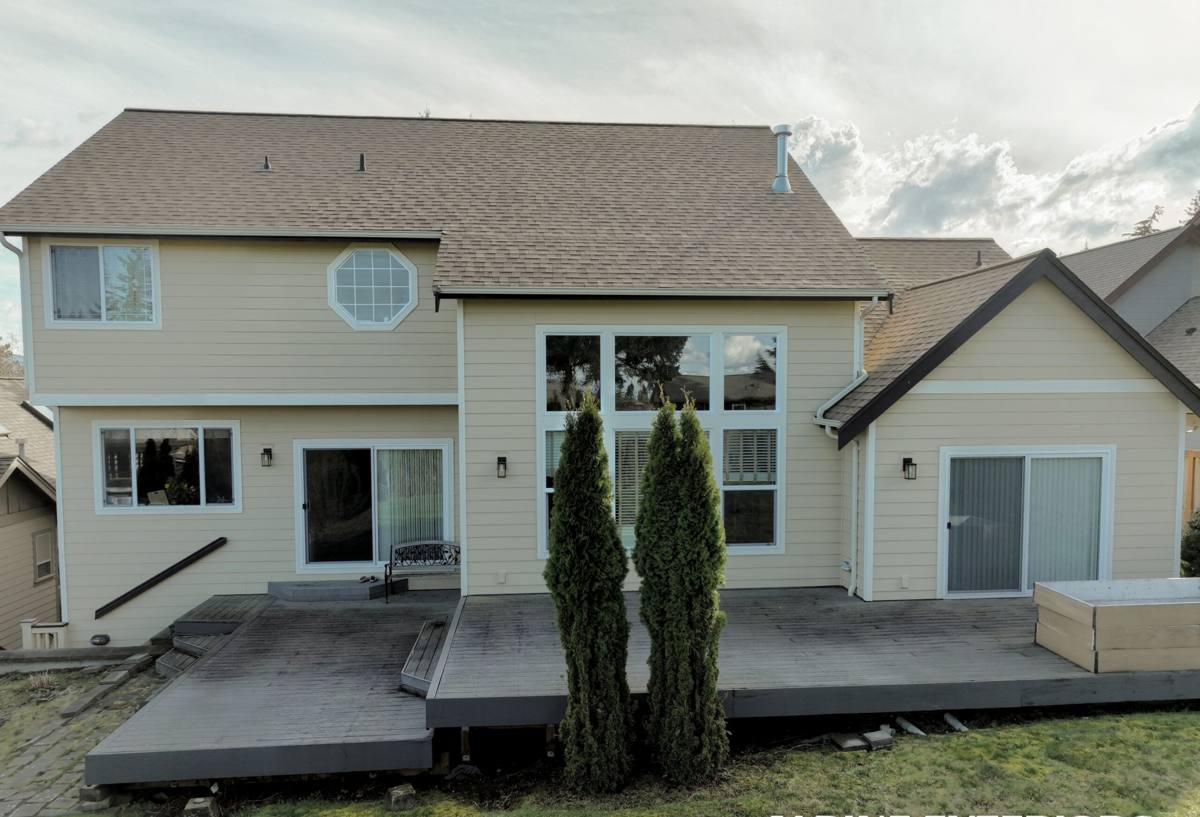
Why Composite Makes Sense on This Stretch of Coastline
Wood decking isn't a bad product — it's a product that needs more from the climate than Blaine is willing to give it. Untreated or even pressure-treated wood decking in a salt-air, high-rainfall environment needs annual attention: sealing, sanding, spot-treating mildew, replacing boards that have started to rot from the underside where nobody's looking. Composite decking shifts that maintenance burden. It doesn't absorb water the way wood does, it doesn't need refinishing, and a quality capped board resists the surface staining and mildew growth that wood decking picks up fast in shaded, damp corners.
That doesn't mean composite is maintenance-free — nothing exposed to this climate is — but the maintenance is lighter and less time-sensitive. A missed year of upkeep on a wood deck can mean real structural damage. A missed year on composite usually just means a wash is overdue.
| Factor | Wood Decking | Composite Decking |
|---|---|---|
| Moisture absorption | Absorbs and swells, especially end grain | Resists absorption; capped boards near-zero |
| Moss/algae resistance | Low — porous surface holds spores | Higher — smooth cap sheds and cleans easily |
| Fastener corrosion risk | Standard fasteners rust and stain wood fast in salt air | Same risk unless hidden/coated fastener systems used |
| Annual maintenance | Sealing/staining, mildew treatment | Periodic wash; no sealing or staining |
| Upfront cost | Lower | Higher |
| Typical service life here | 10–15 years with consistent upkeep | 25+ years with routine cleaning |
What a Correct Composite Deck Build Actually Involves
Substructure and Framing
Composite boards are only as good as what's underneath them. In a wet climate, the framing lumber, ledger connection, and joist protection matter more than the decking material itself. We use joist tape or an equivalent barrier over the framing to keep standing water from sitting against the wood, and we flash the ledger board connection properly so water is directed away from the house rather than into the rim joist — a detail that causes rot problems for years if skipped, and one that's easy to miss on a quick install.
Drainage and Slope
Every deck we build gets a slight pitch away from the house, generally around a quarter inch per foot, so water doesn't pool on the surface or against the ledger. On a property that already deals with heavy seasonal rain, a flat or poorly sloped deck becomes a standing-water problem and a moss farm within a season.
Fasteners and Hardware for Salt Air
This is where a lot of decks in coastal Whatcom County go wrong. Standard galvanized fasteners can corrode faster than expected this close to salt water, leading to rust streaking and eventually fastener failure. We use stainless steel or coated fasteners rated for coastal exposure, along with hidden fastener systems where the board profile supports it, so there's no exposed metal on the walking surface to stain or fail early.
Choosing the Right Composite Board
Not all composite decking is built the same, and the right choice depends on budget, sun exposure, and how much of the deck sits in shade where moss is more likely to take hold.
- Fully capped composite — a polymer shell wraps the entire board, giving the best resistance to moisture, staining, and mold. This is what we recommend for shaded or heavily rain-exposed areas.
- Mineral-based composite — denser and often more fade- and scratch-resistant, a good option for uncovered decks that get direct sun and driving rain together.
- Board color — lighter colors show less algae staining over time in a damp climate than very dark boards, though dark boards hide dirt between cleanings better; we walk through the trade-off with each homeowner.
- Board profile — grooved-edge boards that accept hidden fasteners keep the surface free of exposed screw heads, which matters both for looks and for reducing corrosion points.
Our Process, Start to Finish
- On-site assessment — we look at drainage patterns, sun/shade exposure, existing framing condition, and how close the deck sits to salt spray or standing moisture.
- Material walkthrough — we go over board options and hardware based on what that specific site actually needs, not a one-size answer.
- Permit and code check — railing height, stair geometry, and ledger attachment are confirmed against current code before framing starts.
- Framing and flashing — ledger flashing, joist protection, and proper slope are set before a single composite board goes down.
- Installation — boards are fastened with corrosion-rated hardware, gapped correctly for the material's expansion, and edges finished cleanly.
- Final walkthrough — we check the deck with the homeowner and cover basic care specific to this climate before we consider the job done.
Railings, Stairs, and Local Code
Most deck jobs in this area aren't just decking boards — they include railings and stairs, and both have code requirements around height, baluster spacing, and stair rise/run that we build to as a matter of course. For coastal properties, we also pay attention to railing hardware and post connections, since these see more direct wind and salt exposure than the deck surface itself and are a common spot for premature corrosion if the wrong fasteners are used.
Living With a Composite Deck in a Moss-Prone Climate
A properly built composite deck in Blaine still needs some seasonal attention — it just needs far less than wood, and none of it is urgent if you're a few weeks late.
- Sweep debris off the deck regularly, especially in fall — wet leaves sitting on any surface, composite included, feed moss growth.
- Wash the deck once or twice a year with a soft-bristle brush and a mild soap-and-water solution; a pressure washer on a wide, low-pressure setting works but should never be aimed directly and close at the board surface.
- Keep gutters and downspouts near the deck clear so runoff isn't dumping extra water onto the surface or framing below.
- Check railing posts and fastener points once a year for any early rust staining, and address it before it spreads.
- Trim back overhanging vegetation that keeps a section of the deck shaded and damp longer than the rest.
What It Costs and What Drives the Price
Composite decking costs more upfront than wood, and the total depends heavily on size, board choice, and how much railing and stair work is involved. Rather than quote a number that won't reflect your actual site, here's what actually moves the price:
| Cost Factor | Why It Matters |
|---|---|
| Deck size and shape | More cuts and corners mean more labor and material waste |
| Board tier (capped vs. mineral-based) | Premium boards cost more per foot but last longer with less staining |
| Substructure condition | Rotted or undersized existing framing adds repair cost before decking starts |
| Fastener system | Hidden/coated fastener systems cost more than exposed screws but resist corrosion far better |
| Railings and stairs | Composite or aluminum railing systems add meaningfully to the total |
| Site access | Elevated decks or tight access add labor time |
Why Hiring a Crew That Already Works Blaine Matters
A deck built to a generic spec sheet doesn't account for the fact that Blaine sits right on the water in a way most of Whatcom County doesn't. A crew that hasn't worked this stretch of coastline can underestimate how fast standard hardware corrodes here, or how much faster moss establishes itself on a shaded deck this close to the water compared to a build a few miles inland toward Ferndale. We build decks across this region and adjust the fastener choice, board selection, and drainage detailing to match what the specific site is actually exposed to — not a generic recommendation that happens to work fine somewhere drier.
If you're planning a new composite deck or replacing an aging wood one, we're glad to come take a look and give you a straightforward, no-pressure estimate based on your property, not a guess from a form. Use the estimate request below to get started.