 Ferndale
 Why Sumas Homes Need Siding That Can Take a Beating
Sumas sits in the part of Whatcom County where the weather doesn't do anything halfway. Homes here deal with salt-laden air moving in off the water, driving rain that comes in sideways more often than straight down, and a moss season that can stretch for most of the year in shaded, north-facing spots. That combination is hard on siding. Wood swells and shrinks with every wet-dry cycle. Vinyl chalks, warps in temperature swings, and gives moss and algae plenty of rough surface to grab onto. Cheaper composite products can look fine in the showroom and still struggle once they're facing a real Whatcom County winter.
Fiber cement siding was engineered specifically for climates like this. It doesn't rot, it doesn't feed insects, and it holds its shape and its finish through the freeze-thaw and soak-dry cycles that define this part of the state. For a Sumas home, that's not a luxury upgrade — it's the baseline a siding material needs to meet.
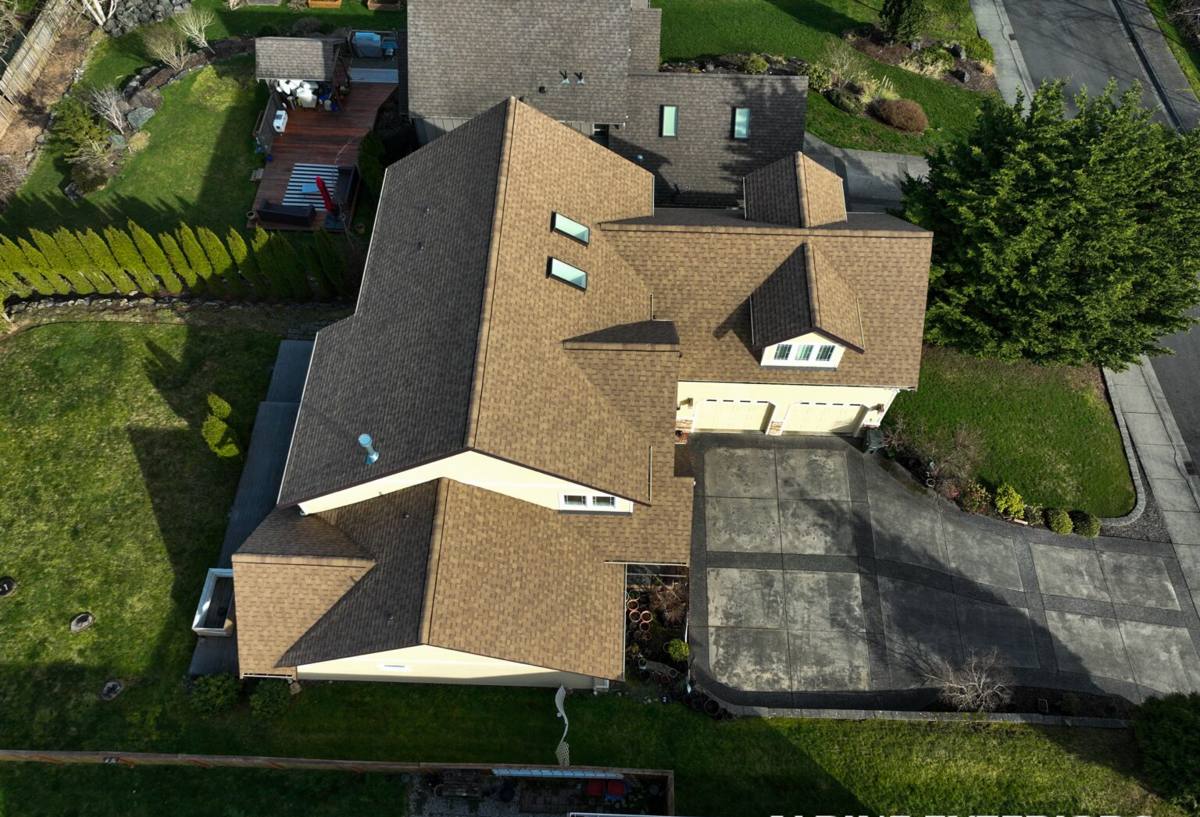
What Fiber Cement Is Actually Built to Handle
Fiber cement is a mix of cement, sand, and cellulose fiber, cured into dense, dimensionally stable boards. It's non-combustible, which matters for insurance and peace of mind, and it doesn't absorb water the way wood fiber siding or oriented strand board products do. That's the core reason it holds up under the kind of prolonged dampness Sumas sees for months at a time — the board itself isn't the weak point.
The weak points on any fiber cement job are almost always at the edges: where a board meets a window, where two courses overlap, where siding meets trim, roofline, or foundation. Get those details right and the siding will genuinely last decades. Get them wrong and moisture will find its way behind the cladding no matter how good the panel itself is. That's why we spend more time talking about installation than about the material — the material is the easy part.
Salt Air and Coastal Exposure
Salt-carrying air accelerates corrosion on fasteners, flashing, and any exposed metal trim. It also breaks down lesser paint systems faster than an inland home would ever see. Fiber cement's factory-applied finish is formulated to resist that kind of UV and salt exposure far longer than a field-applied paint job would.
Driving Rain and Wind-Driven Moisture
When rain comes in at an angle instead of falling straight down, it gets pushed up under laps, into fastener holes, and behind trim edges that would stay dry in a calmer climate. Siding here needs correct lap coverage, proper caulking at penetrations, and a drainage plane behind it that actually lets water out instead of trapping it.
Long Moss and Algae Season
Shaded walls, tree cover, and persistent damp air give moss and algae a long runway to establish themselves. Fiber cement's dense surface and factory finish resist the kind of moisture retention that lets organic growth take hold the way it does on porous or textured wood-based sidings.
Where Fiber Cement Installations Go Wrong
Most siding failures we see on older homes in this area weren't material failures — they were installation shortcuts that only show up years later, once the damage is already behind the wall.
Flashing and Water Management
Every window, door, and horizontal trim transition needs proper flashing integrated with a weather-resistive barrier behind the siding. Skipping this, or relying on caulk alone to do a flashing's job, is the single most common cause of hidden rot behind fiber cement siding. Caulk fails; correctly lapped flashing doesn't depend on staying flexible for thirty years.
Fastening and Panel Gaps
Fiber cement needs to be fastened per the manufacturer's specification — correct nail or screw type, correct placement relative to the panel edge, and correct penetration into framing. Panels also need small gaps at butt joints and terminations to allow for expansion and contraction with temperature and moisture swings. Fasten it too tight, or butt boards hard against each other, and you get buckling or cracking down the road.
Cuts, Caulking, and Painted Edges
Factory-finished ColorPlus boards are engineered to resist weathering on their factory face — but every field cut exposes raw fiber cement that needs to be sealed and touched up correctly. Sloppy cutting or skipped touch-up work creates a weak point that shows up as staining or premature wear at every cut edge on the house.
The James Hardie Product Lines We Install
We install James Hardie exclusively — not because it's the only fiber cement brand on the market, but because it's the one we're confident holding to our own standard for climate performance, factory finish, and warranty backing on every home we touch, including in Sumas and the rest of Whatcom County.
| Product Line | Best Use | What It Offers |
|---|---|---|
| HardiePlank Lap Siding | Most home exteriors | Traditional lap look, widest color and texture selection |
| HardiePanel Vertical Siding | Modern facades, accent walls | Clean vertical lines, often paired with board-and-batten trim |
| HardieShingle Siding | Gable ends, accent areas | Staggered or straight-edge shingle profile without the maintenance of real wood shingle |
| HardieTrim | Corners, fascia, window/door surrounds | Matching fiber cement trim so the whole envelope is one moisture-resistant system |
Hardie's HZ5 formulation is engineered for climate zones with sustained moisture exposure — the Pacific Northwest, including Whatcom County, falls squarely in that zone. The ColorPlus finish is baked on at the factory under controlled conditions, which is a meaningfully more durable result than a field-applied coat, and it carries its own finish warranty separate from the product warranty on the board itself.
Our Process, Start to Finish
A siding job is only as good as the sequence behind it. Here's how we run one:
- Site walk and assessment — we look at existing siding, trim, flashing, and any signs of moisture damage before we quote anything.
- Written estimate — product line, color, trim details, and scope spelled out, no vague allowances.
- Tear-off and substrate check — old siding comes off and sheathing gets inspected for rot or damage before anything new goes up.
- Weather-resistive barrier and flashing — the part of the job nobody sees once it's done, and the part that determines how long everything else lasts.
- Hardie installation to manufacturer spec — correct fastening, correct gaps, correct lap coverage.
- Trim, caulking, and touch-up — every cut edge sealed and finished properly.
- Final walkthrough — we go over the finished work with you before calling the job done.
Cost Factors for a Sumas Fiber Cement Project
Every home is different, but the same handful of factors drive most of the cost variation we see on fiber cement projects in this area.
| Factor | Why It Matters |
|---|---|
| Tear-off scope | Removing old wood or vinyl siding down to sheathing takes more labor than installing over prepped, sound substrate |
| Substrate condition | Hidden rot found once old siding comes off adds repair scope before new siding can go on |
| Home complexity | Dormers, multiple gables, and cut-up wall planes take more time and material than simple rectangular walls |
| Product line and profile | Lap, panel, and shingle profiles differ in material and labor cost per square foot |
| Trim scope | Full HardieTrim replacement at corners and openings adds cost but keeps the whole envelope consistent |
We don't quote off square footage alone — a proper estimate accounts for the specific conditions of your home, not a generic per-foot number.
Why Hiring a Crew That Already Works in Sumas Matters
Installing fiber cement correctly isn't complicated in theory, but getting the details right consistently comes from doing it repeatedly in the conditions a specific area actually produces. A crew that regularly works Sumas and the broader Ferndale area already knows how much lap coverage the local rain patterns call for, how flashing details need to be handled around the moisture load this climate produces, and where moss and algae tend to establish themselves on a typical wall orientation here. That's the difference between a crew reading a spec sheet and a crew that's watched how their own installations hold up through several Whatcom County winters.
It also matters for warranty support. James Hardie's system warranty depends on correct installation — a contractor who's installed the product hundreds of times in this exact climate is far less likely to make the kind of mistake that voids coverage down the line.
Living With Fiber Cement Siding
Fiber cement is low-maintenance compared to wood or vinyl, but "low-maintenance" isn't "no-maintenance." A little basic upkeep keeps it performing the way it's designed to for its full service life.
- Rinse the exterior annually with a garden hose to clear off salt residue, pollen, and general grime — skip the pressure washer, which can force water behind panels or damage caulking.
- Inspect caulking at trim, windows, and penetrations every year or two and re-caulk anything that's cracked or pulling away.
- Trim back vegetation and tree limbs that keep a wall section shaded and damp, since that's exactly where moss gets a foothold.
- Touch up any field-cut or scratched edges promptly so raw fiber cement doesn't sit exposed to moisture.
- Keep gutters and downspouts clear so water isn't sheeting down the siding face during heavy rain.
If your Sumas home is due for new siding, or you're not sure whether what's on the walls now is still doing its job, we're happy to take a look and give you a straightforward, no-pressure estimate — no obligation, just an honest read on where things stand.