 Ferndale
 Siding Installation Built for Sudden Valley's Climate
Homes around Sudden Valley sit in a corner of Whatcom County where the weather doesn't do anything by halves. Winters bring long stretches of driving rain off the water, summers stay cool and damp under tree cover, and the moss season runs longer here than it does further inland. Any siding installed on a Sudden Valley home has to handle all three at once, year after year, without the homeowner having to think about it. That's the standard we hold ourselves to as a Ferndale-based crew that regularly works this part of the county.
A lot of siding problems we get called out to fix aren't caused by bad materials — they're caused by installation choices that didn't account for the local conditions. Flashing details that work fine in a dry climate fail here. Caulk-dependent seams that would be fine in Eastern Washington turn into moisture traps on the wet side of the Cascades. Getting siding installation right in Sudden Valley means designing the whole system around water management first, appearance second — even though with James Hardie's factory finishes, you don't have to sacrifice one for the other.
What Makes Sudden Valley's Exposure Different
Every neighborhood in Whatcom County deals with rain, but not every neighborhood deals with it the same way. Sudden Valley's terrain and tree cover create a few specific conditions worth planning around:
- Salt-tinged air off the Sound and Bellingham Bay that accelerates corrosion on unprotected fasteners and lower-grade trim.
- Driving, wind-pushed rain during fall and winter storms that gets forced sideways into wall assemblies, not just straight down.
- Extended shade and tree canopy in many lots, which keeps siding surfaces damp longer after a rain event than an open, sunny lot would.
- A moss and algae season that runs long — north-facing walls and anything under tree cover can stay green well into the months other parts of the state are already drying out.
None of these conditions are unique to Sudden Valley, but the combination of them — salt exposure, shade, and a long wet season — is exactly the profile that punishes siding systems installed without local knowledge.
Why the Product Matters As Much As the Install
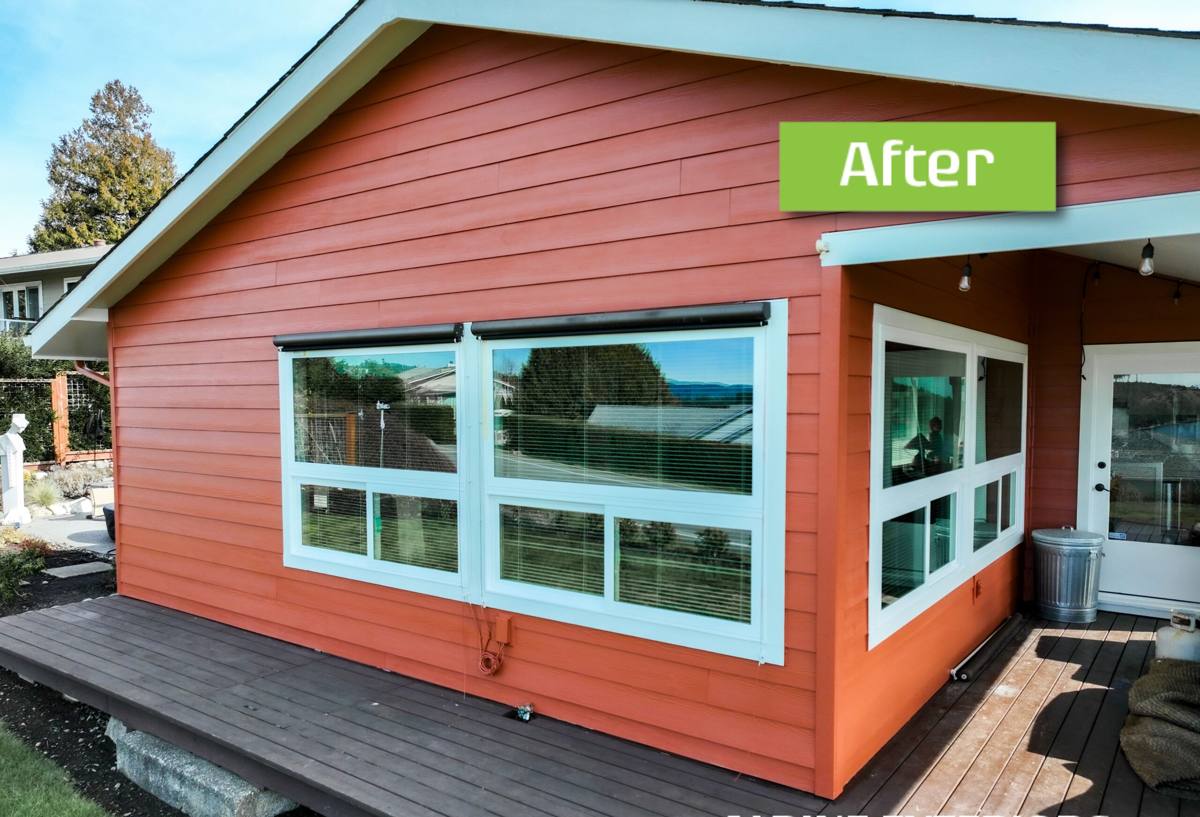
We install James Hardie fiber cement siding exclusively. That's not a marketing position, it's an operational one — we've made the call that in this climate, the material has to be able to absorb moisture cycling without swelling, rotting, or delaminating, and it has to hold its factory finish without homeowners needing to repaint every few years. Fiber cement checks both boxes in a way that wood-based and vinyl products don't, and it's non-combustible, which matters more each summer as wildfire smoke and regional fire risk become a bigger part of Pacific Northwest homeownership.
Hardie's ColorPlus factory finish is baked on and backed by a separate finish warranty, so the color coat isn't riding on how carefully caulk and paint were applied on site. For a shaded, damp lot like a lot of what you find around Sudden Valley, that matters — factory-cured finishes hold up to prolonged moisture contact better than field-applied paint on other substrates.
HZ5 vs. HZ10: Which Belongs on a Sudden Valley Home
James Hardie engineers its siding by climate zone, and Whatcom County sits solidly in the wet, moderate-freeze Pacific Northwest zone. In practice that means we're specifying HZ5 products for most Sudden Valley installs — engineered for moisture and moderate freeze-thaw cycling rather than extreme heat or arid conditions. Getting the zone-matched product right is a small decision on paper that has a large effect on long-term performance.
What a Correct Installation Actually Involves
Fiber cement siding is only as good as the assembly it's part of. A correct install on a Sudden Valley home generally includes:
- Water-resistive barrier inspection or replacement — the house wrap or building paper behind the siding has to be intact and correctly lapped before a single board goes up.
- Rainscreen furring where conditions call for it — a gap behind the siding lets bulk water drain and air circulate, which matters more on shaded, damp elevations than on a sun-exposed south wall.
- Flashing at every penetration and transition — windows, doors, deck ledgers, roof-to-wall intersections, and any other place two materials meet. This is where most real-world siding failures start, not in the field of the wall.
- Correct fastener pattern and blind-nailing or face-nailing per Hardie's published specs — over-driven or misplaced fasteners are one of the most common causes of premature siding failure we see on other people's work.
- Proper clearances — minimum gaps from grade, roofing, decks, and patios so the bottom edge of the siding isn't sitting in standing water or splash-back.
- Factory-cut and factory-primed edges wherever possible, with any field cuts sealed per manufacturer spec so raw fiber cement isn't left exposed to moisture.
Skip or rush any one of these steps and you can still end up with a wall that looks fine from the street for a couple of years — and then doesn't.
Our Process for a Sudden Valley Project
1. On-Site Assessment
We walk the whole exterior, not just the obviously damaged sections. Shaded and north-facing walls, areas near grade, and anything around decks or roof transitions get particular attention, since those are the spots where Sudden Valley's tree cover and rain exposure do the most damage over time.
2. Sheathing and Barrier Check
Before we talk about new siding, we confirm what's underneath the old siding is sound. If there's rot, soft sheathing, or a failed water-resistive barrier, that gets addressed first — new siding over a compromised wall assembly just hides the problem for a while.
3. Product and Color Selection
We help homeowners pick the right Hardie product line and climate-zone rating for their specific lot, plus a ColorPlus finish that suits the home and holds up to the moss and mildew conditions common in shaded parts of the neighborhood.
4. Installation to Manufacturer Spec
Our crews install to James Hardie's published fastening, clearance, and flashing requirements — not shortcuts that speed up the job but shift risk onto the homeowner five or ten years down the road.
5. Final Walkthrough
We go over caulking, trim details, and clearances with the homeowner before calling the job done, so there are no surprises.
Comparing Siding Approaches for This Climate
| Factor | James Hardie Fiber Cement | Vinyl | Wood-Based (LP-type / cedar) |
|---|---|---|---|
| Moisture tolerance | Engineered for wet climates, won't rot or swell | Water-resistant but can trap moisture behind panels | Vulnerable to rot and swelling without diligent maintenance |
| Finish durability | Factory ColorPlus finish, separate finish warranty | Color molded through material, but can fade and chalk | Field-applied paint/stain, needs repainting cycles |
| Combustibility | Non-combustible | Combustible, can melt/deform near heat | Combustible |
| Moss/algae resistance | Good with correct install and clearances | Can trap moisture that feeds growth | Prone to moss and mildew in shaded, damp areas |
| Typical maintenance | Occasional wash, minimal upkeep | Low maintenance but can crack in impacts | Regular inspection, recaulk, and repaint cycles |
Signs a Sudden Valley Home May Need New Siding
Given how gradual siding failure usually is, a lot of homeowners don't notice a problem until it's well underway. Watch for:
- Soft or spongy spots when you press on the siding, especially near the bottom courses or under windows.
- Persistent green or black staining that comes right back after cleaning, particularly on shaded or north-facing walls.
- Peeling, bubbling, or chalking paint on wood-based siding that keeps returning within a year or two of repainting.
- Visible gaps, warping, or cupping in individual boards or panels.
- Interior clues — musty smells, peeling interior paint, or damp drywall on exterior-facing walls — that can point to moisture getting in behind the siding.
Any one of these is worth a closer look. Several at once usually means the water-resistive barrier or flashing details have already been compromised, not just the surface material.
Timing a Project Around the Weather
In Whatcom County, siding work generally goes better outside the heaviest of the winter storm months, but a well-run crew can work through most of the year with the right sequencing and weather protection. For Sudden Valley specifically, where tree cover keeps some walls damp longer after a storm, we pay attention to drying time between removing old siding and sealing up the wall with new barrier and boards — rushing that step in a shaded, wet-prone spot is exactly how moisture gets sealed in rather than kept out.
Why a Local Crew Matters Here
Siding installation isn't a one-size-fits-all trade. A crew that mostly works dry, open lots on the east side of the state will make different — and sometimes wrong — assumptions about rainscreen gaps, flashing details, and clearance heights than a crew that works Whatcom County's wet, shaded, salt-air conditions every week. Working in and around Sudden Valley regularly means we already know which elevations tend to hold moisture, which details fail first in this climate, and how to build a wall assembly that's still doing its job in twenty years, not just five.
If you're weighing a siding project for a Sudden Valley home, we're glad to come take a look, walk the exterior with you, and give you a straight assessment — no pressure, no hard sell. Reach out through the form below to get a free estimate.