 Ferndale
 Siding Replacement in Sudden Valley: What Local Homes Are Up Against
Homes in and around Sudden Valley deal with a specific combination of weather that's harder on siding than most homeowners realize. Whatcom County's marine-influenced climate means long stretches of driving rain, heavy tree cover that keeps siding shaded and damp longer after storms, and a moss season that can run from fall through spring. Add in salt-laden air moving in off the coast during wind events, and you've got conditions that expose weak siding systems fast — usually starting at the seams, the trim edges, and the lower courses closest to grade and landscaping.
We install siding throughout Ferndale and the surrounding Whatcom County communities, and Sudden Valley comes with its own pattern of wear. Wooded lots and lake-proximity setups mean less direct sun to dry siding out between storms, more standing moisture in shaded corners, and more organic growth — moss, algae, lichen — creeping into anything that isn't dense and properly finished. If your siding is more than 15-20 years old and showing dark streaking, soft spots, or paint that won't hold anymore, it's worth a real inspection before another wet season sets in.
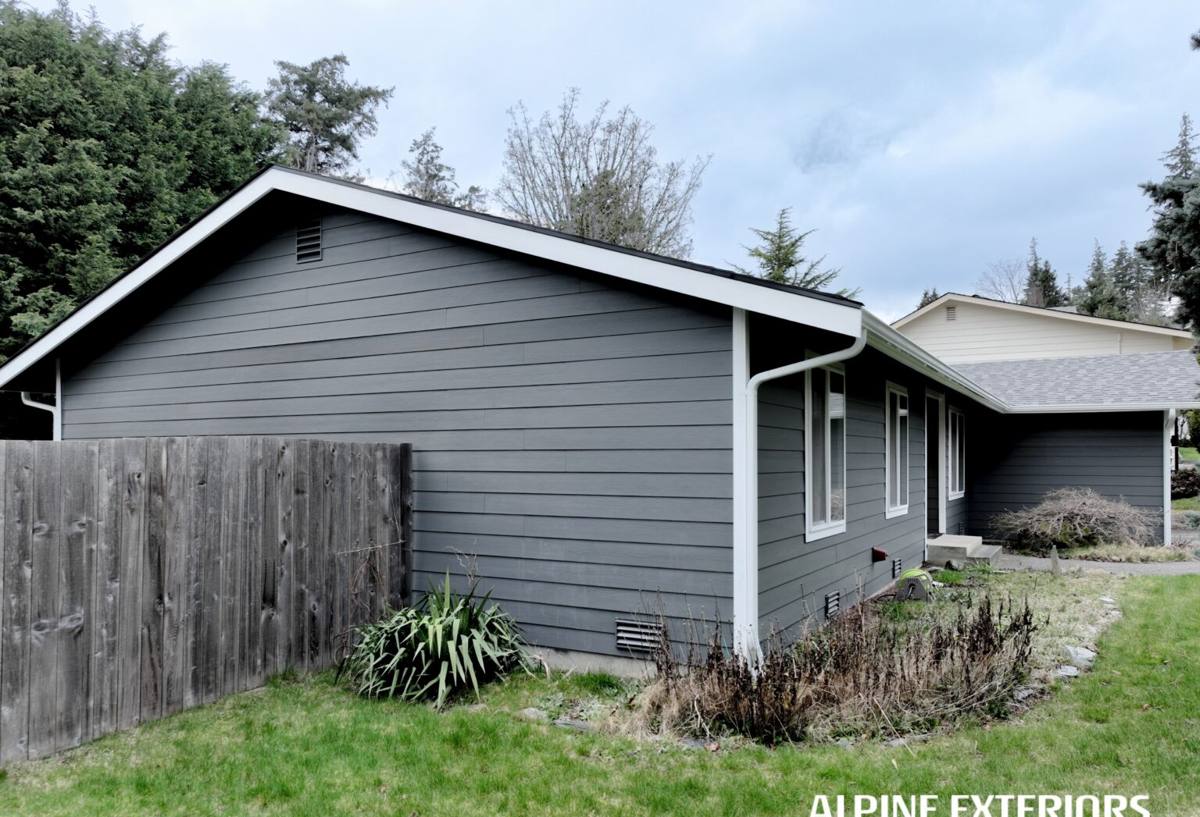
How to Tell When Replacement Beats Repair
Not every siding problem means a full tear-off. But in a climate like this, cosmetic issues often mask something structural underneath. Here's how we sort it out on a typical Sudden Valley inspection:
- Soft or spongy panels when pressed — usually means moisture has already reached the wood sheathing behind the siding, not just the surface
- Persistent moss or algae that comes back within a season of cleaning, especially on north-facing or shaded walls
- Cracked, bowed, or delaminating panels — common on older wood composite or untreated wood siding after repeated wet-dry cycles
- Paint failure that returns within 2-3 years of repainting, a sign the substrate underneath is no longer holding a finish properly
- Visible gaps at seams and trim where caulking has failed and water has a direct path behind the cladding
If you're seeing two or more of these, especially on a shaded elevation, a section-by-section repair usually just delays a full replacement — and can waste money re-patching a wall that needs to come off anyway.
Why We Only Install James Hardie Fiber Cement
We made a decision a while back to install one siding system, on every job, no exceptions: James Hardie fiber cement. We don't install vinyl, LP SmartSide, primed wood, cedar, or other fiber cement brands like Cemplank or Allura. That's not a marketing line — it's a standard we hold because of what we've seen happen to the alternatives in exactly this kind of climate.
Vinyl siding is affordable and low-maintenance in dry climates, but it expands and contracts significantly with temperature swings, its seams rely on lap joints that can loosen over time, and it doesn't hold paint if a homeowner ever wants to change the color. Engineered wood products like LP SmartSide perform reasonably well when installation and maintenance are followed exactly to spec, but they're wood-based, meaning any breach in the factory finish gives moisture a path into a material that swells and degrades once wet. In a region with this much sustained rain and shade-driven dampness, that margin for error is thinner than we're comfortable with.
Other fiber cement brands aren't bad products — they're just not what we've standardized our crews, warranty process, and installation details around. James Hardie's HZ5 product line is specifically engineered for climates with heavy moisture exposure, its ColorPlus factory finish is baked on rather than field-applied, and the company backs it with a strong, transferable limited warranty. For a house in Sudden Valley that's going to spend a good part of the year wet, we think that margin matters.
What James Hardie Gets Right for This Area
- Fiber cement is non-combustible, which matters given regional wildfire smoke and ember exposure concerns in late summer
- It doesn't rot, swell, or provide a food source for the organic growth that thrives in shaded, damp environments
- ColorPlus factory-applied finish resists fading and holds up to repeated wet-dry cycling far better than field-applied paint on wood substrates
- HZ5 boards are engineered specifically for climates with sustained moisture exposure, which describes this part of Whatcom County well
What a Correct Siding Replacement Actually Involves
A siding replacement is only as good as what happens underneath it. On every Sudden Valley project, our process covers the same core steps regardless of the home's size or age:
1. Tear-off and inspection
We remove the existing siding down to the sheathing and inspect for hidden water damage — soft sheathing, rot at window and door openings, or compromised framing. This is where a lot of long-term problems get found and fixed before they're sealed back up behind new siding.
2. Weather-resistive barrier and flashing
A properly lapped weather-resistive barrier and correctly integrated flashing at windows, doors, and roof intersections matters more in this climate than almost anywhere else in the state. Flashing details are where most premature siding failures actually originate — not the siding material itself.
3. Rainscreen or drainage plane where appropriate
On shaded, moisture-heavy walls — which describes a lot of tree-covered Sudden Valley lots — a drainage gap behind the siding gives any moisture that gets past the cladding somewhere to go, rather than sitting against the sheathing.
4. Hardie installation to manufacturer spec
Correct fastener placement, proper gapping at butt joints, factory-cut edges sealed per manufacturer instruction, and manufacturer-approved caulking at penetrations. Installed off-spec, even the best siding product underperforms — this is exactly why we run dedicated crews trained specifically on Hardie installation rather than treating it as interchangeable with other claddings.
5. Trim, caulking, and final detail work
The visible finish work — corner boards, trim profiles, caulking lines — is also functional, not just cosmetic. Done sloppily, it's the first place water finds a way in.
Comparing Siding Options for a Sudden Valley Home
| Factor | Vinyl | Engineered Wood (LP SmartSide) | James Hardie Fiber Cement |
|---|---|---|---|
| Moisture tolerance in shaded/wet conditions | Moderate — seams can loosen over time | Depends heavily on maintaining factory finish | Engineered for high-moisture climates (HZ5) |
| Resistance to moss/algae growth | Can grow on surface, doesn't feed it | Wood-based substrate more susceptible if finish is breached | Dense fiber cement resists organic growth |
| Fire resistance | Combustible | Combustible (wood-based) | Non-combustible |
| Finish longevity | Can fade, cannot be repainted easily | Field-applied or factory finish, wears over time | Factory-baked ColorPlus finish, long-lasting |
| Typical lifespan when installed to spec | 20-30 years | 20-30 years | 30-50+ years |
Cost Factors for a Sudden Valley Siding Replacement
Every home is different, but a few things consistently move the price on a job in this area:
- Extent of hidden damage found during tear-off — repairing rotted sheathing or framing adds cost but is far cheaper than leaving it and reworking siding again in a few years
- Home size, elevation count, and trim complexity — homes with more gables, dormers, and cut-ins take more labor per square foot
- Access and lot conditions — wooded or sloped lots, common in Sudden Valley, can affect staging and material handling
- Whether a rainscreen/drainage plane is added — a worthwhile upgrade on shaded, moisture-prone walls
- Panel style and finish selection — lap siding, panel systems, and trim details all price slightly differently
We give straightforward, itemized estimates so you know exactly what's driving the number, not a flat per-square-foot figure that hides what's actually being done.
Why It Matters That We Already Work in This Area
Siding installation isn't one-size-fits-all across Whatcom County. A crew that mostly works dry, open-lot subdivisions may not think twice about drainage detailing that a shaded, tree-covered Sudden Valley lot actually needs. We work across Ferndale and the surrounding communities regularly enough to know which details are optional in some settings and non-negotiable in others — and moisture management on a shaded lake-area lot falls firmly in the second category.
That local familiarity also shows up in smaller ways: knowing how a home's specific exposure to wind and rain direction should factor into flashing details, and having a realistic sense of how long a project should take given the region's weather windows rather than promising a timeline that only works in dry climates.
What to Expect From Our Process
- An on-site inspection where we look at your current siding, check for hidden moisture damage, and assess your home's specific exposure
- A written, itemized estimate covering material, labor, and any sheathing or moisture-barrier work identified
- A clear project timeline that accounts for realistic weather windows in this region
- Tear-off, inspection, and repair of any hidden damage before new siding goes on
- Installation of James Hardie fiber cement to manufacturer specification, including proper flashing and drainage detailing
- A final walkthrough so you know exactly what was done and what your warranty covers
If your Sudden Valley home's siding is showing its age, we're happy to take a look and give you a straightforward, no-pressure estimate — fill out the form below and we'll get in touch.