 Ferndale
 Blaine's Waterfront Climate Puts Real Stress on Siding
Blaine sits right on the water in northern Whatcom County, and that location shapes what siding has to survive here. Homes close to Drayton Harbor, Semiahmoo Bay, and Boundary Bay take on salt-laden air that ordinary siding materials aren't built to handle. Add in driving rain off the water, wind-driven moisture that finds every gap in a wall assembly, and a moss season that can stretch from fall through spring, and you've got a climate that punishes shortcuts.
Salt air is corrosive to metal fasteners and trim, and it accelerates the breakdown of paint films and less durable siding substrates. Combine that with near-constant dampness for months at a time, and you get the classic Pacific Northwest siding failures: swelling, delamination, soft spots at the bottom courses, and moss or algae staining that never fully washes off. None of this is unique to Blaine, but the combination of coastal salt exposure and heavy regional rainfall makes it more aggressive here than in drier inland parts of Whatcom County.
That's the backdrop for every siding installation we do in Blaine. The material choice and the installation details both have to account for a wall that will spend a large part of the year wet, salty, and exposed to wind.
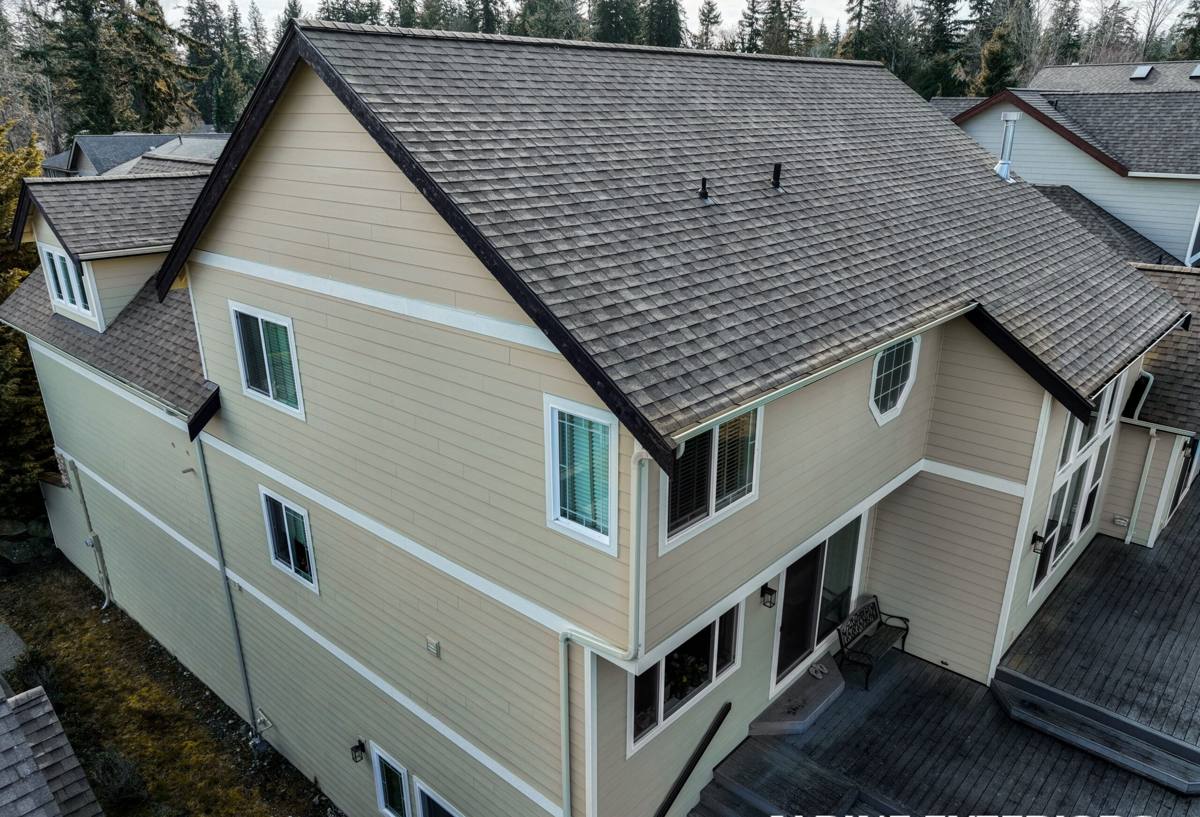
What Correct Siding Installation Actually Involves
Siding installation isn't just fastening panels to a wall. In a coastal, high-rainfall climate like Blaine's, most siding failures trace back to what's happening behind the siding, not the siding itself. A correct installation gets these fundamentals right:
Weather-Resistive Barrier and Drainage
Every wall needs a continuous water-resistive barrier installed with proper shingle-lap sequencing, so water is always directed outward and down, never trapped behind the cladding. Behind that, a drainage gap (rainscreen) gives any moisture that does get past the siding a path to escape instead of sitting against the sheathing.
Flashing at Every Penetration
Windows, doors, hose bibs, light fixtures, and vents are the places siding fails first, because each one is a break in the water barrier. Correct flashing detail at every one of these penetrations — not just caulk — is what keeps wind-driven rain from working its way behind the siding over years of exposure.
Fastener Choice and Placement
In a salt-air environment, fastener corrosion resistance matters more than it does inland. Using the wrong fastener, or driving it wrong (overdriven, underdriven, or into the wrong substrate), shows up years later as streaking, loose panels, or nail pops.
Proper Clearances
Siding installed too close to grade, decks, roof lines, or hardscaping stays wet longer and is more prone to moisture damage and moss growth. Maintaining the manufacturer's minimum clearances is a small detail that has an outsized effect on how the siding holds up.
Get any one of these wrong and the siding can look fine for a few years before problems show up — which is exactly why installation quality matters as much as the product itself.
Why We Install James Hardie Fiber Cement — and Nothing Else
We install James Hardie fiber cement siding exclusively. We don't install vinyl, LP SmartSide, or primed wood siding, and that's a deliberate standard, not a limitation on what we're capable of. Here's the reasoning, specific to a climate like Blaine's:
- Non-combustible: Fiber cement doesn't burn, melt, or warp from radiant heat the way vinyl does, which matters as wildfire smoke and heat events become more common regionally.
- Engineered for wet climates: James Hardie makes climate-specific product lines, and the versions used in western Washington are engineered for high-moisture, high-humidity conditions like Blaine's — not a generic national product.
- Factory-applied ColorPlus finish: The finish is baked on at the factory under controlled conditions, which holds up better against UV and salt exposure than field-applied paint, and comes with its own finish warranty.
- Dimensionally stable: Fiber cement doesn't swell, cup, or rot the way wood-based products can when they take on repeated moisture cycles through a wet Pacific Northwest winter.
- Strong transferable warranty: When installed to spec, Hardie's product warranty is one of the strongest in the industry and can transfer to a new owner, which matters for resale in a coastal market.
We're not going to pretend other products are without merit — vinyl is inexpensive and low-maintenance in mild climates, and cedar has a look some homeowners love. But in a salt-air, high-rainfall environment, we've seen enough of how those materials age here that we no longer put them on a Blaine home, even when a customer would prefer the lower upfront cost.
How Fiber Cement Compares in a Coastal Climate Like Blaine's
| Material | Salt Air Durability | Moisture Behavior | Fire Resistance | Typical Maintenance |
|---|---|---|---|---|
| James Hardie Fiber Cement | Strong — factory finish resists salt-driven fading and chalking | Dimensionally stable, does not swell or rot | Non-combustible | Occasional wash; repaint only if desired after 15+ years |
| Vinyl | Fair — can chalk, warp, or fade faster near salt water | Can warp with heat/cold cycling; seams allow water intrusion | Melts/deforms under heat | Low, but replacement panels can be hard to color-match later |
| Primed Wood / LP SmartSide | Weak to fair — finish and edges are the failure point | Prone to swelling, delamination at cut edges if moisture gets in | Combustible | Regular repainting and edge sealing required |
| Cedar | Moderate — natural rot resistance but finish needs upkeep | Absorbs and releases moisture; needs consistent sealing | Combustible | Frequent staining/sealing to prevent graying and rot |
This isn't a blanket condemnation of the alternatives — it's an honest look at how each material tends to perform specifically in a wet, salty, coastal environment like Blaine's over a 15-20 year span.
Our Installation Process
Every Blaine project follows the same process, whether it's a full re-side or a targeted section replacement:
- On-site assessment: We inspect the existing siding, sheathing, and trim to catch any hidden moisture damage before it's covered up again.
- Detailed estimate: You get a clear scope of work, product selection, and cost breakdown — no vague allowances.
- Prep and protection: Landscaping, walkways, and windows are protected before removal begins.
- Removal and sheathing repair: Old siding comes off, and any water-damaged sheathing or framing is repaired, not covered over.
- Water-resistive barrier and drainage plane: Installed to manufacturer spec with correct lapping and a functioning drainage gap.
- Flashing at all penetrations: Windows, doors, and fixtures get proper flashing before siding goes on.
- Hardie installation: Panels or lap siding installed with correct fastener spacing, clearances, and joint treatment.
- Final walkthrough: We review the completed work with you and confirm everything meets both our standard and manufacturer requirements for the warranty to apply.
Signs Your Current Siding May Be Failing
Because Blaine's climate accelerates siding problems, it's worth knowing what to look for before small issues become structural ones:
- Soft or spongy spots when you press on the siding, especially near the bottom courses
- Persistent moss, algae, or dark streaking that returns shortly after cleaning
- Visible gaps, warping, or buckling panels
- Peeling or bubbling paint, particularly around seams and trim
- Rising energy bills that suggest the wall assembly is no longer sealing properly
- Cracking or chalking that exposes the substrate underneath
- Musty smells or visible staining on interior walls that back up to exterior siding
Any one of these on its own may not be urgent, but a few together usually mean the water-resistive barrier or flashing behind the siding has already failed, and it's worth having it looked at before the damage spreads to the framing.
Why a Crew That Already Works in Blaine Makes a Difference
Siding installation done by a crew that only occasionally works this far north misses details that are second nature to a crew that works Whatcom County's coastal areas regularly. Knowing how aggressively moss establishes itself on a north-facing wall near the water, how much clearance to leave near landscaping that stays damp longer, and which details tend to fail first in a Blaine winter isn't something you learn from a manual — it's something you learn from doing the work here repeatedly.
We're based in Ferndale and work throughout Whatcom County, including Blaine, on a regular basis. That means we're not learning the local climate on your project — we already know what it takes for siding to hold up on a home exposed to salt air and driving rain year after year, and we build the installation around that reality from the start.
What to Expect for Timeline and Upkeep
Most single-family siding replacements take a few days to a couple of weeks depending on the size of the home, how much repair work is needed underneath the old siding, and weather windows — which matter more in a region where extended dry stretches aren't guaranteed. Once James Hardie siding is installed correctly, upkeep is minimal: periodic washing to keep moss and salt residue from building up, and an occasional check of caulking at penetrations. There's no repainting cycle to plan around like there is with wood or field-finished materials.
If you're weighing a siding replacement or repair on a Blaine home, we're happy to take a look and give you a straightforward, no-pressure estimate — including an honest read on whether repair or full replacement makes more sense for your situation. Use the form below to get started.