 Ferndale
 Why Birch Bay Roofs Wear Out Faster Than You'd Expect
Birch Bay sits right on the water, and that changes what a roof has to deal with compared to a home a few miles inland. Salt-laden air moves off the bay and settles on every exposed surface, including your roofing material and the metal flashing, fasteners, and vents that hold a roof system together. Add in wind-driven rain that comes in sideways during winter storms, plus the shade and moisture that fuel a long moss season across Whatcom County, and you have a climate that's genuinely tougher on a roof than most manufacturers' warranty testing accounts for.
None of this means a roof in Birch Bay is doomed to fail early. It means the installation has to be done with the coastal exposure in mind from the first layer of underlayment to the last cap shingle. A roof installed the same way you'd install one in a dry inland climate will show its age faster here — corroding fasteners, curling shingle edges, and moss creeping under the shingle courses within a handful of years instead of a couple of decades.
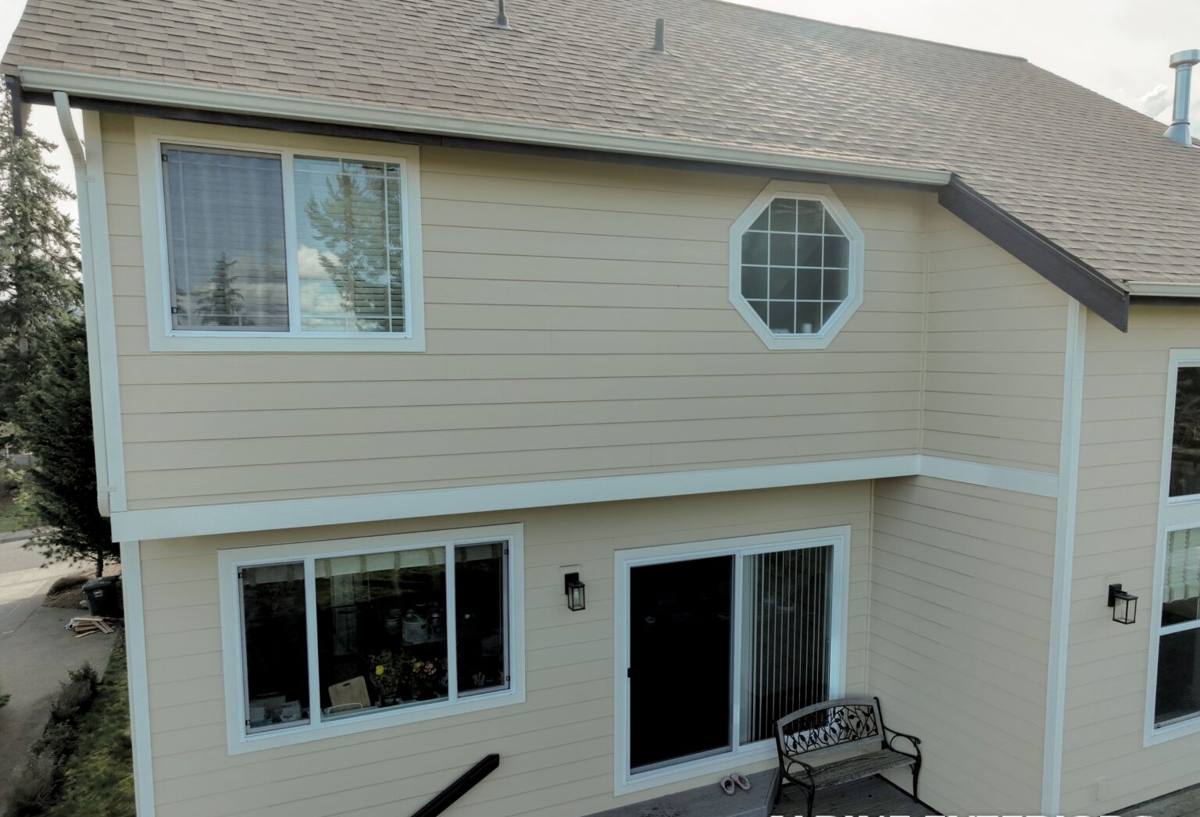
What Salt Air, Wind-Driven Rain, and Moss Actually Do to a Roof
Salt Air and Corrosion
Salt is hygroscopic — it pulls moisture out of the air and holds it against whatever it lands on. On a roof, that means galvanized fasteners, cheap flashing, and unprotected metal components corrode faster than they would even a short distance inland. Once a nail head or a flashing seam starts to rust, it stops sealing properly, and water finds its way underneath the roofing material.
Wind-Driven Rain
Straight-down rain is easy for any roof to shed. Rain that's being pushed sideways by wind off the bay behaves differently — it can work its way up under shingle tabs, around vent boots, and into any gap in flashing that a calmer climate would never expose. This is why lap direction, fastener placement, and underlayment overlap matter more here than they do in sheltered inland neighborhoods.
Moss and Algae
Western Washington's damp, shaded conditions are close to ideal for moss, and Birch Bay's tree cover and marine humidity add to it. Moss holds moisture against the roofing surface, works its root structure into shingle granules and seams, and lifts shingle edges as it grows. Left unaddressed, it shortens the usable life of a roof by years and can hide leaks until they've already caused interior damage.
What a Correctly Installed Roof Includes
A new roof is more than shingles nailed to plywood. In a coastal, high-moss environment like Birch Bay, every layer of the system earns its place:
- Deck inspection and repair — any soft, delaminated, or water-stained sheathing gets replaced before new material goes down, not covered over.
- Synthetic underlayment — a water-resistant barrier across the full deck, with extra protection at eaves, valleys, and any low-slope transitions where wind-driven rain collects.
- Ice and water shield at vulnerable points — valleys, roof-to-wall transitions, chimneys, and skylights get self-adhering membrane, not just felt or synthetic underlayment alone.
- Corrosion-resistant fasteners and flashing — stainless or coated fasteners and properly formed step, valley, and counter-flashing suited to salt exposure.
- Balanced ventilation — matched intake at the eaves and exhaust at the ridge, sized to the attic volume, so moisture doesn't get trapped under the deck.
- Correct shingle or panel installation — proper nail placement, exposure, and starter course so every course sheds water into the one below it, not sideways into it.
- Moss-resistant details at install — algae-resistant roofing material and, where appropriate, zinc or copper strips near the ridge to inhibit regrowth.
Skip any one of these and the roof will likely still look fine on install day. The failures show up two, five, or ten years later — usually as a leak, not as an obvious defect you could have caught by looking at it.
Choosing a Roofing Material for a Bay-Front Climate
There's no single "best" roofing material for every home — it depends on your roof's slope, your home's style, your budget, and how much maintenance you're willing to do. Here's how the common options compare for a Birch Bay property specifically:
| Material | Salt-Air Performance | Moss Resistance | Typical Lifespan Here |
|---|---|---|---|
| Architectural asphalt shingle (algae-resistant) | Good, with corrosion-resistant fasteners | Good — copper-infused granules slow moss/algae growth | 20-30 years |
| Standard 3-tab asphalt shingle | Fair — thinner profile wears faster | Poor without added protection | 15-20 years |
| Standing seam metal | Excellent with proper coating | Excellent — moss struggles to grip smooth metal | 40-50+ years |
| Cedar shake | Fair — needs regular maintenance near salt air | Poor — organic material feeds moss without upkeep | 20-25 years with maintenance |
We don't install every product on this list on every home, and that's intentional. Cedar shake, for example, can look excellent, but it's an organic material that requires consistent upkeep to resist moss and moisture in a climate like this — if a homeowner isn't planning on that maintenance schedule, we'll say so up front rather than sell a product that will disappoint them in year six. Our default recommendation for most Birch Bay homes is an algae-resistant architectural shingle or, for homeowners who want the longest possible service life and lowest maintenance, standing seam metal.
Building Moss Prevention Into the Installation
Moss prevention works best when it's designed into the roof, not bolted on afterward. A few things we account for during installation:
Material choice. Algae- and moss-resistant shingles have copper or zinc granules embedded in the surface, which slowly release ions that inhibit moss and algae growth over the life of the roof.
Zinc or copper strips. Installed near the ridge, these let rainwater carry trace metal ions down the roof face each time it rains — which, in this climate, is often — creating an environment moss doesn't like.
Tree and shade awareness. We can't move your trees, but we do factor in shade patterns when discussing maintenance expectations, since the shadiest sections of a roof are almost always the first to show moss regrowth.
Ventilation. A roof that vents properly dries out faster after rain, which matters more in a marine climate that rarely gets a long dry stretch to naturally dry things out.
None of this makes a roof moss-proof forever — Whatcom County's climate is simply too favorable to moss for any product to guarantee that. What it does is meaningfully extend the time between when moss becomes cosmetic and when it becomes a maintenance problem.
Our Installation Process
- On-site inspection and estimate. We assess your current roof, deck condition, ventilation, and any problem areas specific to your home's exposure to wind and salt air, then walk you through material options honestly.
- Tear-off and deck inspection. Old roofing comes off completely so we can inspect the sheathing underneath — this is where hidden moisture damage from a failing roof usually shows up.
- Deck repair. Any damaged sheathing is replaced before anything new goes down.
- Underlayment and flashing. Water-resistant underlayment goes down across the full deck, with self-adhering membrane at valleys and transitions, and new flashing at every penetration and roof-to-wall connection.
- Ventilation check and correction. We confirm intake and exhaust venting is balanced for your attic, correcting it if the existing setup is inadequate.
- Roofing material installation. Shingles or panels go on per manufacturer specification, with attention to nailing pattern, exposure, and coastal-grade fasteners.
- Cleanup and final walkthrough. Site is cleared of debris and nails, and we walk the finished roof with you before calling the job done.
Signs Your Birch Bay Home May Need a New Roof
Roofs rarely fail all at once — they give warning signs first. Worth a look if you notice:
- Shingles that are curling, cupping, or losing granules faster than they used to
- Moss buildup that returns quickly after cleaning, especially on shaded or north-facing slopes
- Rust streaks around vent pipes, flashing, or metal fasteners
- Daylight visible through the attic decking, or damp insulation after a storm
- Shingles missing or lifted after a windy, wet weather event
- A roof that's approaching or past its material's expected service life, regardless of visible damage
If your roof is showing more than one of these, it's usually more cost-effective to plan a full replacement than to keep patching — repeated repairs on an aging roof rarely add up to less than a properly installed new one.
What Drives Cost on a Birch Bay Roof Replacement
| Factor | Why It Matters Here |
|---|---|
| Roof size and pitch | More steep or complex rooflines mean more labor and material |
| Material selection | Standard shingle vs. algae-resistant shingle vs. metal changes both material cost and long-term maintenance cost |
| Deck condition | Hidden moisture damage from a previous failing roof can require sheathing repair or replacement |
| Ventilation upgrades | Older homes often need intake or exhaust venting corrected to meet current standards |
| Flashing and penetrations | Chimneys, skylights, and multiple roof-to-wall transitions add detail work |
| Access and site conditions | Waterfront lots, steep driveways, or limited staging space can affect labor time |
We won't quote a number without seeing the roof — anyone who does is guessing. What we can tell you honestly is that the cheapest bid is rarely the cheapest roof over a ten- or twenty-year span, especially in a climate this hard on corrosion-prone materials.
Why Local Installation Experience Matters in Birch Bay
A crew that's worked roofs throughout Ferndale and along the Whatcom County shoreline has already seen how salt air, coastal wind patterns, and moss behave on homes like yours — not in a training manual, but on actual roofs a few miles from your own. That experience shows up in small decisions during installation: where to add extra underlayment protection, which fastener grade holds up near the water, and where moss is most likely to return based on how the sun and shade move across a bay-front lot through the seasons. It's the difference between a roof that's technically installed to code and one that's installed for the specific conditions it has to survive.
If your roof in Birch Bay is showing its age or you're planning ahead for a replacement, we're happy to take a look and give you a straightforward, no-pressure estimate. Use the form below to get started.