 Ferndale
 Why Board & Batten Fits Nooksack-Area Homes
Board and batten has become one of the most requested siding styles in the Nooksack area of Ferndale, and it's easy to see why. The vertical lines read as clean and modern on newer builds, but the same profile also reads as classic farmhouse or craftsman on older homes and outbuildings. Homeowners often choose it for a full elevation, or use it as an accent on a gable, dormer, or entry bay next to horizontal lap siding elsewhere on the house. Either way, it's a distinctive look that stands out from the lap siding on most of the block.
What doesn't get talked about enough is that board and batten is a different animal from lap siding when it comes to keeping water out of a wall. The vertical orientation, the extra layer of battens, and the additional seams all change how the assembly has to be built. Get those details right and you get a siding system that looks sharp for decades. Get them wrong and you get a good-looking wall with a moisture problem hiding behind it.
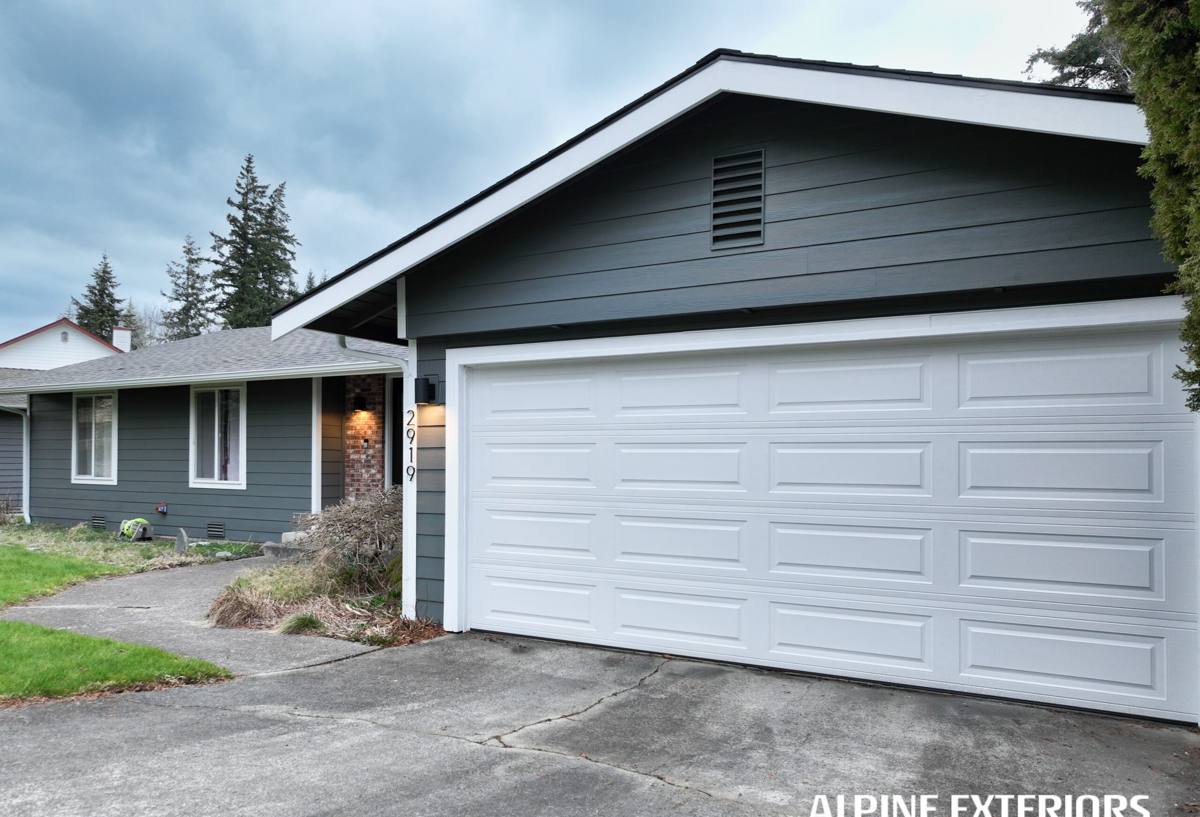
What Whatcom County's Climate Does to Vertical Siding
Nooksack and the rest of Ferndale sit in a stretch of Whatcom County where three climate factors show up on exterior siding faster than almost anywhere else in the state: salt air, driving rain, and a moss season that runs most of the year.
Salt Air
Proximity to the Salish Sea means airborne salt is a constant, low-level presence on this side of the county. Salt is corrosive to fasteners and hard on finishes that aren't built to handle it. On a board and batten wall, the battens themselves are the most exposed part of the assembly — they sit proud of the field panel and catch wind-driven salt spray directly.
Driving Rain
Storms coming off the water don't just fall straight down here — they come in sideways. That matters a lot on a vertical siding style, because every horizontal seam (the bottom edge of a board, the top of a batten cap, a butt joint at a story break) is a spot where wind-driven rain can be pushed upward and inward instead of just running down and off.
A Long Moss Season
Mild, wet winters and shaded lots near trees and riverbank vegetation give moss and algae a long runway to establish on north-facing and shaded walls. Once organic growth gets a foothold in a seam or at the base of a batten, it holds moisture against the substrate long after the rain has stopped — which is exactly the condition that causes rot in wood-based products and staining on lower-grade finishes.
Where Board & Batten Installations Go Wrong
Most board and batten failures we get called out to inspect aren't failures of the siding material — they're failures of the details around it. The pattern repeats often enough that it's worth spelling out plainly:
- No drainage gap behind the battens. Battens installed flat against the field panel with no rainscreen space trap moisture instead of letting it drain and dry.
- Caulk doing a fastener's job. Relying on sealant at butt joints and panel seams instead of proper flashing means the joint fails the moment the caulk ages, shrinks, or is applied in the wrong conditions.
- Missing kick-out flashing. Where a roofline meets a board and batten wall, water needs to be diverted away from the siding. Skip this detail and that corner rots first — every time.
- Insufficient ground and deck clearance. Splash-back from grade or a low deck keeps the bottom courses wet far longer than the rest of the wall.
- Unsealed cut edges. Field cuts on any fiber cement product expose raw material that needs to be primed or capped before it's ever left bare against Whatcom County weather.
What a Correct Board & Batten Installation Involves
A board and batten wall that's actually built to last in this climate follows a specific sequence, not just a nailing pattern. Before a single batten goes up, the wall needs:
- A weather-resistive barrier installed and lapped correctly, shingle-style, so every seam sheds water downward
- Flashing at every window, door, and roof intersection, integrated with the barrier rather than just caulked over it
- A rainscreen gap — typically a furring strip or drainable wrap — behind the field panels so any moisture that gets past the surface can drain and the wall can dry
- Correct fastener spacing and type for the specific Hardie product and local exposure, following the manufacturer's published fastening schedule rather than a generic pattern
- Starter strips and proper first-course alignment so the bottom of the wall isn't the weak point
- Primed or factory-finished cut edges on every field cut, with no bare fiber cement left exposed
- Kick-out flashing at every roof-to-wall intersection, without exception
- Batten spacing and fastening that matches the panel width and the manufacturer's spec — not just "even to the eye"
Every one of those items is inspectable after the fact. If a contractor can't walk you through how they're handling each one before they start, that's worth pausing on.
The James Hardie Board & Batten System
We install James Hardie exclusively, and board and batten is one of the styles where the reasoning is easiest to see. Hardie's vertical siding system pairs HardiePanel vertical siding — the flat field panel, available in a few surface textures — with HardieTrim boards used as the battens. Both are fiber cement, engineered and manufactured as a matched system rather than mixed materials from different suppliers.
Fiber cement doesn't absorb and swell the way wood-based panels do, which matters directly for the salt-air and moss conditions described above: it isn't feeding organic growth the way untreated wood substrate can, and it isn't expanding and contracting with every wet-dry cycle in a way that eventually opens up seams. Hardie also builds its products in HZ5 and HZ10 climate-engineered formulations for regions with sustained moisture exposure like the Pacific Northwest, and finishes them with the factory-applied ColorPlus finish — baked on before the boards ever reach a job site, so the color and the moisture barrier are one layer instead of a field-applied coat that will need repainting on its own schedule.
None of that replaces correct installation. Even the best product on the market will fail early if the rainscreen, flashing, and fastening aren't done right. But it does mean the material itself isn't the weak link in a wall that's built correctly — which is the whole reason we standardized on it instead of installing whatever the customer's original quote called for.
Comparing Board & Batten Materials
| Material | Moisture behavior in this climate | Maintenance | Typical lifespan |
|---|---|---|---|
| James Hardie fiber cement | Doesn't absorb moisture or swell; resists moss-related deterioration when installed with proper drainage | Occasional wash; factory finish reduces repainting cycles | Multiple decades with correct install and upkeep |
| Solid or engineered wood | Absorbs moisture at cut edges and joints; prone to rot if drainage or finish fails | Regular repainting/resealing and rot inspection | Shorter, especially in shaded or salt-exposed areas |
| Vinyl board and batten | Doesn't rot, but expands/contracts with temperature and can warp or gap at seams over time | Low, but limited repair options if panels crack or fade | Variable; appearance often degrades before function does |
This table isn't meant to declare every alternative unusable — plenty of homes around Whatcom County have wood or vinyl board and batten that's held up fine. It's meant to show why, when we're the ones specifying and installing the siding, we choose the material that gives the wall the fewest ways to fail in this specific climate.
Our Installation Process for Nooksack-Area Homes
- On-site assessment. We look at wall orientation, tree cover, roofline intersections, and existing moisture damage before quoting anything.
- Barrier and flashing plan. We map out where flashing, kick-outs, and the weather-resistive barrier need to go before ordering material.
- Rainscreen installation. Furring or drainable wrap goes in first, so the field panels never sit flat against a moisture-trapping surface.
- HardiePanel and HardieTrim installation. Field panels and battens go up to Hardie's published fastening schedule for our climate zone, with all cut edges primed or capped.
- Detail work. Window and door flashing, corner treatment, and roofline kick-outs get finished and checked before trim and caulking.
- Final walkthrough. We go over the finished wall with the homeowner, including what routine upkeep looks like going forward.
Why Hiring a Crew That Already Works in Nooksack Matters
Board and batten forgives fewer installation mistakes than lap siding, and this part of Whatcom County forgives fewer installation mistakes than a drier climate would. A crew that's worked walls in the Nooksack area already knows which elevations catch the worst of the wind-driven rain, which lots hold onto moss longest because of tree cover, and where salt exposure tends to hit fasteners and trim hardest. That's not something you can fully substitute with a generic install checklist — it comes from having done the work here before.
It also matters for what happens after installation. A local crew is the one you can actually call if a question comes up two years down the road, and a Ferndale-area company has a direct stake in every wall it puts up being seen by neighbors and repeat customers for years to come.
Maintenance After Installation
A correctly installed Hardie board and batten wall doesn't need much, but "not much" isn't "nothing." Rinse the siding periodically to keep salt residue and organic buildup from accumulating, especially on shaded or north-facing walls where moss is most likely to take hold. Keep gutters clear so overflow isn't running down the wall face, and keep an eye on caulking at trim joints over the years — it's a much smaller part of the water-management system than it is on a wall built without proper flashing, but it's still worth a visual check each season.
If you're weighing board and batten for a home in the Nooksack area, we're happy to walk the property, look at your specific exposure, and put together a straightforward, no-pressure estimate. Use the form below to get started.