 Ferndale
 Siding in Everson Has to Deal With a Lot of Water
Everson sits in the Nooksack River valley, ringed by farmland and heavy tree cover, which means two things every homeowner here already knows: it stays damp for long stretches of the year, and shade plus moisture equals moss. Add in the driving rain that blows through Whatcom County during fall and winter storms, and you've got a climate that is genuinely hard on exterior building materials. Siding here doesn't just get rained on — it gets soaked, shaded, and rarely gets a full day to dry out before the next system rolls through.
That combination is exactly what separates siding that looks fine for five years from siding that actually holds up for thirty. Wood-based products swell and rot where water sits. Vinyl can't stop moss and mildew from taking hold in its seams and laps. Cheaper fiber cement blends without a real factory finish start to show streaking and fading faster than they should. None of that is theoretical — it's the normal wear pattern for exterior siding anywhere in this part of Whatcom County, Everson included.
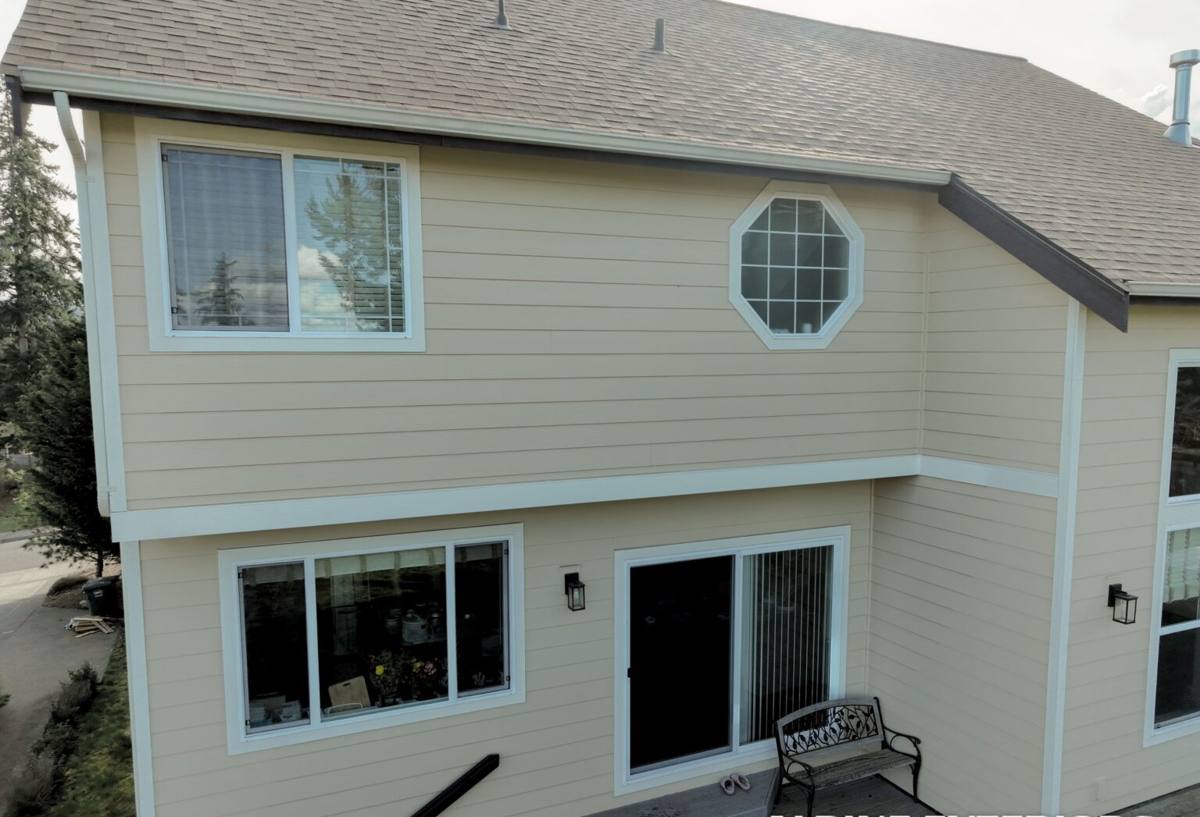
Why We Only Install James Hardie Here
We standardized on James Hardie fiber cement siding for every home we work on in the Ferndale and greater Whatcom County area, and Everson is no exception. It's not brand loyalty — it's what holds up under the specific abuse this region hands out year after year. James Hardie's HZ5 product line is engineered for climates like ours: freeze-thaw cycles, sustained moisture exposure, and long stretches without direct sun to dry things out.
Fiber cement itself is a mix of cement, sand, and cellulose fibers, which makes it dimensionally stable — it doesn't swell, cup, or warp the way wood-based siding does when it takes on moisture. It's also non-combustible, which matters more each year as wildfire season creeps further into the Pacific Northwest's calendar. And with the ColorPlus factory-applied finish, the color is baked on under controlled conditions rather than sprayed on-site, so it resists the fading, chalking, and peeling that field-applied paint jobs are prone to in a wet climate.
What "Climate-Engineered" Actually Means
James Hardie doesn't make one product for the whole country. The HZ5 line sold in our region is formulated specifically for wetter, colder climates, with different moisture and freeze-thaw performance than the HZ10 line sold in the Southeast or the HZ3 line used in dry inland climates. When we spec Hardie for an Everson home, we're using the version of the product actually built for Whatcom County weather — not a generic national blend.
What Correct Installation Actually Involves
James Hardie siding is only as good as the installation behind it. The product itself is engineered to shrug off moisture, but a sloppy install can undo all of that. There are a handful of details that separate a correct Hardie job from one that will cause problems in a few years, and every one of them matters more in a climate as wet as ours.
- Weather-resistive barrier and flashing: A continuous water-resistive barrier goes on before the siding, with proper flashing at every window, door, and roofline intersection so water is directed out and away from the wall assembly, not trapped behind it.
- Correct clearances: Hardie requires specific gaps from grade, roof lines, decks, and other siding-to-trim intersections. Skipping these gaps is one of the most common causes of moisture intrusion and premature rot in the framing behind the siding.
- Fastener pattern and type: Hardie specifies fastener type, spacing, and embedment depth. Using the wrong nails or gun settings can crack boards, cause fastener corrosion, or let the siding work loose over time.
- Joint and seam treatment: Butt joints need to be properly flashed or caulked with a compatible sealant, and seams should be planned to shed water, not collect it.
- Panel and lap siding orientation: Overlaps need to be sized correctly so wind-driven rain — which Whatcom County gets plenty of — can't get pushed up and under the board above it.
Every one of these is spelled out in James Hardie's own installation manual, and every one of them is something a crew can technically skip and still have the siding "look" finished on install day. The problems show up two, five, or ten years later — usually as trapped moisture, rot in the sheathing, or premature finish failure that isn't covered under warranty because the installation didn't meet spec.
How We Approach a Job in Everson
1. On-Site Assessment
We start by walking the home and looking at what's actually happening with the existing siding — where moisture is getting in, where moss and mildew are established, and what the underlying sheathing and trim look like once we get past the surface. This tells us whether we're dealing with a straightforward re-side or whether there's water damage that needs to be addressed before new siding goes on.
2. Prep and Substrate Check
Old siding comes off, and we inspect the sheathing and framing underneath. Any soft or rotted material gets addressed before anything new goes up — installing James Hardie over a compromised substrate just hides the problem, it doesn't fix it.
3. Weather Barrier and Flashing
This is the step that determines how the home performs in a wet winter five years from now, not just how it looks on install day. We install a continuous water-resistive barrier and properly integrated flashing at every penetration and transition.
4. Installation to Manufacturer Spec
Panels or lap boards go up following James Hardie's clearance, fastening, and seam requirements exactly. This is also where a crew's experience with the product shows — cutting, fitting, and fastening fiber cement correctly takes practice, and it's not identical to working with wood or vinyl.
5. Trim, Caulking, and Final Walkthrough
Trim and caulking get finished with compatible, paintable products, and we walk the completed job with the homeowner before calling it done.
Comparing Siding Options for a Home Like Yours
| Material | Moisture Behavior in Wet Climates | Moss/Mildew Resistance | Typical Lifespan (Correctly Installed) |
|---|---|---|---|
| James Hardie Fiber Cement | Dimensionally stable; doesn't swell or rot | Non-organic surface resists mildew growth | 30+ years |
| Vinyl | Can warp/buckle with heat and wind; seams trap moisture | Moss and mildew take hold in laps and seams | 15-25 years |
| Primed Wood/Cedar | Absorbs water; prone to swelling and rot without diligent upkeep | Organic material, moss-prone in shaded/damp settings | 10-20 years, upkeep-dependent |
| LP SmartSide | Engineered wood strand; better than raw wood but still moisture-sensitive at cut edges | Requires diligent edge sealing to resist moisture and moss | 20-30 years, install-sensitive |
This isn't a knock on every alternative — vinyl and engineered wood both have a place, and each does some things well. But for a home in a river-valley, tree-shaded, high-rainfall environment like Everson, the moisture and moss performance of fiber cement is the deciding factor for us, which is why it's the only product we put our name behind.
What Drives Cost on a Real Project
| Factor | Why It Matters |
|---|---|
| Home size and wall complexity | More corners, dormers, and trim details mean more cutting, fitting, and flashing work |
| Current siding removal and substrate repair | Rot or water damage found underneath adds carpentry time before new siding goes on |
| Product line and profile | Lap, panel, and shingle-style Hardie products carry different material and labor costs |
| Color and finish | Factory ColorPlus finishes vs. site-painted primed board affect both cost and long-term maintenance |
| Access and site conditions | Tree cover, slope, and driveway access around Everson properties can affect staging and labor time |
We don't quote a job without seeing it — every home's trim detail, substrate condition, and access is different, and that's what actually drives the number, not a flat per-square-foot rate pulled out of thin air.
Living With Hardie Siding Through Whatcom County's Moss Season
James Hardie siding dramatically reduces moss and mildew growth compared to wood-based products because it's not an organic material for moss to root into. But "reduces" isn't "eliminates" — in a climate with as much shade and moisture as ours, some surface-level moss and algae growth on any exterior surface is normal, including on gutters, roofs, decks, and fences. A simple annual rinse-down keeps Hardie siding looking like new far longer than untreated wood ever would.
- Rinse siding annually with a garden hose and soft brush — avoid high-pressure washing, which can force water behind laps and seams
- Keep gutters clear so overflow doesn't run down the face of the siding and feed moss growth
- Trim back tree branches and shrubs that keep sections of siding shaded and damp longer than the rest of the house
- Inspect caulking at trim and seams every year or two and touch up as needed
- Address any paint chips or exposed cut edges promptly to keep water out of the substrate
Why It Matters That We Already Work in Everson
Product knowledge is only half of a good siding job — the other half is knowing how the local conditions actually play out on a house. A crew that regularly works Whatcom County knows where wind-driven rain tends to concentrate on a wall, how much shade a typical lot gets and for how long, and what kind of moss and moisture patterns show up on homes in river-valley settings like Everson versus more open, exposed sites. That familiarity shows up in small decisions — flashing details, seam placement, trim choices — that a crew unfamiliar with the area might not think twice about.
It also means we're not disappearing after the invoice is paid. James Hardie backs its products with a strong transferable warranty, but that warranty depends on correct installation, and having a local contractor who stands behind that work — and is still around locally if a question comes up years later — is part of what you're actually paying for when you hire for a siding project.
Ready to Talk About Your Home?
If you're weighing a siding replacement in Everson, we're happy to take a look, walk you through what we're seeing, and give you a straightforward, no-pressure estimate — no scare tactics, no inflated urgency, just an honest read on your home's siding and what it would take to do the job right. Use the form below to get started.