 Ferndale
 Why Everson Homes Need Siding Built for This Climate
Everson sits in the Nooksack River valley, a few miles inland from the Ferndale and Bellingham lowlands, and that location shapes how siding ages here. The farmland and river bottom hold moisture longer than the surrounding hills, mornings often start with fog sitting low over the fields, and the same marine weather systems that bring salt-tinged air and driving rain across Whatcom County still reach Everson with plenty of force. Add in a long moss season — the stretch from fall through spring when shaded, north-facing walls barely dry out between storms — and you have a climate that is genuinely hard on exterior building materials.
Wood-based sidings absorb that moisture and eventually rot or delaminate at the edges. Vinyl handles moisture fine but flexes, gaps, and fades over time, and it can't stop moss and algae from taking hold in the grooves. Fiber cement, installed correctly, is built to resist all of it — but "installed correctly" is doing a lot of work in that sentence. A lot of siding failures we see in this area aren't a materials problem, they're an installation problem.
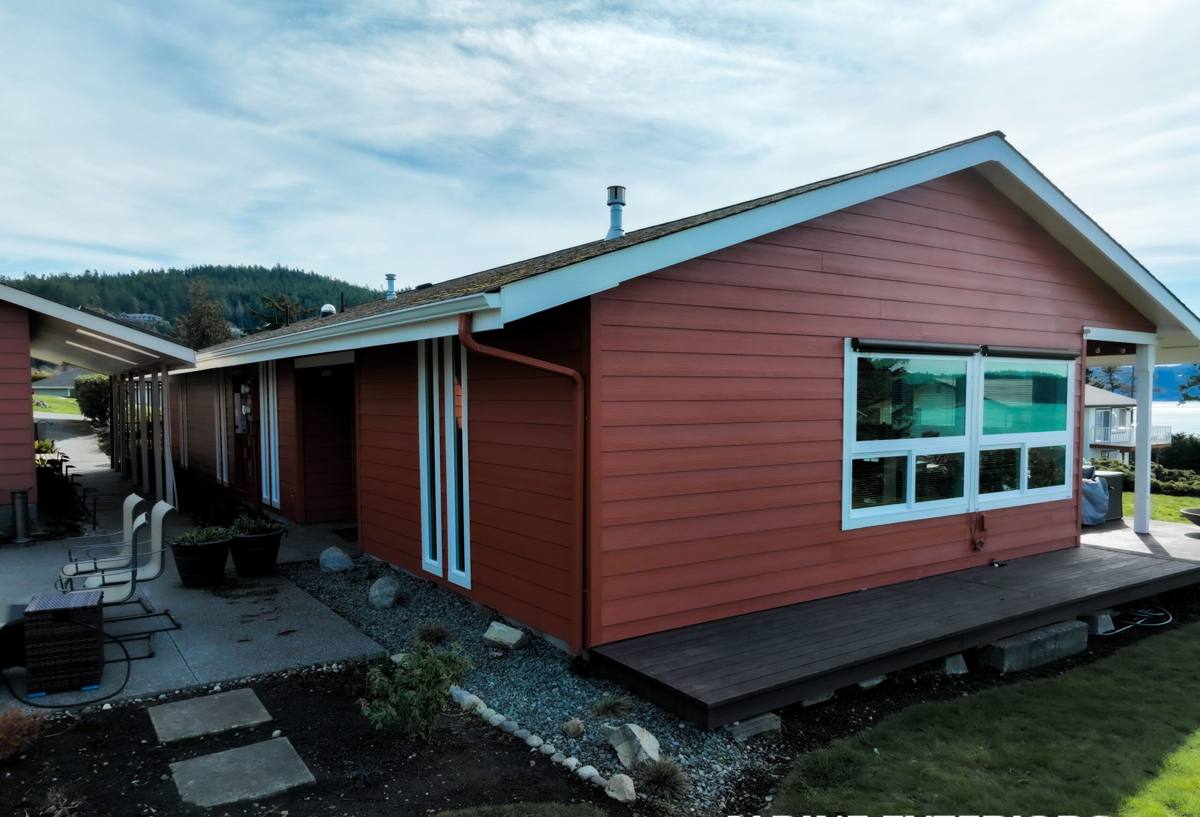
What Fiber Cement Siding Has to Do Right in a Climate Like This
Moisture Management Behind the Siding
Siding is only the visible layer. Behind every board there needs to be a properly lapped weather-resistant barrier and, ideally, a drainage gap that lets any moisture that does get behind the cladding find its way back out instead of sitting against the sheathing. In a river valley with long damp stretches, skipping this step is how homes end up with hidden rot years before anyone notices a problem on the surface.
Moss and Algae Resistance
Moss doesn't rot fiber cement the way it can rot wood trim, but it does hold moisture against the surface and stain the finish if it's allowed to build up. Correct installation — proper clearances off the roofline, gutters that actually shed water away from the wall, and factory-finished color that resists staining — keeps moss from getting a foothold in the first place instead of relying on homeowners to pressure-wash it off every year.
Standing Up to Wind-Driven Rain
Rain in this part of Whatcom County rarely falls straight down. Storms push in off the water at an angle, and that means siding joints, butt seams, and trim intersections take on more water than a calm-weather install would suggest. Every seam and penetration needs to be treated as a place water will try to get in, not just a place two boards happen to meet.
Why We Install Only James Hardie Fiber Cement
We don't install LP SmartSide, vinyl, Cemplank, Allura, primed spruce, or cedar. That's a deliberate standard, not a matter of brand preference. James Hardie engineers its HZ5 and HZ10 product lines specifically for climates like ours — wet winters, real humidity, and long stretches without direct sun to dry a wall out. The boards are non-combustible, dimensionally stable when they take on moisture, and finished at the factory with ColorPlus technology, which bakes color into the board under controlled conditions rather than relying on job-site paint that has to cure in whatever weather shows up that week. That combination — climate-engineered substrate, factory finish, and a strong transferable warranty — is why it's the only fiber cement we put on Everson homes.
What a Correct Fiber Cement Installation Involves
Flashing and Weather Barrier First
Before a single piece of siding goes up, windows, doors, and any wall penetrations get properly flashed and integrated with a continuous weather-resistant barrier. This is the step that determines whether the wall stays dry for the next 30 years or starts failing quietly behind the finish in year five.
Clearances and Fastening
James Hardie specifies minimum clearances from grade, roofing, decks, and horizontal surfaces for a reason — those gaps keep the bottom edge of the siding from sitting in standing water or snowmelt. Fastening has to hit the framing at the correct spacing and depth; overdriven or underdriven nails are one of the most common causes of premature siding problems we're called out to fix on other people's installs.
Joints, Caulking, and Trim
Butt joints need to be backed and sealed correctly, not just butted together and caulked over. Trim boards, corners, and transitions to roofing or masonry are where wind-driven rain finds its way in if they're rushed. This is detail work, and it's the difference between a siding job that looks fine at completion and one that still performs correctly a decade later.
Our Process for Everson Siding Projects
- On-site assessment — we look at the existing siding, check for hidden moisture or rot at trim and penetrations, and assess sun exposure and moss-prone areas specific to your property.
- Product and color selection — we walk you through HardiePlank, HardiePanel, and Board & Batten options and ColorPlus colors that fit both your home and its surroundings.
- Removal and prep — old siding comes off, sheathing is inspected and repaired where needed, and the weather barrier and flashing are installed correctly before any new siding goes up.
- Installation — siding, trim, and accessories go on to manufacturer spec, with attention to the clearances, fastening, and sealing details that determine long-term performance.
- Final walkthrough — we go over the finished job with you before we consider it done.
Choosing the Right Hardie Line for an Everson Property
Most Everson homes we work on fall into one of two settings: open farmland lots with full sun exposure, or wooded and river-adjacent lots with more shade and moisture. Both benefit from HZ5 or HZ10 fiber cement, but the color and profile choice can differ.
| Home Setting | Common Challenge | What We Typically Recommend |
|---|---|---|
| Open farmland lot, full sun | UV fade on lesser materials, wind-driven rain with no windbreak | HardiePlank lap siding with a durable ColorPlus finish |
| Wooded or river-adjacent lot | Extended damp periods, moss and algae growth | Lap siding with wider gutter clearance and lighter, stain-resistant color tones |
| Mixed-use or accent areas (gables, entries) | Visual monotony, need for texture contrast | Board & Batten or HardiePanel as an accent alongside lap siding |
What Fiber Cement Siding Costs to Install in Everson
Every home is different, and the honest answer is that cost depends on a handful of factors more than on a flat per-square-foot number. The main drivers we see:
- Home size and wall complexity — more corners, gables, and dormers mean more cutting and trim work.
- Condition of what's underneath — hidden rot or a sheathing repair adds time before new siding can go up.
- Siding profile mix — straight lap siding runs faster than a job combining lap, panel, and board-and-batten accents.
- Tear-off scope — full removal of old wood or vinyl siding versus a simpler re-side.
- Trim and accessory package — window and door trim, corner boards, and fascia detailing add to the scope.
We give a firm, itemized estimate after seeing the home in person rather than a number over the phone — it's the only way to be honest about what your particular project needs.
Signs Your Current Siding Is Already Failing
If you're noticing any of the following, it's worth having it looked at before it gets more expensive to fix:
- Soft or spongy spots when you press on the siding, especially near the bottom courses
- Paint that's bubbling, peeling, or chalking faster than it used to
- Persistent moss or dark staining that comes back within months of cleaning
- Visible gaps, warping, or cupping at board edges and seams
- Rising heating bills that suggest the wall assembly isn't sealing the way it should
Why a Crew That Already Works in Everson Matters
Whatcom County's building requirements, the practical realities of rural Everson properties — gravel driveways, wells, septic systems, outbuildings — and the specific way this valley's weather behaves aren't things you want a crew figuring out for the first time on your house. A contractor who already installs siding regularly in this area knows how to sequence a job around the wet season, where moisture problems tend to hide on local homes, and how to get a crew and materials out here efficiently without turning your project into a logistics problem. That familiarity shows up in fewer surprises and a straighter path from estimate to finished siding.
If your Everson home needs new siding or you're just trying to figure out what shape yours is in, we're happy to take a look. The estimate is free, there's no pressure, and you'll walk away with a straight answer about what your home actually needs — just fill out the form below.