 Ferndale
 Composite Decking in Cordata: Built for the Weather You Actually Get
Cordata sits close enough to the water and the lowland fog belt that its decks live a harder life than the glossy composite brochures suggest. Salt-tinged air off the Strait, long stretches of driving rain, and a moss season that can run from October well into spring all work on a deck's substructure, fasteners, and board surface at the same time. A composite deck installed without those conditions in mind will look fine for a year or two and then start showing problems — soft spots in the framing, black-green film on the boards, corrosion streaks at the fastener heads — that a properly built deck simply won't have.
This page covers what a composite deck actually needs to hold up in Cordata specifically: the framing and drainage details that matter more here than in a drier climate, how we approach installation, what the material choices really trade off against each other, and what to look for in whoever ends up building it.
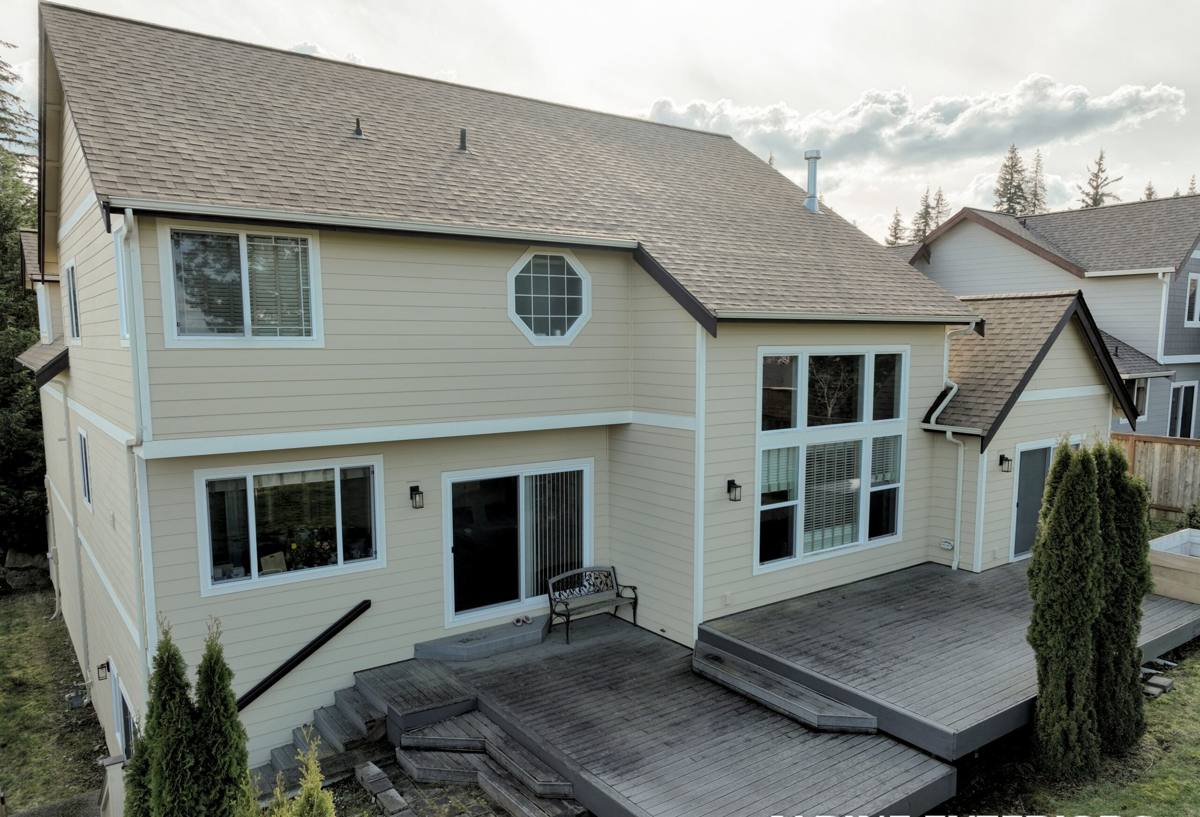
Why Local Climate Conditions Change the Job
Composite decking is marketed as low-maintenance and weather-resistant, and the boards themselves largely live up to that. But a deck is a system — boards, hidden fasteners, joists, ledger, footings, flashing — and in this region the weak points are almost never the composite boards themselves. They're everything underneath and around them.
Salt Air
Even a few miles inland from the water, airborne salt accelerates corrosion on any fastener, bracket, or ledger flashing that isn't rated for it. Standard interior-grade hardware will start showing rust streaks on composite boards faster here than it would further from the coast — and once a fastener starts corroding, it stains the board around it permanently.
Driving Rain
Wind-driven rain in this area doesn't just fall on a deck, it gets pushed sideways into ledger connections, under rim joists, and behind any siding-to-deck transition that isn't flashed correctly. A deck attached to the house needs a ledger flashing detail that assumes water will hit it horizontally, not just from above.
Moss and Organic Growth
Extended damp, shaded stretches of the year give moss, algae, and mildew a long runway to establish themselves on any decking surface that doesn't drain and dry quickly. Composite boards resist rot, but they don't resist surface growth — that depends entirely on airflow underneath the deck and how much standing moisture the board surface holds onto.
What a Correctly Built Composite Deck Involves
The boards get most of the attention, but the framing underneath them determines whether the deck lasts 10 years or 30. In our climate, a few details matter more than they would in a drier region:
- Joist spacing matched to the board — composite boards have manufacturer-specified maximum joist spacing, and going wider to save material leads to bounce, and eventually board fatigue, especially when boards are wet more often than they're dry.
- Ventilation under the deck — enough clearance and airflow beneath the joists so the framing can dry out between rain events instead of staying damp for weeks at a stretch.
- Corrosion-resistant fasteners and brackets — hardware rated for coastal or high-moisture exposure, not standard interior-grade galvanized, on every structural connection.
- Proper ledger flashing — a flashing detail at the house connection that sheds water outward and down, not one that relies on caulk alone to stay sealed.
- Hidden fastener systems installed to spec — clips need consistent gapping for drainage and expansion; overtightened or underspaced clips are a common cause of board cupping later.
- Footings sized and set below frost depth — settling footings are the root cause of most "deck suddenly feels uneven" calls we get on older builds.
None of this is visible once the deck is finished, which is exactly why it's worth asking about before the work starts rather than after.
Composite vs. Wood vs. PVC: An Honest Comparison
Every decking material is a set of trade-offs. Here's how the main options actually compare for a project in this climate, not just on a spec sheet.
| Material | Moisture Behavior Here | Maintenance | Typical Lifespan | Upfront Cost |
|---|---|---|---|---|
| Pressure-treated wood | Absorbs and releases moisture readily; prone to surface checking and splintering with our wet/dry cycles | Annual cleaning, periodic staining or sealing | 10–15 years before major repair | Lowest |
| Composite (wood-plastic blend) | Doesn't rot, but surface can hold moisture and support moss/mildew without regular cleaning | Periodic surface cleaning, no staining or sealing | 25–30 years | Moderate to higher |
| Capped composite / PVC | Fully sealed cap resists moisture absorption and staining better than uncapped composite | Occasional rinsing, minimal upkeep | 25–30+ years | Higher |
We install composite because it's the right balance of durability and maintenance for most Cordata homeowners, but we're upfront that "low-maintenance" doesn't mean "no-maintenance" here — it still needs a rinse-off and occasional cleaning to keep moss from getting a foothold, more so than the same product would in a drier climate.
Board and Fastener Choices We Stand Behind
We install capped composite boards as our default recommendation for this area, and we're honest about why: an uncapped or lower-grade composite board absorbs more surface moisture over time, which is exactly the condition that lets algae and moss establish themselves during the long damp stretch of the year. A fully capped board sheds that moisture instead of holding it, which means less surface cleaning and a more consistent look over the deck's life.
On fasteners and brackets, we use hardware rated for coastal and high-moisture exposure on every structural connection — ledger bolts, joist hangers, post bases. This is a small cost difference at the time of install and a large difference in whether the deck develops rust staining and corrosion issues five or ten years in. We won't cut this corner to shave a bid down, because it's the single most common reason we get called out to repair someone else's deck.
What We Deliberately Avoid
We don't install decking systems that rely entirely on surface sealants or caulk to manage water at the house connection — those details fail quietly over a few wet seasons and the damage shows up as rot in the rim joist, not in the visible boards. We also steer away from non-rated fasteners on structural connections, even when a cheaper option is available, because the failure mode (corrosion staining, loosening brackets) shows up years after the crew that installed it is gone.
Our Installation Process
- On-site assessment — we look at the attachment point to the house, existing grade and drainage around the deck footprint, and sun/shade exposure that affects how fast the deck will dry after rain.
- Framing plan — joist spacing, ventilation clearance, and footing layout sized to the board manufacturer's specifications and local frost depth, not a generic template.
- Flashing and structural connections — ledger flashing and all structural hardware installed first, before any decking goes down, since this is the part that can't be fixed later without pulling boards back up.
- Board installation — hidden fastener systems set to the correct gap for drainage and thermal movement, board runs planned to minimize waste and keep seams away from high-traffic areas.
- Final walk-through — we check gapping, fastener seating, and railing attachment before we call it done, and go over basic seasonal cleaning with the homeowner.
Cost Factors for a Cordata Deck Project
Composite decking costs vary by size, structure complexity, and board grade, but the main cost drivers on most projects in this area are consistent:
| Factor | Why It Matters Here |
|---|---|
| Deck height and footing depth | Sloped lots and frost-depth footing requirements add framing cost beyond the board price |
| Board grade (uncapped vs. capped composite) | Capped boards cost more upfront but resist moisture and staining better over time in our climate |
| Ledger and flashing complexity | Older homes may need siding removed and re-flashed properly at the ledger connection, which adds labor |
| Railing and fastener hardware | Coastal-rated hardware costs more than standard hardware but avoids early corrosion issues |
| Site access and demolition | Removing an existing deck, especially one with hidden rot, adds time before the new build even starts |
We give straightforward, itemized estimates so homeowners can see where the cost is actually going rather than a single lump number.
Maintaining a Composite Deck Through Ferndale's Wet Season
Composite decking cuts down on maintenance significantly compared to wood, but "low-maintenance" still means a few basics, especially given how long the damp season runs in Whatcom County:
- Rinse the deck surface periodically during fall and winter to keep organic debris from sitting and feeding moss growth.
- Clear leaves and needles out of gaps between boards where moisture collects and stays trapped.
- Keep gutters and downspouts near the deck clear so runoff isn't dumping extra water directly onto the deck surface.
- Check railing posts and fastener heads once a year for any early signs of corrosion staining.
- Trim back vegetation that shades the deck heavily, since constant shade slows drying time and extends moss season on the surface.
What to Check Before Hiring Anyone for This Job
Composite decking is straightforward to sell and much harder to install correctly. Before hiring a crew for a Cordata deck project, it's worth confirming:
- They size joist spacing to the specific board's manufacturer requirements, not a generic on-center spacing.
- They can explain their ledger flashing detail without hand-waving — this is the single most common point of water intrusion on deck-to-house connections.
- They use corrosion-rated fasteners and brackets as standard, not an upsell option.
- They pull permits and have footings inspected where required, rather than treating that as optional paperwork.
- They've actually worked in this neighborhood or a comparably exposed area, and can talk specifically about how they handle the moisture and moss conditions here.
Why Local Experience in Cordata Actually Matters
A composite deck built to a generic national spec sheet will hold up fine in a mild, dry climate. Built the same way here — with standard fasteners, minimal under-deck ventilation, and a caulk-only ledger seal — it runs into the specific conditions Cordata deals with every year: salt air working on hardware, driving rain finding its way into connections, and a long damp season giving moss every chance to take hold. A crew that already works decks in this part of Whatcom County isn't guessing at how to handle those conditions — it's just how every project gets built, because the alternative is repeat callbacks a few years down the line.
If you're planning a new deck or replacing one that's showing its age, we're happy to walk the site, look at what's actually going on with the existing structure if there is one, and put together a clear, no-pressure estimate. There's a form below to get that started.