 Ferndale
 Blaine's Climate Is Rough on Siding — Here's Why
Blaine sits at the very top of Whatcom County, right on Semiahmoo Bay and Drayton Harbor, which means homes here take on a combination of weather stresses that inland Washington houses simply don't deal with. Salt-laden marine air moves off the water almost constantly, driving rain comes in sideways during winter storms, and the wet season stretches long enough that north-facing walls and shaded siding can stay damp for weeks at a stretch. Any siding product installed on a Blaine home has to hold up to all three at once, year after year.
Salt Air and Corrosion
Airborne salt doesn't just affect boats and dock hardware. It settles on exterior surfaces, works into fasteners, and accelerates the breakdown of coatings and trim that weren't built for a marine environment. Over time this shows up as chalking paint, corroding nail heads, and premature failure at joints and seams — problems that show up faster on homes near the water than they do a few miles inland.
Driving Rain and Wind-Driven Moisture
Blaine's exposure to weather systems moving in off the Strait of Georgia means rain doesn't always fall straight down. Wind-driven rain gets pushed under laps, around trim, and into any gap in the water-resistive barrier that wasn't detailed correctly. Siding that relies on caulk and paint film alone to keep water out — instead of a properly built drainage plane behind it — is the siding most likely to trap moisture where you can't see it.
The Long Moss Season
Shaded walls, roof lines that shed onto siding, and the sheer number of wet months in a Whatcom County winter add up to a long moss and algae season. Some siding materials feed organic growth or hold onto moisture in a way that makes moss harder to keep off. Others resist it far better. This is one of the practical reasons product choice matters as much as installation quality.
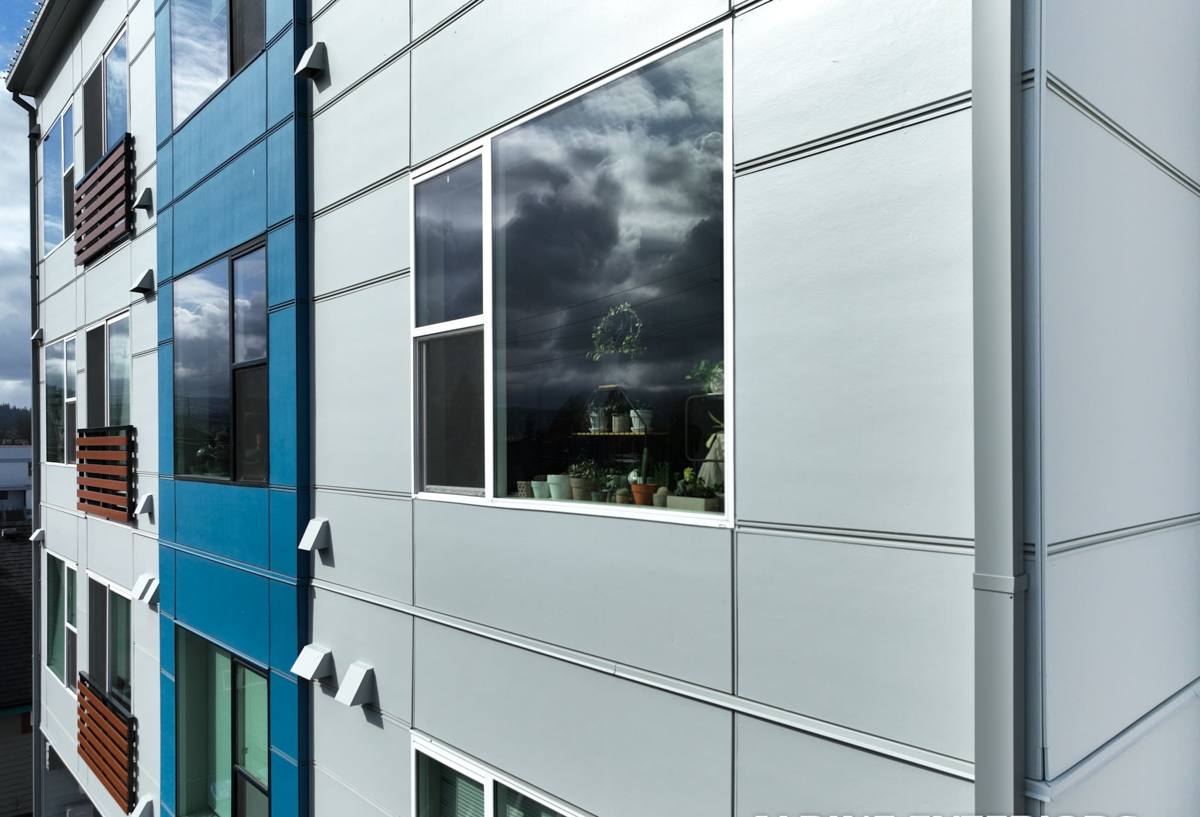
Why We Install Only James Hardie Siding
We don't install vinyl, LP SmartSide, Cemplank, Allura, primed spruce, or cedar. That's not a marketing angle — it's a standard we hold to because we've seen how each of those products performs, or struggles to perform, in exactly the kind of climate Blaine sits in. Vinyl expands, contracts, and can warp in temperature swings and doesn't offer the impact or fire resistance homeowners increasingly want. Engineered wood products like LP SmartSide depend on an intact factory coating to keep moisture out — any breach at a cut edge or fastener hole becomes a weak point. Untreated or primed wood and cedar require an ongoing maintenance commitment that most homeowners don't want to sign up for, especially in a climate this wet.
James Hardie fiber cement is non-combustible, dimensionally stable, and manufactured with a factory-applied ColorPlus finish that's baked on rather than field-sprayed, which gives it far better resistance to fading, chipping, and the kind of UV and moisture cycling Blaine sees all year. It's engineered specifically for Pacific Northwest conditions through Hardie's climate-specific HZ product lines. That combination — the material itself plus a finish designed to survive marine exposure — is why it's the only product we put on homes.
What a Correct James Hardie Installation Actually Involves
Hardie siding is only as good as the installation behind it. The product is engineered to perform for decades, but that performance depends entirely on details most homeowners never see once the siding is up. A rushed or corner-cut install can undermine even the best material.
The Water-Resistive Barrier and Drainage Plane
Every Hardie install we do starts with a continuous, correctly lapped weather-resistive barrier, with a drainage gap behind the siding so any moisture that does get past the cladding has somewhere to go instead of sitting against the sheathing. This is the single most important layer for a house exposed to driving rain, and it's completely invisible once the job is done — which is exactly why it has to be done right the first time.
Flashing, Clearances, and Fastening
Every window, door, and roof-to-wall intersection needs flashing detailed to shed water outward, not trap it behind the siding. Hardie specifies minimum clearances from grade, roof lines, and decks, and fastener spacing and placement that keep panels secure without over-driving nails or splitting material. Skipping any of these doesn't fail immediately — it fails in year three or four, usually where you can't see it until there's already damage behind the wall.
Caulking and Joint Treatment
Butt joints, trim intersections, and penetrations need the right sealant, applied correctly, not just enough to look finished. On a home exposed to constant salt air and wind-driven rain, joint failure is one of the most common paths for water intrusion.
- Continuous, correctly lapped weather-resistive barrier with a drainage gap
- Flashing at every window, door, and roof-to-wall transition
- Manufacturer-specified clearances from grade, decks, and roofing
- Correct fastener type, spacing, and depth for the panel or lap profile
- Sealant at joints and penetrations rated for exterior, marine-exposure use
- Factory-cut or properly sealed field cuts to protect the ColorPlus finish
Choosing the Right Hardie Products for a Blaine Home
James Hardie makes several siding profiles — lap, panel, and shingle-style — and offers ColorPlus prefinished options alongside primed-for-paint choices. For a coastal Whatcom County home, we generally lean toward ColorPlus finishes because they're factory-cured under conditions a job site can't replicate, giving better long-term color and moisture performance than field-applied paint. Product selection also depends on wall exposure: south- and west-facing walls that take direct wind-driven rain sometimes call for different detailing than a sheltered, shaded elevation more prone to moss.
| Consideration | Why It Matters in Blaine |
|---|---|
| ColorPlus vs. field-painted | Factory finish resists fading and moisture better than site-applied paint in a marine climate |
| Lap vs. panel profile | Affects drainage detailing and how wind-driven rain sheds off exposed walls |
| Trim and fascia material | Should match the siding's moisture and coating performance, not be an afterthought |
| Color selection | Darker colors show chalking and salt residue differently than lighter tones over time |
Our Process, Start to Finish
We keep the process straightforward because homeowners deserve to know what's happening to their house at every stage.
- Walkthrough and assessment — we look at existing siding, trim, moisture points, and any signs of past water intrusion before quoting anything.
- Product and color selection — we walk through Hardie lines and ColorPlus options suited to the home's exposure.
- Tear-off and inspection — removing old siding lets us check sheathing and framing for hidden damage before anything new goes on.
- Weather barrier and flashing — the drainage plane and flashing details go in first, correctly lapped and sealed.
- Installation — Hardie siding, trim, and accessories installed to manufacturer clearance and fastening specs.
- Final detailing and walkthrough — joints, caulking, and touch-up reviewed with the homeowner before we call it done.
Why a Crew That Already Works in Blaine Matters
Siding crews that mostly work drier, inland areas don't always build the same habits around drainage planes, flashing overlap, and clearance details that a coastal Whatcom County home actually needs. A crew that regularly works Blaine and the surrounding shoreline communities has already seen how salt air, wind-driven rain, and a long wet season expose weak installation work — and adjusts accordingly instead of building to a generic standard. That local experience also means fewer surprises with permitting, drainage requirements, and the kind of wall assemblies that hold up on this stretch of the Whatcom County coastline.
Maintenance in a Coastal, Moss-Prone Climate
Correctly installed James Hardie siding is low-maintenance, not no-maintenance. A yearly rinse to clear salt residue, pollen, and organic buildup goes a long way, especially on shaded or north-facing walls where moss tends to establish first. Keep an eye on caulked joints and touch up any chipped trim promptly — catching a small gap before a wet winter matters more here than in a drier climate. Beyond that, ColorPlus finishes are built to go years without repainting, which is a real advantage over materials that demand a repaint cycle to keep performing.
What Affects the Cost of a Blaine Siding Project
| Factor | How It Affects the Project |
|---|---|
| Home size and wall complexity | More corners, dormers, and trim detail increase labor and material needs |
| Condition of existing sheathing | Hidden moisture damage found during tear-off can add repair scope |
| Product line and finish | ColorPlus prefinished siding costs more upfront than primed-for-paint but reduces long-term maintenance |
| Exposure and detailing needs | Waterfront or wind-exposed walls may need additional flashing and drainage work |
| Trim and accessory scope | Fascia, corner boards, and trim replacement add to total project cost |
Every home is different, and the only way to get real numbers is to have someone look at the house in person. If you're weighing a siding project for a Blaine property, we're happy to walk the exterior with you, point out what we see, and put together a straightforward, no-pressure estimate — just fill out the form below to get started.