 Ferndale
 Siding Repair Built for Kendall's Climate
Kendall sits inland from the Strait of Georgia but still catches the same weather pattern that defines Whatcom County exteriors: long stretches of driving rain off the water, humid air that never fully dries out between storms, and enough shade under fir and cedar canopy to keep north-facing walls damp well into the afternoon. Add the salt content that rides in on marine air even this far from the coastline, and you get a combination that is hard on any siding material that isn't detailed correctly. We repair siding on Kendall homes regularly, and the failures we find almost always trace back to water finding a way behind the cladding and staying there.
A repair here isn't just about patching a hole or replacing a cracked board. It's about figuring out why that spot failed in the first place, fixing the underlying cause, and making sure the repair holds up through the next twenty wet seasons — not just the next one.
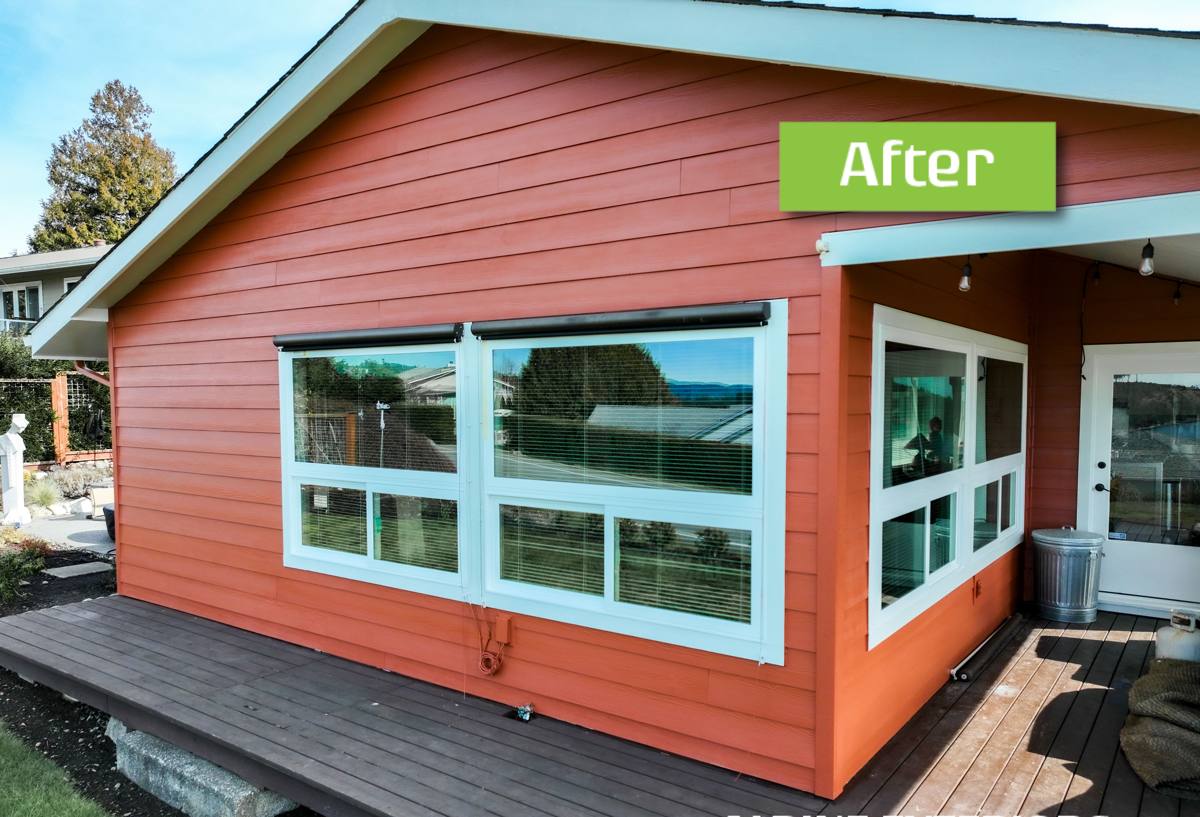
What Kendall's Climate Does to Siding Over Time
Moss and Organic Growth
Whatcom County's moss season runs long — realistically most of the year in shaded spots. Moss holds moisture directly against the siding surface, which accelerates rot in wood-based products and can stain and etch weaker cementitious materials over time. On homes tucked under tree cover, which describes a lot of Kendall lots, moss buildup on north and east walls is one of the most common things we get called out for.
Driving Rain and Wind-Driven Moisture
Storms coming off the water don't just fall straight down — wind pushes rain sideways into wall assemblies, especially at corners, around windows, and at any point where flashing is missing or was installed short. Once water gets behind the siding, it doesn't evaporate quickly in our climate. It sits against the sheathing and the back side of the cladding, which is where rot and delamination actually start, often long before anything is visible from the yard.
Salt Air and Corrosion
Even inland from the immediate coastline, salt-laden air corrodes exposed fasteners and metal flashing faster than it would in a dry climate. Rusted nail heads, streaking below fastener points, and corroded J-channel are all signs we watch for during a repair inspection, because a compromised fastener is a future leak point even if the siding around it still looks fine.
Temperature Swings and Material Movement
Whatcom County doesn't have extreme heat, but the daily swing between damp mornings and drier afternoons causes repeated expansion and contraction in siding materials — particularly wood and some engineered products. Over years, that movement opens up seams, loosens caulk joints, and can telegraph nail pops through paint or factory finish.
Signs a Kendall Home Needs Siding Repair
- Soft, spongy, or crumbling spots when you press on the siding, especially near the bottom courses and around window and door trim
- Visible moss or dark streaking that keeps coming back after cleaning
- Paint that's bubbling, peeling, or failing in one localized area rather than uniformly across the wall
- Gaps, cracks, or warping at butt joints and corners
- Rust streaks below nail heads or at metal flashing and trim
- Interior signs — a musty smell, discolored drywall, or peeling interior paint on an exterior wall — that point to moisture getting through from outside
- Siding that separates slightly from the wall or flexes when touched, suggesting the fasteners or the substrate behind it have deteriorated
Any one of these on its own might be minor. Several showing up in the same area, or a soft spot that's spreading year over year, usually means water has been getting behind the siding for a while and the damage goes deeper than the surface.
What a Correct Siding Repair Actually Involves
A repair that just swaps a damaged board for a new one, caulks the edges, and repaints is treating the symptom, not the problem. We approach every repair with the same sequence:
1. Find the Water Path
Before we touch the siding, we trace where the moisture is actually getting in. That might be a missing kick-out flashing above a roofline, a window that was never properly flashed, a caulk joint that failed years ago, or simply siding that was installed too close to grade or a deck surface. Replacing the visible board without fixing this step means the same failure comes back.
2. Open Up and Inspect the Substrate
Once we remove the damaged section, we check the sheathing, house wrap or building paper, and framing behind it. In our climate, it's common to find that the visible damage is smaller than what's happened behind the wall. If the substrate is compromised, that gets addressed as part of the repair — not glossed over.
3. Correct the Water Management Details
This is the step that actually prevents a repeat. Proper flashing at windows, doors, and rooflines; correct lap and overlap on house wrap; the right clearance at grade and hard surfaces; and fastener placement that won't loosen with material movement. These details matter more in Whatcom County's climate than in drier parts of the state, because there's less margin for error when a wall assembly rarely gets a chance to fully dry out.
4. Match or Upgrade the Material
Where we can source a compatible match for existing siding, we do — particularly for small, isolated repairs on newer siding that's otherwise sound. Where a section needs a real rebuild, or where the existing material is the reason for repeat failures, we install James Hardie fiber cement for that section, which is the only siding product we install company-wide. More on why below.
Repair vs. Replacement: How We Help You Decide
| Situation | Usually a Repair | Usually Points to Replacement |
|---|---|---|
| Damage extent | Isolated to one wall or a few boards | Recurring issues across multiple walls |
| Siding age | Under 15-20 years, otherwise sound | Original siding is decades old or already patched multiple times |
| Substrate condition | Sheathing and framing test dry and solid | Rot found in sheathing or framing during inspection |
| Material | Fiber cement or well-maintained wood with a clear cause | Aging wood, older masonite, or vinyl showing widespread failure |
| Cause | A fixable detail — flashing, caulk, clearance | Systemic issue with how the whole wall was originally built |
We'll tell you honestly which side of that table your home falls on. A lot of Kendall homes we look at genuinely just need a targeted repair — we don't push replacement when a repair will hold. But we also won't patch over a problem that's going to be back in your yard in two years asking for another repair bill.
Why We Only Install James Hardie for Repair Sections
When a repair calls for new siding material — not just a caulk-and-paint fix, but an actual section replacement — we use James Hardie fiber cement. We made that decision company-wide, not just for Kendall, but it matters even more here because of how demanding this climate is on a wall assembly.
- It doesn't rot. Fiber cement isn't organic material, so the moss, humidity, and standing moisture that cause wood siding to fail over time don't have the same effect on it.
- It's engineered for wet climates. James Hardie's HZ5 product line is specifically formulated for regions like the Pacific Northwest, where moisture exposure is a year-round condition rather than a seasonal one.
- The factory finish holds up. ColorPlus finish is baked on at the factory and resists the fading and peeling that field-applied paint struggles with under our UV and moisture cycle.
- It's non-combustible. Fiber cement doesn't contribute fuel to a fire, which matters as wildfire smoke and dry-season risk have become a bigger part of the conversation even in Western Washington.
- The warranty is real and transferable. That protects you if you sell the home, not just while you own it.
We don't install LP SmartSide, vinyl, Cemplank, Allura, primed spruce, or cedar. Each of those has legitimate strengths, but we've standardized on Hardie because it performs consistently in exactly the conditions Kendall homes deal with — and because when we do a repair, we want it to be the last time you have to think about that section of wall.
Our Repair Process
- On-site inspection. We look at the visible damage, probe the surrounding area, and check for related issues like flashing or grading problems nearby.
- Honest assessment. You get a clear explanation of what's causing the damage, what a proper fix requires, and whether that's a repair or points toward a larger project.
- Written estimate. No pressure, no upsell — a scope and price for the actual work needed.
- The repair itself. Substrate correction where needed, proper flashing and water management details, and matched or Hardie replacement material as appropriate.
- Final check. We walk the repair with you before we consider the job done.
Why a Crew That Already Works Kendall Matters
Siding repair done by someone unfamiliar with this specific stretch of Whatcom County often misses the climate-specific causes — treating a Kendall moisture problem like it's a dry-climate cosmetic fix. A crew that regularly works this area already knows which details tend to fail first here: the flashing points that take the brunt of driving rain, the shaded walls that hold moss longest, and the grading and drainage patterns common to local lots. That local pattern recognition is often the difference between a repair that lasts and one that's back on the schedule next winter.
Get a Straight Answer About Your Siding
If you're seeing soft spots, recurring moss, peeling paint, or any of the other warning signs on your Kendall home, it's worth getting eyes on it before the next wet season does more damage. We'll give you a free, no-pressure estimate and tell you plainly whether you're looking at a simple repair or something bigger — use the form below to get started.