 Ferndale
 Homes in the Semiahmoo area near Ferndale sit close enough to the water that salt air, wind-driven rain, and a long stretch of shaded, damp months all work on siding harder than they do just a few miles inland. If you're noticing soft spots, peeling paint, staining, or panels that look "off" compared to the rest of the house, that's usually not cosmetic — it's a sign moisture has already gotten past the surface. Repairing it correctly, and understanding why it failed in the first place, matters more here than in drier parts of Whatcom County.
Why Siding Fails Differently Near the Water
Coastal proximity changes how siding ages. Salt-laden air accelerates corrosion on fasteners, flashing, and any exposed metal trim — once those components start to rust or loosen, water finds a path behind the siding long before you see a problem on the surface. Combine that with driving rain that hits west- and southwest-facing walls at an angle during winter storms, and you get moisture intrusion at seams, laps, and butt joints that wouldn't be an issue on a more sheltered lot.
Then there's moss and algae. Whatcom County's damp season runs long, and homes with tree cover or north-facing walls that don't get much sun can stay wet for days after a storm passes. Moss holds moisture directly against the siding surface, and on materials that aren't dimensionally stable, that constant dampness is what starts rot, swelling, and paint failure — even if the moss itself never physically damages the panel.
What This Means for Repair Work
A repair that only addresses the visible symptom — patching a soft spot, recaulking a seam, pressure-washing off the moss — without checking what let the moisture in usually fails again within a season or two. Correct repair work in this area starts with figuring out the entry point, not just the damage.
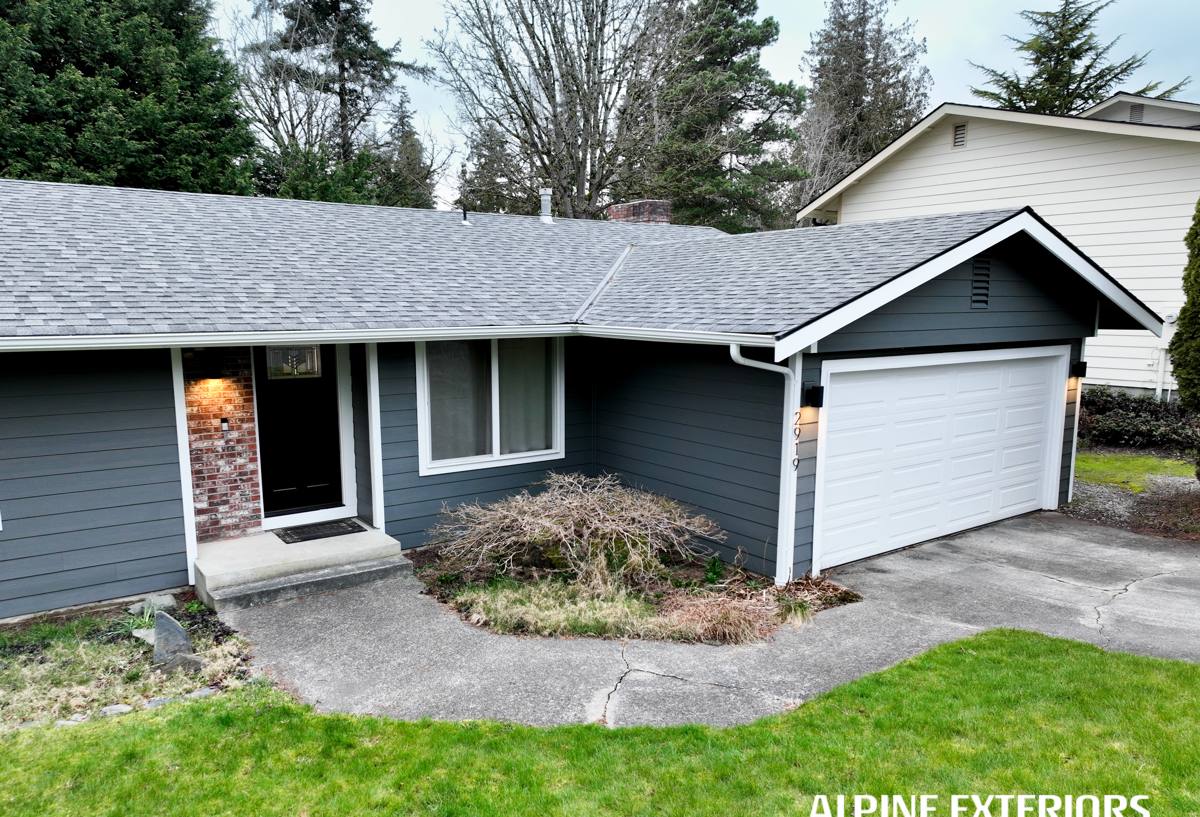
What a Correct Siding Repair Actually Involves
A siding repair is only as good as the diagnosis behind it. Here's what we check before we touch a single panel:
- Where water is actually entering — often several feet away from where the damage shows up, since water travels down behind the siding before it pools or soaks in
- Condition of the flashing around windows, doors, and roof-to-wall transitions
- Whether house wrap or weather-resistive barrier behind the siding is intact, torn, or missing entirely at the damaged area
- Fastener condition — rusted, backed-out, or improperly placed nails and screws are a common hidden cause of loosening panels
- Whether the substrate (sheathing, framing) underneath has softened or started to rot, which changes the scope of the repair significantly
- Caulking and sealant condition at all butt joints, corners, and penetrations
Only once we know the actual cause do we decide whether the fix is a targeted panel replacement, a flashing correction, resealing, or — if rot has spread into the sheathing — a larger repair that goes beyond the siding itself.
Common Repair Scenarios We See in This Area
Moisture Damage at Butt Joints and Corners
These are the most vulnerable points on any siding system, and they're where driving rain does the most damage. If joints weren't properly flashed or sealed during the original install, water works its way in over years, and by the time staining or softness is visible on the surface, the damage often extends further than expected.
Moss and Algae Staining
On its own, surface growth is a cleaning issue, not a repair issue — but we always check whether prolonged dampness has already caused paint failure or early softening underneath before treating it as cosmetic.
Fastener and Flashing Corrosion
Salt air speeds up corrosion on any exposed metal. Rusted fasteners lose their grip, panels loosen, and once a panel isn't sitting flush, water intrusion accelerates. This is a quiet failure mode — it doesn't look dramatic until panels start visibly shifting.
Impact and Storm Damage
Wind-driven debris during winter storms can crack or dislodge panels, especially on exposed elevations. These repairs are usually straightforward once we confirm the underlying wrap and flashing weren't compromised in the same event.
Repair vs. Replacement: How We Decide
Not every damaged section needs a full re-side, and we don't recommend replacement just because it's damaged in more than one spot. The decision comes down to how widespread the underlying moisture problem is, not how many panels look bad.
| Situation | Typical Approach |
|---|---|
| Isolated panel damage, sound sheathing underneath | Targeted repair — replace affected panels, correct the cause (flashing, sealant, fasteners) |
| Repeated failures at the same wall or elevation | Repair plus a closer look at flashing/wrap for that whole elevation |
| Rot has spread into sheathing or framing | Repair scope expands beyond siding — this is where cost and disruption go up |
| Siding material itself (not just the install) is failing broadly — swelling, delaminating, or moisture-sensitive by nature | Full or partial replacement is usually the more honest long-term answer |
| Aging system nearing the end of its practical service life | Repair buys time, but replacement conversation should happen before failures multiply |
We'll always tell you plainly which category your home falls into. If a repair is genuinely the right call, that's what we'll recommend — we're not trying to sell a full re-side when a targeted fix will hold.
Why We Only Repair With and Recommend James Hardie Fiber Cement
When a repair calls for replacement panels, or when the damage points toward the siding material itself being the ongoing problem, we use James Hardie fiber cement — it's the only siding product we install. In a coastal, high-moisture environment like the Semiahmoo area, that choice matters for a specific reason: fiber cement doesn't absorb and swell the way wood-based or wood-adjacent products can, and it's non-combustible, which is a separate but real advantage.
Hardie's HZ5 product line is engineered specifically for regions with more moisture and freeze-thaw cycling, and the factory-applied ColorPlus finish resists the fading and peeling that repainted siding in salt air tends to suffer from. When we're patching in replacement panels, matching to an existing Hardie install is straightforward because the product line and color system are consistent and well documented — something that's much harder to do cleanly with discontinued vinyl profiles or weathered wood siding where an exact match may not exist anymore.
We won't install LP SmartSide, vinyl, Cemplank, Allura, or primed wood siding, even as a repair patch. If your existing siding is one of those materials and it's failing broadly rather than in one isolated spot, we'll be upfront that a like-for-like patch is a short-term fix, and walk you through what a fiber cement transition would look like instead.
Our Repair Process
- On-site inspection — we look at the damaged area and the surrounding wall system, not just the spot you called about
- Diagnosis — identify the actual moisture entry point and check for hidden damage to wrap, flashing, or sheathing
- Written scope and cost range — you'll know upfront whether this is a contained repair or something larger before work starts
- Repair — remove and replace only what's necessary, correct the underlying cause (flashing, sealant, fasteners), and match materials as closely as the product line allows
- Final check — confirm the repaired area is properly sealed and flush before we call it done
Why Hire a Crew That Already Works This Area
Siding repair in a coastal Whatcom County location isn't the same trade as siding repair in a dry, inland subdivision. A crew that regularly works near the water already knows what driving rain and salt exposure typically do to flashing, fasteners, and wall assemblies in homes of this age and construction style — that experience shortens the diagnosis and reduces the chance of a repair that looks fine for a season and fails again next winter. We've built our repair process around exactly these conditions, not a generic checklist.
Signs You Should Get a Repair Looked At Now
- Soft or spongy areas when you press on the siding
- Visible staining, streaking, or discoloration that doesn't wash off
- Paint that's peeling, bubbling, or failing in one concentrated area
- Panels that look loose, warped, or slightly out of alignment
- Persistent moss or algae growth in the same spot year after year
- Any musty smell near an exterior wall from the inside of the house
Catching these early is almost always cheaper and less disruptive than waiting until the damage reaches the sheathing.
If you're seeing any of these signs on a home in the Semiahmoo area or elsewhere near Ferndale, we're happy to take a look and give you an honest, no-pressure assessment of what's actually going on and what it will take to fix it — use the form below to request a free estimate.