 Ferndale
 Why Semiahmoo-Area Roofs Wear Differently
Homes along the Whatcom County coastline near Ferndale deal with a roofing environment that's noticeably harder on materials than what you'll find a few miles inland. Salt-laden air off the water accelerates corrosion on fasteners, flashing, and metal components. Driving rain, pushed sideways by wind off the water, finds every weak seam and gap that a calmer climate would never expose. And a moss season that stretches across most of the fall, winter, and spring keeps roofs damp and shaded far longer than they'd like. None of this means a roof is doomed — it means repairs have to be done with those specific stresses in mind, not treated the same way you'd treat a roof repair in a dry inland climate.
We work on homes in this exact stretch of Whatcom County regularly, and the patterns repeat: fastener corrosion before the shingles themselves fail, moss working into granule loss at the eaves and valleys, and wind-driven rain finding its way in through flashing that was installed correctly but never accounted for the direction and force of coastal storms. A repair that ignores those patterns tends to fail again within a season or two. One that accounts for them holds up.
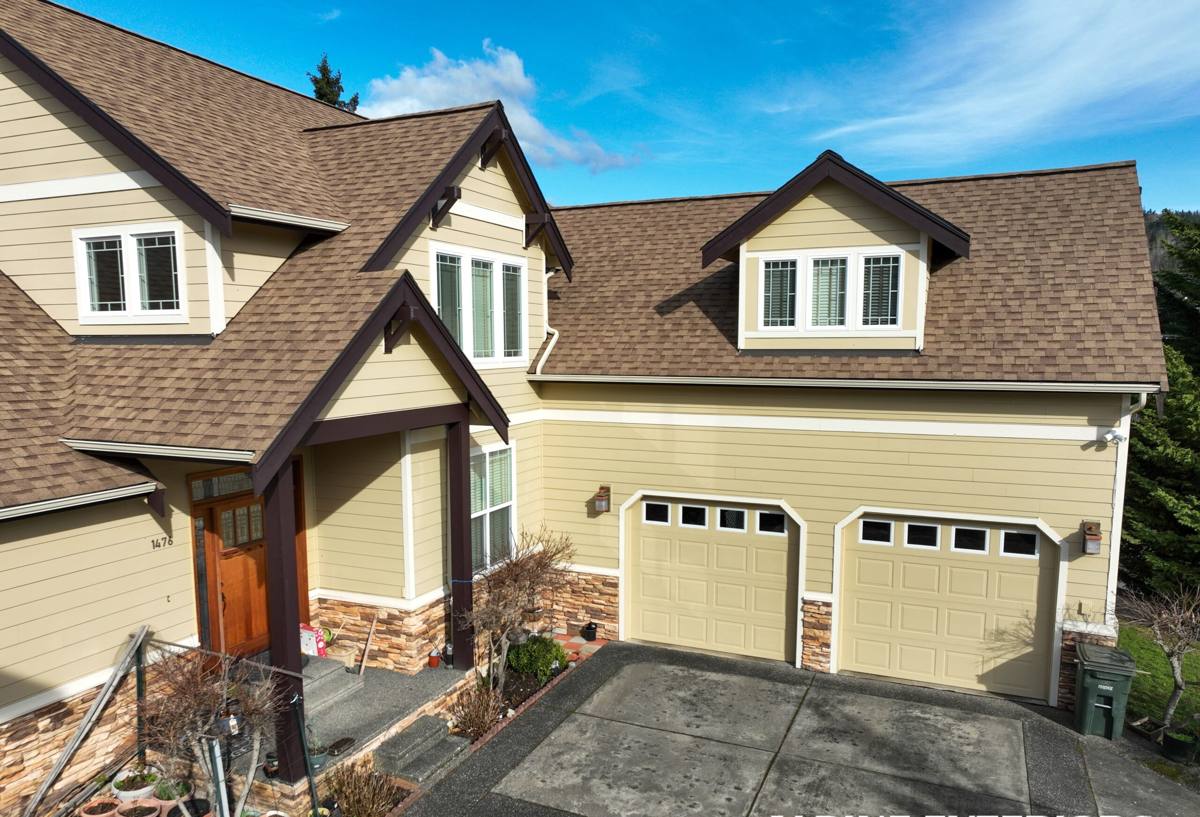
Signs a Semiahmoo Roof Needs Repair, Not Replacement
Most roofs don't fail all at once — they fail in specific spots while the rest of the system is still sound. Catching those spots early is what keeps a repair a repair instead of turning it into a full replacement. Watch for:
- Dark streaking or thick moss growth concentrated in shaded areas, north-facing slopes, or under overhanging trees
- Granules collecting in gutters or at the base of downspouts, especially after a hard rain
- Soft or discolored ceiling patches, particularly near chimneys, skylights, or where two roof planes meet
- Visible rust streaks below metal flashing, vents, or fasteners
- Curling, cracking, or lifted shingle edges, most often on the sides of the roof that catch the most wind
- Daylight visible through the attic decking, or damp insulation near the roofline
Any one of these on its own is usually a localized fix. Several showing up together, or damage that's spread across multiple roof planes, is a sign it's worth a full inspection before deciding what to do.
What a Correct Roof Repair Actually Involves
Diagnosing the Real Cause, Not Just the Symptom
A leak stain on a ceiling tells you where water showed up, not where it got in. Water travels along rafters and decking before it drips, so a repair that only patches the spot above the stain often misses the actual entry point. A correct repair starts by tracing the path — checking flashing, underlayment, and decking condition along the way — before anything gets cut open or replaced.
Flashing and Transition Points
Most roof leaks in this region trace back to flashing: the metal that seals roof penetrations, valleys, and the joints where a roof meets a wall or chimney. Flashing takes the brunt of wind-driven rain, and in a salt-air environment it also corrodes faster than the shingles around it. A proper repair replaces compromised flashing rather than caulking over it — caulk is a temporary patch, not a fix, and it tends to fail within a year or two in this climate.
Decking and Structural Integrity
If water has been getting in for a while, the plywood or OSB decking underneath the shingles may be soft, delaminated, or rotted. Repairing shingles over compromised decking just delays the same failure. Any legitimate repair includes checking decking condition in the affected area and replacing it where needed before new roofing material goes down.
Matching Materials Correctly
Patch repairs need to match the existing roofing material in type, weight, and where possible, age and color. Mismatched shingles or incompatible metal flashing can create new problems — different expansion rates, different wear rates, and in coastal environments, different corrosion behavior when dissimilar metals sit next to each other.
Moss and Algae: A Season, Not a One-Time Problem
In Whatcom County's damp, shaded conditions, moss isn't a cosmetic issue — it holds moisture directly against the roofing material for months at a time, which shortens the life of shingles and works its way under tabs and flashing edges. Algae streaking is mostly cosmetic but is often a sign that a roof is staying damp longer than it should, which is worth checking for other causes.
Removing moss requires care. Scraping or pressure-washing aggressively can strip granules and do more damage than the moss itself. We remove growth by hand where it's established, treat the area to slow regrowth, and — where a repair is already underway — address the underlying moisture retention (poor ventilation, overhanging branches, low-slope shaded areas) rather than just clearing what's visible and leaving the conditions that caused it.
Salt Air and Coastal Material Considerations
Proximity to saltwater changes what holds up and what doesn't. Standard steel fasteners and untreated flashing corrode faster here than they would inland, and that corrosion is often the first visible sign of trouble — well before the shingles themselves show wear. When we repair a roof in this area, we use fasteners and flashing rated for coastal exposure rather than standard-grade materials, even if it costs a bit more upfront. A repair done with the wrong-grade hardware often needs to be redone within a few years, which costs more in the long run than doing it right the first time.
This is also why we're cautious about certain lightweight metal trims and unsealed fastener systems in this environment — not because the products are bad, but because their maintenance requirements and corrosion sensitivity are a poor match for salt air specifically. We'll always explain the trade-offs honestly rather than push a product that's going to cause a callback.
Our Repair Process
- Inspection: We walk the roof (or use ladder and binocular inspection where walking isn't safe) and check the attic from inside, looking for the actual water path, not just the visible symptom.
- Written assessment: You get a clear explanation of what's failing, why, and what a repair versus a replacement would involve — no pressure, no scare tactics.
- Repair scope: We isolate the affected area, remove damaged material, and check decking condition before rebuilding.
- Rebuild: New underlayment, corrosion-rated flashing, and matched roofing material go in, sealed and fastened for wind and driving rain, not just a dry-day install.
- Cleanup and walkthrough: We clear debris, check gutters and downspouts for granule buildup, and walk you through what was done.
Repair vs. Replacement: What Actually Drives the Decision
Homeowners often assume any leak means a new roof is coming. In our experience, most roofs in this area can be repaired multiple times before replacement makes more sense than continued repair. The factors that tip the decision:
| Factor | Favors Repair | Favors Replacement |
|---|---|---|
| Roof age | Under 15-20 years, or recently replaced | Near or past expected material lifespan |
| Damage extent | Isolated to one or two areas | Spread across multiple roof planes |
| Decking condition | Solid, no rot or delamination | Widespread soft spots or rot |
| Moss/algae history | Surface growth, not chronic | Years of untreated buildup with granule loss |
| Flashing condition | Localized corrosion or gaps | Corrosion throughout the flashing system |
We'll always tell you honestly which side of that table your roof falls on. A repair that's going to need redoing in a year isn't a favor to you — it's just a delayed, more expensive replacement.
Choosing a Contractor Who Actually Works This Area
Roofing crews who mostly work inland don't always account for the coastal-specific issues covered above — corrosion-rated hardware, wind-driven rain sealing, and moss patterns tied to persistent shade and dampness. When you're vetting a contractor for a Semiahmoo-area repair, it's worth asking directly:
- Do you use corrosion-resistant fasteners and flashing for coastal exposure, or standard-grade hardware?
- Will you check attic and decking condition, or just patch the visible damage?
- Are you licensed and insured to work in Washington, and can you show proof?
- Do you give a written assessment before starting work, including repair vs. replacement reasoning?
- Have you worked on homes in this specific area before, and do you understand the moss and wind patterns here?
A contractor who can answer those clearly, without hedging, is one who's actually done this work in this climate — not just roofing work in general.
Maintaining Your Roof Between Repairs
Whatever repair work gets done, a bit of regular attention keeps small issues from becoming repair calls in the first place:
- Clear gutters and downspouts at least twice a year, more often near overhanging trees
- Trim back branches that keep sections of the roof shaded and damp
- Check for granule buildup in gutters after heavy storms — it's an early wear indicator
- Have moss treated before it spreads, not after it's covering a full slope
- Schedule a visual inspection after any major windstorm to catch lifted flashing or shingles early
If you're noticing a leak, moss buildup, or storm damage on a home in the Semiahmoo area, we're happy to take a look and give you a straight answer on what it needs. The estimate is free, there's no pressure to book anything, and you'll walk away knowing exactly what's going on with your roof — just fill out the form below to get started.