 Ferndale
 Composite Decking Built for Lynden's Weather
Homeowners in and around Lynden deal with a specific mix of conditions: long stretches of driving rain from fall through spring, a moss and algae season that can run half the year in shaded yards, and the damp, marine-influenced air that moves through this part of Whatcom County. A deck here doesn't fail because of one bad storm — it fails slowly, from moisture that never fully dries out between rain events and organic growth that gets a foothold in board seams, fastener heads, and the gaps between boards and framing.
Composite decking exists largely to solve this problem. Unlike wood, it doesn't absorb water into the fiber itself, so it isn't prone to the swelling, splintering, and rot cycle that wears out a cedar or pressure-treated deck in this climate. But composite isn't maintenance-free or install-proof — the board only performs as well as the framing, drainage, and fastening underneath it. We've built decks and replaced failed ones throughout the Lynden and Ferndale area long enough to know where those details actually matter.
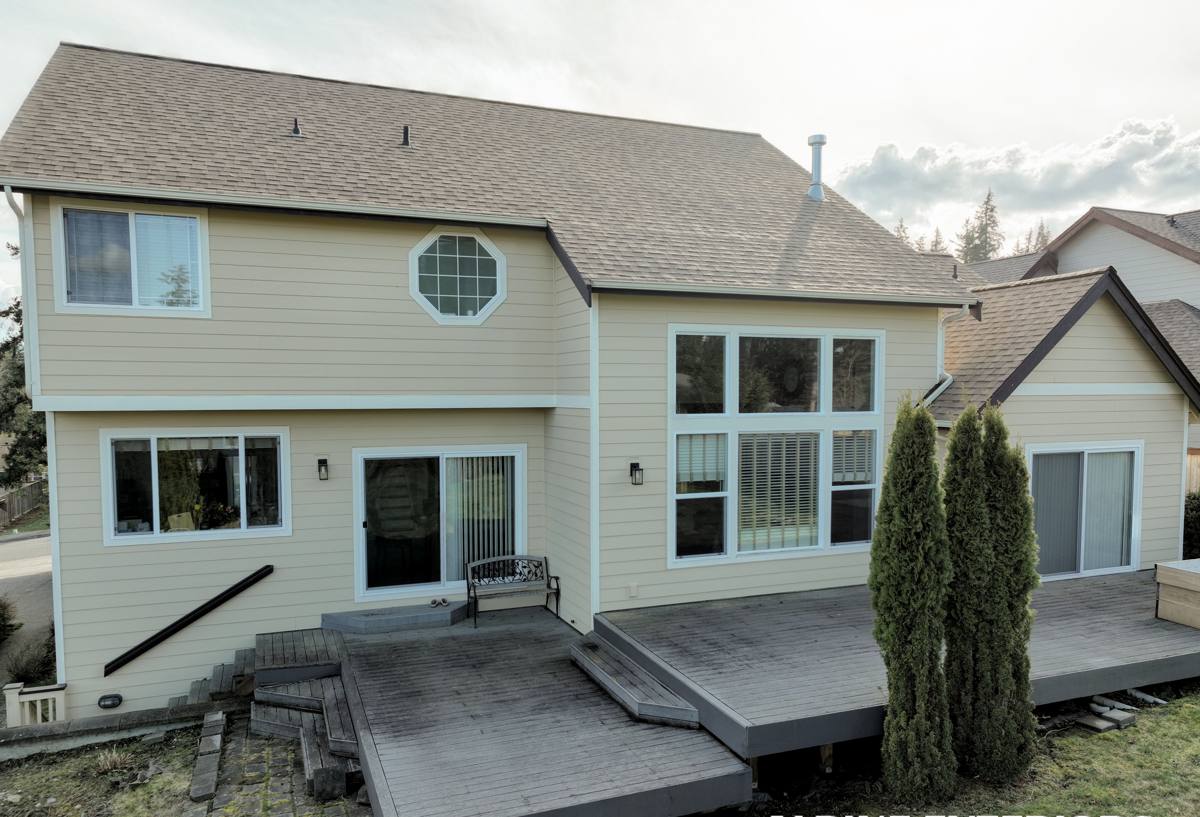
What a Correct Installation Actually Involves
Most composite deck problems we get called out to fix aren't a bad board — they're a shortcut taken during the build. In a wet climate, those shortcuts show up faster than they would somewhere dry.
Framing and Structure
Composite boards are heavier than wood and move differently with temperature. Joist spacing needs to match the manufacturer's span rating for the board profile you're using, not just "what we always do." We check joist condition, spacing, and ledger attachment before any composite goes down — a composite deck installed over undersized or already-softening framing will still fail, it'll just take the framing with it while the boards look fine on top.
Joist Protection and Drainage
We run joist tape over the top of every joist and beam. It's a small material cost that stops water from sitting on end grain and fastener penetrations — the number one cause of hidden rot under decks that "shouldn't" have a moisture problem. We also make sure the deck has somewhere for water to go: proper slope away from the house, gaps at the rim, and no dead zones where leaves and moss debris can pack in and hold moisture against the structure all winter.
Fastening and Board Gapping
Composite expands and contracts with temperature more than most homeowners expect. Gapping has to account for the board's actual moisture content and the ambient temperature on install day, not a fixed number pulled from memory. Hidden fastener systems need to be the ones rated for that specific board profile — mixing systems or overdriving fasteners is a common cause of squeaking, board lift, and warranty denial down the road.
Choosing the Right Board for This Climate
Not all composite decking handles a wet, mossy Pacific Northwest yard the same way. The biggest choice is capped versus uncapped composite.
- Capped composite has a plastic polymer shell wrapped around a wood-plastic core. This shell resists moisture absorption and staining, which matters a lot given how much of the year this region spends damp. It's what we recommend for the large majority of Lynden-area decks.
- Uncapped composite is more affordable up front but the exposed core can absorb some moisture and is more prone to surface mold and fading over time in a climate that doesn't get much of a hard dry-out period.
- Board texture matters more here than in drier climates — a heavily embossed wood-grain finish can actually trap moisture and organic film in the grooves, giving moss and algae something to grip. Flatter, tighter-grain finishes are easier to keep clean.
We don't push one manufacturer over another as a blanket rule — the right choice depends on your budget, the deck's sun exposure, and how much upkeep you actually want to do. What we won't do is install a board profile or fastening system that isn't rated for the framing and climate conditions on your property, even if it's the cheaper option, because we're the ones who get the call when it fails early.
Composite vs. Wood vs. PVC: A Straight Comparison
| Material | Moisture Behavior in This Climate | Maintenance | Typical Lifespan Here |
|---|---|---|---|
| Pressure-treated wood | Absorbs and releases water; prone to cupping, splintering, and moss growth in shaded, damp spots | Annual cleaning, periodic staining/sealing | 10–15 years before major repair |
| Cedar | Naturally rot-resistant but still absorbs moisture; graying and softening over time without upkeep | Regular sealing to hold color and resist moisture | 15–20 years with consistent care |
| Uncapped composite | Core can absorb some surface moisture; more prone to mold film in shaded areas | Periodic scrubbing to prevent staining | 20–25 years |
| Capped composite | Shell resists water absorption and staining, best fit for prolonged wet seasons | Occasional rinsing and soft-brush cleaning | 25–30+ years, per manufacturer warranty |
| PVC decking | Fully synthetic, essentially no moisture absorption | Low; rinse to remove surface debris | 25–30+ years |
For most Lynden homeowners, capped composite hits the best balance of upfront cost, long-term durability against our rain and moss patterns, and appearance that still reads as a real deck surface rather than plastic.
Living With a Long Moss Season
Even the best composite deck needs some seasonal attention here — the difference is how forgiving that maintenance is compared to wood.
- Sweep leaves and needles off the deck regularly in fall; trapped organic debris is what feeds moss and algae growth, not the board material itself.
- Rinse shaded, low-airflow areas more often — north-facing decks and spots under trees stay damp longer and are where moss establishes first.
- Use a soft-bristle brush and a composite-safe cleaner for seasonal deep cleaning; pressure washers can be used carefully but the wrong nozzle or distance can etch the board surface.
- Keep gutters and downspouts clear so runoff isn't dumping extra water directly onto or under the deck.
- Check board-to-board gaps once or twice a year to make sure debris hasn't packed in tight enough to trap moisture against the edges.
Our Process for a Lynden Composite Deck
We start with an on-site look at the existing structure or the build area, including drainage patterns, sun/shade exposure, and how the deck ties into the house. From there we walk through board options and framing needs specific to that site, not a generic package. During the build, we handle joist protection, correct fastening, and proper drainage as standard practice, not an upsell. When it's done, we walk the deck with you and explain what upkeep — if any — that specific board line needs.
Why Local Experience Matters Here
A composite deck built to a spec sheet written for a dry climate doesn't automatically perform the same way in Whatcom County. Framing details that are optional in Arizona are not optional a few miles from the water in Ferndale or out in the Lynden valley, where a deck can sit damp for days at a time in the winter. A crew that works this area regularly has already seen which board profiles hold up, which fastening systems loosen over a few wet-dry cycles, and where drainage mistakes turn into a soft joist two years later instead of ten. That experience shows up in details you won't notice until they either hold up — or don't.
Signs an Existing Deck Needs Attention
- Boards that feel spongy, uneven, or have visible cupping
- Persistent green or black staining that returns quickly after cleaning
- Fasteners backing out or visible board movement underfoot
- Gaps between boards that have closed up or widened unevenly
- Any soft spot in the framing when checked from underneath
Cost Factors to Expect
| Factor | Why It Affects Price |
|---|---|
| Board tier (uncapped vs. capped vs. PVC) | Material cost and expected lifespan scale together |
| Framing condition | Existing rot or undersized joists may need replacement before decking goes down |
| Deck size and shape | Cuts, picture-framing, and multiple levels add labor |
| Railing and fascia choices | Composite and metal railing systems vary widely in cost |
| Site access | Tight lots or elevated decks can increase labor time |
We'll always give you the real range for your specific project rather than a number that sounds good on the phone and changes once we're on site.
If you're planning a new composite deck or dealing with one that's not holding up the way it should, we're happy to take a look and give you a straightforward, no-pressure estimate. Fill out the form below and we'll get back to you.