 Ferndale
 Why Custer Roofs Wear Differently Than Roofs Inland
Custer sits close enough to the water that homes here deal with a different set of stresses than a roof twenty miles inland. The marine air carries salt that settles on shingles, flashing, and fasteners, slowly working on anything that isn't rated for it. Add in the driving rain that Whatcom County sees for a good chunk of the year — often coming in sideways on windy days — and you've got water finding its way into laps, valleys, and fastener lines that a calmer climate would never test. Then there's moss. The combination of shade, moisture, and mild temperatures gives moss a long growing season here, and once it gets a foothold on a roof it holds water against the shingle surface far longer than plain rain ever would.
None of this means Custer homes need exotic materials or gimmicks. It means the ordinary parts of a roof replacement — underlayment choice, fastener quality, ventilation, flashing detail — matter more here than they would somewhere dry and calm. A roof that's merely "up to code" can still underperform in this climate if those details are treated as an afterthought.
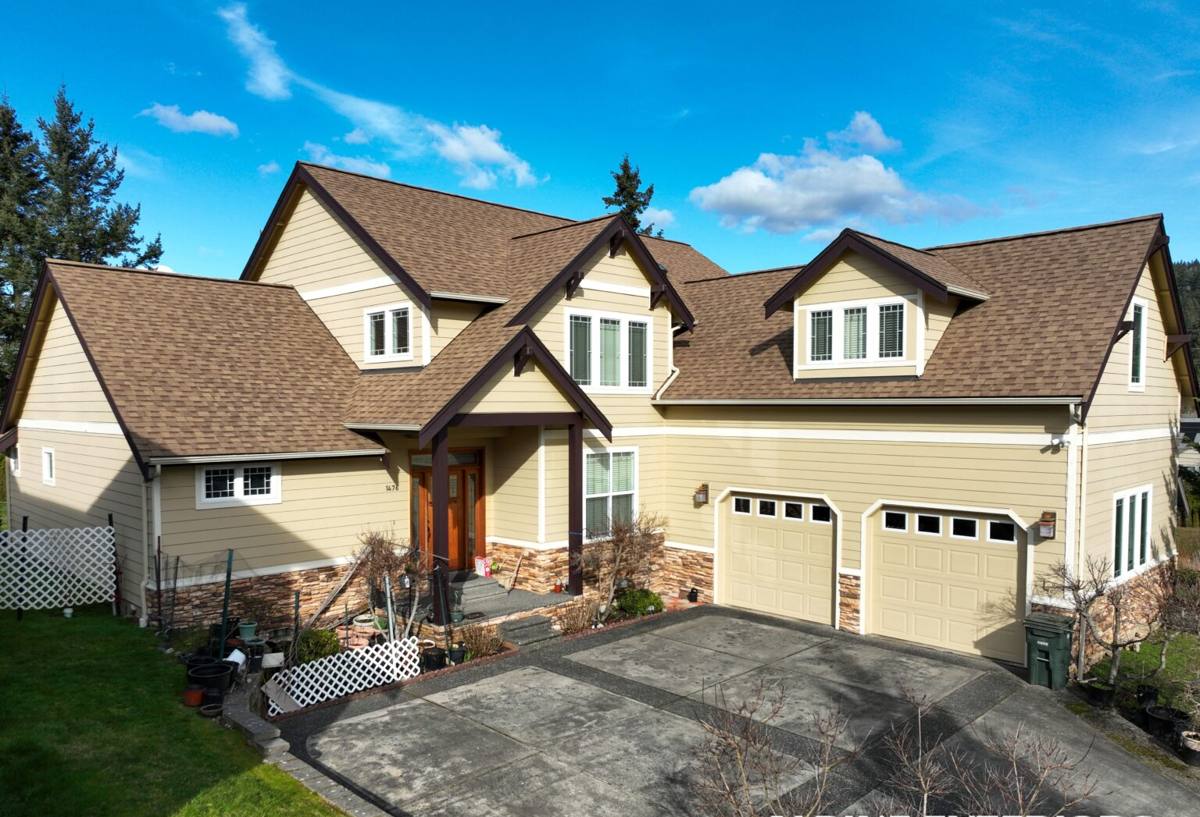
Signs Your Custer Home Needs a Replacement, Not Just a Repair
Most roofs give warning signs well before they fail outright. The trick is knowing which signs point to a patch job and which point to a full replacement.
- Granules collecting in gutters or at downspouts in noticeable amounts, especially on a roof over 15 years old
- Shingles that are cupping, curling at the edges, or cracking in multiple areas rather than one isolated spot
- Moss or dark streaking that keeps coming back within a season or two of cleaning
- Soft spots in the decking you can feel when walking the roof, or sagging visible from the ground
- Daylight visible through the roof deck from inside the attic, or water stains on ceilings after heavy rain
- Flashing around chimneys, vents, or skylights that's rusted, lifted, or was never properly step-flashed to begin with
One or two of these in isolation can often be repaired. Several at once, especially on a roof that's already past its expected service life, usually means repair costs start adding up toward what a replacement would run — without solving the underlying problem.
When a Repair Is the Honest Answer
We'll say so if a repair is the right call. A localized leak from a single damaged flashing detail, a small area of storm damage, or a handful of cracked shingles doesn't justify tearing off a roof that otherwise has years left in it. Replacing a whole roof early wastes money that's better spent maintaining what you have.
Roofing Materials That Hold Up Near the Coast
Material choice matters more in a salt-air, high-moisture climate than it does elsewhere. Here's how the common options compare for a Custer home specifically.
| Material | Coastal / Moisture Performance | Moss Resistance | Typical Lifespan |
|---|---|---|---|
| Architectural asphalt shingles | Good, when paired with proper underlayment and corrosion-resistant fasteners | Moderate — benefits from algae-resistant granules and periodic cleaning | 25–30 years |
| 3-tab asphalt shingles | Fair — thinner profile is more sensitive to wind-driven rain | Lower unless treated | 15–20 years |
| Standing seam metal | Excellent when using coastal-rated coatings and stainless or coated fasteners | High — sheds moisture quickly, little surface for moss to grip | 40–60 years |
| Cedar shake | Requires diligent maintenance in a wet, mossy climate | Low without regular treatment and cleaning | 20–30 years with upkeep |
For most Custer homes, a well-installed architectural asphalt shingle with algae-resistant granules is the practical middle ground — it holds up to the driving rain and salt exposure without the higher upfront cost of metal. Metal earns its keep on homes where the owner wants the longest possible interval between roof projects, or where moss has been a persistent, repeat problem.
What a Correct Roof Replacement Actually Involves
A roof replacement isn't just stripping old shingles and nailing on new ones. Done right, it's a sequence of decisions that each affect how the roof performs in this specific climate.
Tear-Off and Deck Inspection
Full tear-off lets us see the actual condition of the decking underneath — something you can't evaluate from a re-roof over existing layers. Any soft, delaminated, or water-damaged sheathing gets replaced before anything new goes down. Skipping this step is the single most common shortcut that leads to problems years later.
Underlayment and Ice-and-Water Protection
In a climate with sustained wind-driven rain, synthetic underlayment does a better job than old-style felt at resisting water intrusion during the window between tear-off and final shingle coverage — and for the life of the roof if wind ever lifts a shingle edge. Valleys, eaves, and any low-slope transitions get self-adhering ice-and-water membrane, which matters here even though hard freezes aren't the primary concern — the same membrane resists wind-driven rain intrusion at vulnerable points.
Flashing Detail
Chimneys, skylights, sidewall intersections, and roof-to-wall transitions are where most leaks actually start — not in the open field of shingles. Proper step flashing and counter-flashing, rather than relying on caulk or roof cement as the primary seal, is what keeps these areas dry for the long term.
Fasteners and Hardware
Salt air corrodes standard fasteners faster than it does in inland climates. We use corrosion-resistant nails and hardware throughout, and stainless or coated fasteners on metal components, so the roof isn't quietly failing at the fastener level while the shingles above look fine.
Ventilation and Moisture Control: The Part Most Roofs Get Wrong
A roof replacement is also a chance to fix ventilation problems that are invisible from the ground but shorten a roof's life dramatically. Attics that don't exchange air properly trap moisture from everyday household humidity, and in a climate as wet as Whatcom County's, that moisture has nowhere good to go. Over time it condenses on the underside of the decking, promotes rot, and can void a shingle manufacturer's warranty outright.
Balanced ventilation means intake at the eaves and exhaust at or near the ridge, sized correctly for the attic's square footage. We check this on every replacement rather than assuming the existing setup was done correctly the first time — a lot of older homes in this area were built before current ventilation standards were common practice.
Our Roof Replacement Process, Start to Finish
- On-site inspection and estimate. We walk the roof, check the attic, and give you an honest assessment — repair or replace — along with a written estimate before any work starts.
- Material selection. We walk through the options that make sense for your home, budget, and exposure, without pushing a product that doesn't fit either.
- Scheduling around the weather. Whatcom County's rain patterns mean timing matters. We plan tear-off in windows where we can get the deck protected and dried in before weather moves through.
- Tear-off and deck repair. Old material comes off, decking gets inspected, and any damaged sheathing is replaced before we move forward.
- Underlayment, flashing, and ventilation work. The parts that don't show once the roof is finished, done in the sequence that keeps water out.
- Shingle or material installation. Installed to manufacturer specification, which is also what keeps the material warranty valid.
- Cleanup and final walkthrough. Magnetic sweep for nails, full site cleanup, and a walkthrough so you know exactly what was done.
What Affects the Cost of a Roof Replacement
Every roof is different, but the same handful of factors drive most of the cost variation we see on Custer homes.
| Factor | How It Affects Cost |
|---|---|
| Roof size and complexity | More valleys, dormers, and roof planes mean more labor and flashing work |
| Current layers of roofing | Removing multiple old layers costs more than a single-layer tear-off |
| Decking condition | Rotted or soft sheathing needs replacement, which adds material and labor |
| Material choice | Asphalt shingles cost less upfront than metal; metal costs less over a longer ownership horizon |
| Access and pitch | Steep roofs or difficult access require more safety setup and time |
| Ventilation upgrades | Adding or correcting intake/exhaust venting is a smaller add-on cost during a replacement than as a standalone project later |
We don't quote a number without seeing the roof. Broad ranges you'll see online rarely account for decking condition or complexity, and we'd rather give you an accurate figure after a real inspection than a low estimate that grows once we're up there.
Why a Crew That Already Works Custer and Ferndale Makes a Difference
A roof replacement isn't just about the materials — it's about the crew's familiarity with how homes in this specific area were built and what conditions they've been sitting in. Knowing what to expect from decking on homes of a certain age in this part of Whatcom County, how local weather windows typically run, and where permitting and inspection requirements apply saves time and avoids surprises mid-project. A crew that's already worked roofs in Custer and around Ferndale isn't learning the area's quirks on your job — that groundwork is already done, which tends to show up as fewer change orders and a more accurate original estimate.
There's also a practical logistics side: being local means a faster response if weather threatens a project mid-tear-off, and a shorter wait if a warranty question or minor follow-up item comes up after the job is finished.
Protecting Your New Roof: A Homeowner's Maintenance Checklist
A correctly installed roof still needs basic upkeep to hit its full lifespan in this climate. A few simple habits go a long way.
- Clear gutters and downspouts at least twice a year so water isn't backing up under the shingle edge
- Keep overhanging branches trimmed back to reduce shade, debris, and the conditions moss prefers
- Have moss treated or gently removed before it spreads, rather than waiting until it's visible from the street
- Walk the attic once a year and check for damp insulation, daylight gaps, or musty odors
- After any major windstorm, do a visual check from the ground for lifted or missing shingles
- Schedule a professional inspection every few years, even if nothing looks obviously wrong
Getting a No-Pressure Estimate
If your Custer home's roof is showing its age, or you just want an honest read on how much life it has left, we're happy to take a look. There's no obligation and no pressure — just a straightforward inspection and a clear explanation of what we find. Use the form below to request a free estimate.