 Ferndale
 Why Blaine Homes Take a Different Kind of Beating
Blaine sits about as close to the water and the Canadian border as a Whatcom County home can get, and that location comes with a specific combination of punishment: salt-laden air moving in off the water, long stretches of driving rain through the fall and winter, and short winter days that never quite dry things out before the next system rolls through. Add in the deep shade many Blaine lots get from mature evergreens, and you have ideal conditions for moss, algae, and slow moisture intrusion to take hold on siding that isn't built or installed to handle it.
None of that damage happens overnight. It shows up as a soft spot near a window trim, a section of siding that stays damp two days after everyone else's has dried, or a green-black film creeping up from the bottom courses. By the time most homeowners notice a problem, the siding has usually been dealing with it quietly for a season or two. That's the case for repair — catching it before a small, fixable issue becomes a full re-side.
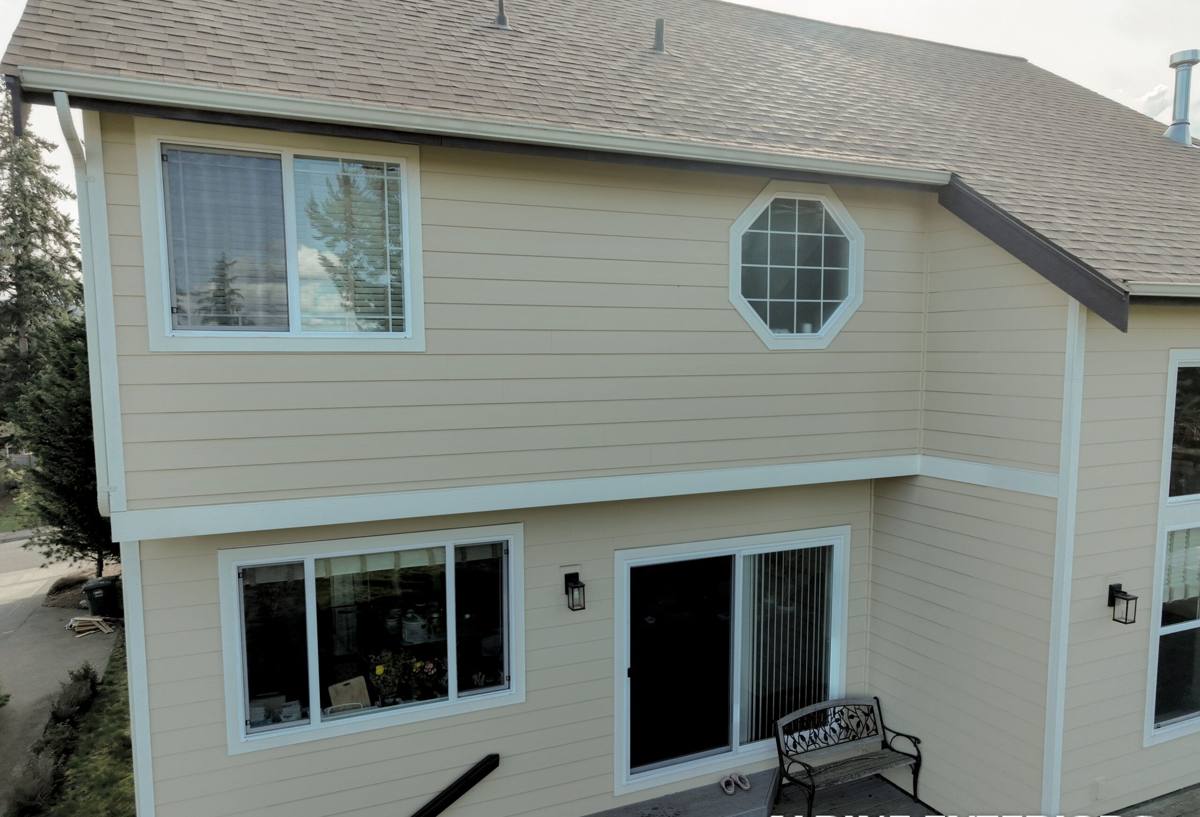
What Blaine's Climate Actually Does to Siding Over Time
It helps to understand the mechanism, not just the symptom. In a coastal, high-moisture climate like Blaine's, siding fails in a few predictable ways:
- Salt air accelerates corrosion on fasteners, flashing, and any exposed metal trim — a rusted nail head or corroded flashing joint is often the actual entry point for water, not the siding material itself.
- Prolonged dampness feeds moss and algae, which hold moisture against the surface far longer than rain alone would, softening substrates that aren't moisture-resistant by design.
- Repeated wet-dry cycling stresses joints and seams — caulking fails, panels shift slightly, and gaps open up that weren't there when the siding was installed.
- Shaded, slow-drying wall sections age faster than sun-exposed walls on the same house, which is why damage is so often concentrated on one side of a home rather than spread evenly.
Any siding material will experience some version of this. The difference is how much damage accumulates before it becomes visible, and how the material behaves once moisture does get in — which is a big part of why we standardized on one product system rather than installing whatever a homeowner already has.
Signs a Blaine Home Needs Repair — Not a Full Re-Side
Most of the calls we get in this area fall into one of two categories: localized damage that a proper repair will resolve for years, or widespread failure where patching one section just means the next section fails six months later. Knowing which one you're looking at matters, because a repair done on siding that's already failing system-wide is money spent twice.
Good candidates for repair
- Isolated soft spots, cracks, or impact damage in an otherwise sound wall
- Moss or algae staining that hasn't yet caused the substrate underneath to soften
- Failed caulking or trim at windows, doors, or corner boards, with the siding field itself still solid
- Damage from a specific event — a fallen branch, a pressure washer used too aggressively, a one-time water intrusion
Signs it's past repair
- Soft, spongy siding in multiple locations across more than one wall
- Visible delamination, buckling, or warping on wood-based or engineered wood products
- Water staining on interior walls near exterior siding, suggesting moisture has already reached the sheathing
- Siding that's been patched more than once in the same spot in recent years
We'll tell you honestly which category your home falls into. A repair-first approach only makes sense when the underlying structure is sound — if it's not, we'll say so rather than sell you a patch that won't last through another wet season.
What a Correct Siding Repair Actually Involves
A repair that just replaces the visible damaged piece and stops there is the most common shortcut we see, and it's usually why the same spot fails again within a year or two. A repair done right addresses what's underneath, not just what's visible from the curb.
The steps that matter
- Find the actual water path. Damage rarely appears exactly where water is entering — it tracks along framing and sheathing before showing up somewhere lower or to the side. We trace it back rather than just patching the visible spot.
- Check the sheathing and framing underneath. If water has been getting in for a while, the wood behind the siding may need attention before new siding goes back on. Covering rot with new siding just hides the problem.
- Correct the flashing and house wrap, not just the siding. Most siding failures near windows, doors, and roof lines trace back to flashing that was missing, reversed, or improperly lapped — the siding is often the innocent bystander.
- Match the replacement material and profile. Repairs that use the wrong reveal, thickness, or texture stand out permanently and can create their own water traps at the seams.
- Re-seal and re-paint to match. ColorPlus-finished Hardie panels and trim are factory color-matched, which makes blending a repair section far more reliable than trying to field-match a stain or paint color years after original installation.
Why Repair Behavior Differs by Siding Material
Not every siding material responds to moisture, repair, and re-matching the same way. This matters specifically in a climate like Blaine's, where repairs happen more often and need to hold up in wetter conditions than most.
| Material | Common failure mode in this climate | Repair difficulty |
|---|---|---|
| Vinyl siding | Warping/cracking from moisture cycling and UV; color fades unevenly over time | Old panels are often discontinued or sun-faded, making color-matched patches hard to find |
| Cedar / primed wood | Rot and moss growth where moisture sits against the grain | Requires ongoing refinishing; a patched section needs repainting to blend and can still absorb moisture at the seam |
| LP SmartSide / engineered wood | Edge swelling and delamination if moisture reaches the strand board core | Damaged panels typically need full replacement, not spot repair, once the core has absorbed water |
| James Hardie fiber cement | Primarily wear at caulking, flashing, and fastener points rather than the panel material itself | Non-combustible, moisture-resistant core holds up to patch repair without the panel itself degrading further |
This is a large part of why we install James Hardie exclusively rather than servicing whatever product happens to already be on a house. Fiber cement doesn't swell, delaminate, or rot the way wood-based products can when water finds a way in — which means a repair on Hardie siding is addressing a localized issue, not chasing a material that's failing everywhere at once.
Our Repair Process for Blaine Homes
Because we work in Ferndale and the surrounding Whatcom County coastline regularly, we've seen how the same climate conditions play out differently from one Blaine property to the next depending on tree cover, wall orientation, and how the home was originally built and flashed. Our process reflects that:
- On-site inspection first. We look at the damaged area and the walls around it — repair recommendations are based on what we find, not a phone estimate.
- Moisture check behind the siding. Where damage suggests water has been present for a while, we check the sheathing before quoting a fix.
- Honest repair-vs-replace guidance. If a full section or wall makes more sense than a patch, we'll explain why — and if a patch will genuinely hold, we won't upsell a bigger job.
- Matched materials and finish. For homes already on Hardie, we match panel profile and ColorPlus finish so repairs blend in rather than becoming a visible patch.
- Attention to flashing and sealant details. Since these are the actual failure points in most of the repairs we see, we don't consider the job done until they're corrected — not just covered.
Repair vs. Replacement: What Actually Drives the Cost
Homeowners often want a single number, but siding repair cost depends on a handful of factors that are worth understanding before you get quotes.
| Factor | Why it matters |
|---|---|
| Extent of hidden moisture damage | Sheathing or framing repair adds real cost but is not optional if it's compromised |
| Material match availability | Matching an existing product's color and profile can be simple or difficult depending on age and manufacturer |
| Number and location of damaged sections | Scattered damage across several walls starts to approach the cost of a partial re-side |
| Access and wall height | Second-story or hard-to-access sections require more setup time |
| Flashing and trim condition | Correcting the actual water entry point, not just the siding, is part of a lasting repair |
We'd rather walk your property and give you real numbers than throw out a broad range that doesn't reflect what's actually happening on your walls.
Why a Ferndale-Based Crew That Already Works Blaine Matters
Siding repair isn't just a swap-the-part job — it requires understanding how a specific region's weather actually attacks a wall over time. Working throughout Ferndale and out to Blaine on a regular basis means we're not guessing at how moss establishes itself on shaded elevations here, how salt air affects fasteners near the water, or how much rain exposure a given wall orientation gets through a typical winter. That local pattern recognition is what keeps a repair from becoming a repeat visit.
It also means we're a known, reachable crew if a question comes up after the work is done — not a company that did one job in the area and moved on. For coastal Whatcom County homes, where the climate keeps testing every seam and joint year-round, that ongoing accountability matters as much as the repair itself.
After the Repair: Keeping Blaine Siding in Good Shape
A correct repair buys you years, but a little routine attention afterward buys you more. In this climate, we recommend homeowners keep an eye on:
- Moss or algae buildup on shaded walls — address it early with gentle cleaning rather than letting it establish
- Caulking at trim, windows, and corner boards — it's usually the first thing to fail again, and the cheapest to catch early
- Gutters and downspouts directing water away from siding, especially during heavy fall and winter rain
- Any soft spots or discoloration that reappear in the same location — a recurring issue usually means the underlying cause wasn't fully resolved
- Foundation plantings or shrubs kept trimmed back from siding to allow airflow and drying
If you're noticing damage, soft spots, or persistent moss on your Blaine home's siding, we're happy to take a look and give you a straightforward, no-pressure assessment of what it actually needs — repair, partial replacement, or nothing urgent at all. Fill out the form below for a free estimate.