 Ferndale
 Why Birch Bay's Climate Is Hard on Siding
Birch Bay sits right on the water, and that location is exactly what makes siding decisions here different from siding decisions ten miles inland in Ferndale proper. Homes along the bay take a steady diet of salt-laden air, wind-driven rain off the Strait of Georgia, and a long stretch of gray, wet months that give moss and algae plenty of time to take hold. Any siding product can look fine in a showroom. Whether it actually holds up depends on how well it handles moisture, salt exposure, and constant damp shade — conditions Birch Bay has in abundance.
This page is about one job in one place: installing fiber cement siding correctly on a Birch Bay home. Not a general overview of siding options, and not a sales pitch — just what the climate actually does to a house here, what a correct installation needs to account for, and why the crew doing the work matters as much as the material itself.
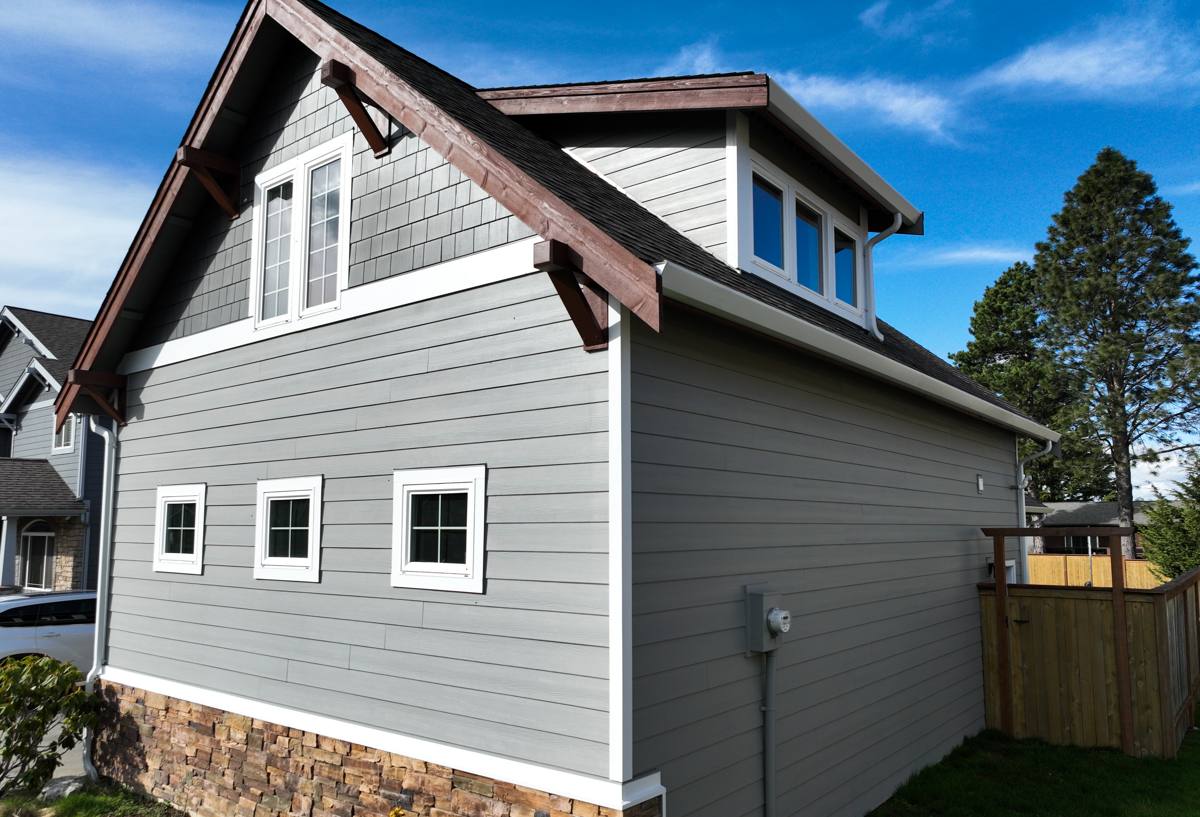
What Salt Air, Driving Rain, and Moss Season Do to a House
Salt Air and Corrosion
Airborne salt doesn't just affect boats and dock hardware. It settles on exterior surfaces, works into fasteners, trim, and any exposed metal, and accelerates corrosion on anything not rated for coastal exposure. Over years, that corrosion can loosen fasteners, stain lighter-colored finishes, and degrade caulking and sealants faster than the same products would wear inland. Siding, trim, and the fasteners holding them on all need to be chosen with that exposure in mind, not treated as an afterthought.
Wind-Driven Rain and Water Intrusion
Whatcom County gets plenty of rain generally, but Birch Bay's exposure to open water means storms often arrive with real wind behind them. Wind-driven rain doesn't fall straight down — it gets pushed sideways and upward, finding its way behind siding through gaps that would never be a problem in a calmer, more sheltered location. That means flashing details, water-resistive barriers, and butt joint treatment matter more here than they would on a home tucked away from the water.
Moss, Algae, and the Long Wet Season
Shaded, north-facing walls and anything near mature trees stay damp for extended stretches through fall, winter, and spring. That damp, low-light environment is exactly what moss and algae need to establish themselves on a wall surface. Once organic growth takes hold on a porous or poorly finished surface, it holds moisture against the wall longer, which compounds the problem. Siding with a durable, factory-cured finish resists that buildup far better than field-painted or lower-grade surfaces.
Why James Hardie Fiber Cement Is What We Install Here
We install James Hardie fiber cement siding exclusively — not vinyl, not LP SmartSide, not primed wood, and not other fiber cement brands. That's a deliberate standard, not a limitation of what we're capable of installing. On a coastal Whatcom County property, the trade-offs of those other products (moisture sensitivity, shorter finish life, more frequent maintenance) show up faster than they would somewhere drier and more sheltered, and we'd rather stand behind one system we know performs than offer a menu of products with very different long-term outcomes.
Engineered for Damp, Marine-Influenced Climates
James Hardie makes climate-specific product lines, including an HZ5 formulation engineered for regions with significant moisture exposure. Fiber cement itself is dimensionally stable — it doesn't swell, warp, or rot the way wood-based products can when they take on repeated moisture cycles. That matters directly in a location where the siding is dealing with rain, salt spray, and prolonged damp shade in the same year.
A Factory Finish, Not a Field Finish
James Hardie's ColorPlus finish is baked on at the factory under controlled conditions, rather than brushed or sprayed on site. That finish resists fading and holds up to UV and moisture exposure better than a standard field-applied paint job, and it gives a harder, more consistent surface for resisting the kind of organic growth that thrives in Birch Bay's wet months. It's also non-combustible, which is a genuine advantage during wildfire smoke and ember seasons that have become more common across the Pacific Northwest.
What a Correct Fiber Cement Siding Installation Actually Involves
Fiber cement is only as good as the installation behind it. The material can be excellent and the finished wall can still fail early if flashing, fastening, and clearances aren't handled correctly — and in a high-exposure location like Birch Bay, mistakes show up sooner than they would somewhere more sheltered.
| Detail | Common Shortcut | Correct Practice |
|---|---|---|
| Fasteners | Standard fasteners not rated for coastal exposure | Corrosion-resistant fasteners specified for the exposure level |
| Butt joints | Caulk relied on as the only water barrier | Proper flashing or joint treatment behind the caulk line |
| Ground clearance | Siding installed close to grade or hardscape | Manufacturer-specified clearance maintained above grade, decks, and walkways |
| Water-resistive barrier | Barrier gaps or poor lap sequencing | Continuous, properly lapped barrier behind the siding |
| Cut edges | Field cuts left unsealed | Cut edges sealed per manufacturer instructions |
Before we consider a fiber cement installation finished, we confirm each of these items on every job:
- Fasteners and trim hardware rated for coastal, high-moisture exposure
- Water-resistive barrier installed continuously with correct laps, no gaps
- Flashing installed at every window, door, and horizontal transition
- Manufacturer-specified clearance maintained at grade, roofs, decks, and walkways
- All field cuts sealed, not left exposed to moisture
- Fastener spacing and placement matching James Hardie installation specifications
Our Process for a Birch Bay Fiber Cement Siding Project
- On-site assessment: We walk the exterior, check current siding and moisture damage, and identify exposure areas specific to the property's orientation toward the water.
- Plan and product selection: We recommend the James Hardie product line, profile, and color that fit the home and its exposure, and outline the flashing and barrier details the job requires.
- Written estimate: A clear scope and price before any work begins, no pressure to decide on the spot.
- Prep and tear-off: Removal of existing siding, inspection of sheathing for hidden moisture damage, and repair of any compromised framing or sheathing before new material goes up.
- Barrier and flashing installation: The water-resistive barrier and flashing details go in first — this is the step that determines whether the wall stays dry for the next several decades.
- Siding installation: Installed to James Hardie specifications for fastening, clearance, and joint treatment.
- Final walkthrough: We review the finished work with the homeowner and confirm everything matches what was scoped.
Cost Factors for Fiber Cement Siding in Birch Bay
Every home is different, so we don't quote pricing until we've seen the property, but the factors below are what typically move a project's cost up or down.
| Factor | Why It Affects Cost |
|---|---|
| Existing siding condition | Hidden moisture or rot behind old siding adds repair scope before new siding goes up |
| Home size and wall complexity | More corners, dormers, and trim detail mean more labor and material cuts |
| Exposure level | Walls facing the water directly may need additional flashing detail versus more sheltered elevations |
| Product line and profile | Plank width, texture, and color selection affect material pricing |
| Site access | Waterfront lots and tighter properties can affect staging and labor time |
Why Hiring a Crew That Already Works in Birch Bay Matters
A siding crew that mostly works inland, drier neighborhoods can do a technically fine installation and still miss details that matter specifically near the water — under-specifying fastener corrosion resistance, skipping extra flashing attention at exposed elevations, or not accounting for how much longer a shaded, damp wall stays wet after a storm. None of that shows up as a problem on day one. It shows up in year five or year ten, as premature fastener staining, early caulk failure, or moss establishing itself faster than it should on a properly finished wall.
Working regularly in Birch Bay and the surrounding Whatcom County coastline means we've already made the adjustments that matter here part of our standard process, not a special add-on. That's less about local familiarity as a talking point and more about not treating a waterfront home the same as one three miles inland when the exposure genuinely is different.
Maintenance After Your New Siding Is Installed
James Hardie fiber cement is low-maintenance compared to wood-based sidings, but "low-maintenance" isn't "no-maintenance," especially in a salt-air, high-moss environment. A few simple habits go a long way toward protecting the investment:
- Rinse the exterior periodically to clear salt residue and surface debris, especially on water-facing walls
- Keep gutters clear so water is directed away from the siding rather than overflowing down the wall face
- Trim back vegetation that shades walls and keeps them damp longer than necessary
- Check caulking at trim and joints every year or two and have any cracked sections resealed promptly
- Address any moss or algae growth early with a gentle wash rather than letting it establish and spread
If you own a home in Birch Bay and want a straight answer about what your siding actually needs given the exposure it's dealing with, we're happy to take a look. Reach out for a free, no-pressure estimate using the form below.