 Ferndale
 Birch Bay's Waterfront Climate Is Rough on Decks
Birch Bay sits right on the water, and that changes what a deck has to survive compared to a deck built a few miles inland. Salt-laden air off the bay accelerates corrosion on fasteners and metal hardware, wind-driven rain gets pushed sideways into joints and ledger connections that would stay dry elsewhere, and the long, damp Whatcom County shoulder seasons keep surfaces wet longer between dry-outs. Add in tree cover on many Birch Bay lots and you get a moss season that can run from fall through spring.
None of that is unusual for this part of Washington. But it does mean a deck built with generic assumptions — standard hardware, minimal airflow underneath, boards run without attention to drainage — tends to show problems here faster than the same deck would somewhere drier. Composite decking earns its keep in this environment when it's installed with those conditions in mind, not just laid down like a wood deck with different boards.
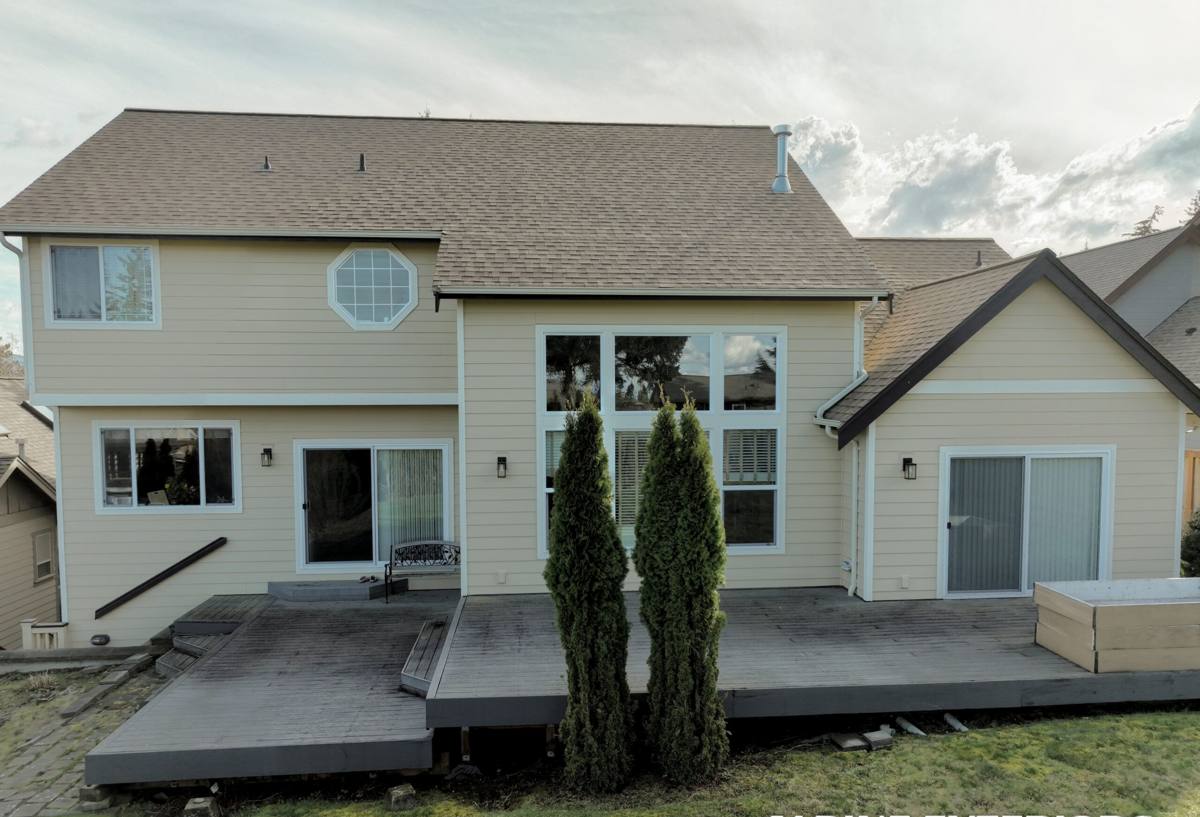
What Composite Decking Actually Solves for Birch Bay Homes
Composite boards don't absorb water the way wood does, so they don't swell, cup, or hold rot the same way. They don't need annual staining or sealing, which matters on a waterfront property where salt film and moisture make maintenance more of a chore than it is inland. And because composite doesn't provide the same food source for spores that raw wood does, it's more resistant to the moss and algae growth that's common on shaded Birch Bay lots — though it's not immune, and we'll get into why below.
What composite doesn't solve on its own is bad substructure design. The framing, flashing, fasteners, and drainage underneath the boards still have to be right, or moisture gets trapped where you can't see it and the structure underneath suffers even while the decking on top looks fine. That's the part of the job that actually determines how a deck performs in a place like Birch Bay.
Where Salt Air Does the Most Damage
- Uncoated or poorly plated fasteners and brackets, which corrode faster near the water and can stain boards as they fail
- Aluminum or low-grade railing hardware exposed to salt spray
- Ledger board connections at the house, where a slow water leak plus salt exposure accelerates hidden wood decay
- Any metal-to-metal contact point that isn't isolated or properly coated
What a Correct Composite Deck Installation Involves
A composite deck is only as good as what's underneath it. Here's what we treat as non-negotiable on every install, Birch Bay or otherwise:
Framing and Fasteners
We use fasteners and structural hardware rated for coastal or wet-use exposure, not the standard-grade hardware that's fine 20 miles inland but corrodes faster in salt air. Joist spacing follows the manufacturer's specification for the board profile being used — composite boards vary in how much span they can handle, and undersized framing shows up later as bounce or long-term sagging between joists.
Ledger Attachment and Flashing
Where the deck attaches to the house is the single most common point of hidden water damage on any deck, composite or wood. Proper flashing at the ledger board keeps water from tracking behind the siding and into the wall structure — this is exactly the kind of detail that gets rushed on lower-bid jobs and doesn't cause a visible problem until years later.
Ventilation and Drainage Underneath
Composite boards need airflow beneath them just as much as wood does, arguably more in a wet climate, because trapped moisture under a low deck with poor ventilation creates a damp microclimate that promotes mold and mildew on the underside of boards and on the framing itself. We build in ventilation gaps and grade the ground or substructure to shed water rather than pool it.
Fastening the Boards
Hidden fastener clip systems are standard on most composite installs now — they avoid the surface holes that collect grit and moisture, and they allow the boards to expand and contract with temperature swings without splitting or binding, which matters through Whatcom County's seasonal shifts.
Composite vs. Wood vs. PVC: How They Hold Up Near the Water
| Factor | Composite | Pressure-Treated Wood | PVC/Cellular |
|---|---|---|---|
| Moisture resistance | High — won't rot, minimal swelling | Moderate — needs sealing, prone to rot at fasteners over time | Very high — fully synthetic, no organic material |
| Salt air exposure | Good, with coastal-rated hardware | Fasteners and metal hardware corrode faster; wood itself weathers | Excellent — least reactive to salt |
| Moss/algae resistance | Better than wood, not immune in heavy shade | Prone to moss and mildew, especially on north-facing or shaded decks | Best resistance, smooth surface sheds spores more easily |
| Maintenance | Occasional wash, no staining/sealing | Annual sealing or staining recommended | Lowest — occasional wash |
| Upfront cost | Mid-range | Lowest | Highest |
| Typical lifespan (properly installed) | 25-30+ years | 10-15 years before major repair/replace | 25-30+ years |
We install composite most often in Birch Bay because it hits a reasonable middle ground — meaningfully lower maintenance and better moisture behavior than wood, at a lower cost than full PVC systems. PVC has its place, particularly on very shaded or heavily wind-exposed sites, and we'll talk through that trade-off honestly if your lot calls for it.
Our Process, Start to Finish
- On-site assessment — we look at drainage, sun/shade exposure, existing structure (if this is a rebuild), and how close the deck sits to the water or prevailing wind.
- Design and material selection — board profile, color, railing system, and hardware grade chosen for the specific site conditions, not a one-size-fits-all package.
- Permitting — most deck work in Whatcom County requires a permit depending on size and height; we handle that process rather than leaving it to you.
- Demolition (if replacing an existing deck) — including an honest look at the ledger and framing underneath, since that's often where the real problems are hiding.
- Framing and flashing — built to the specification above, with coastal-appropriate hardware.
- Decking, railing, and finish work — hidden-fastener installation, railing, stairs, and any trim or fascia.
- Final walkthrough — we go over care and maintenance specific to your board choice and site before we call the job done.
Living With a Composite Deck in a Moss-Prone, Salty Climate
Composite is low-maintenance, not no-maintenance. In Birch Bay specifically, a few habits go a long way:
- Rinse salt film and organic debris off the surface periodically, especially after storms with onshore wind
- Keep gutters and downspouts near the deck clear so runoff isn't dumping extra water onto or under it
- Sweep leaves and needles off the boards through fall — trapped organic debris in shaded spots is what actually feeds moss and algae growth, not the composite material itself
- Wash with a soft-bristle brush and a mild deck cleaner rather than a pressure washer on high pressure, which can damage the board surface over time
- Check railing hardware and any exposed metal fasteners periodically for early corrosion, particularly on decks closest to the water
What Affects the Cost of a Composite Deck in Birch Bay
| Cost Factor | Why It Matters Here |
|---|---|
| Board tier/brand | Entry-level, mid-range, and premium composite lines vary significantly in price and warranty coverage |
| Substructure condition | Rebuilds on older decks often need full ledger and framing replacement, especially on waterfront lots with a history of moisture exposure |
| Hardware grade | Coastal-rated fasteners and brackets cost more than standard grade but matter for longevity in salt air |
| Deck height and railing requirements | Elevated decks need code-compliant railing systems, which add material and labor |
| Site access | Waterfront and hillside lots in Birch Bay can complicate material delivery and staging |
| Permitting scope | Size, height, and proximity to property lines affect what Whatcom County requires |
We'll walk through these factors specific to your property during the estimate rather than quoting off a generic price sheet — a straightforward ground-level deck and a raised, view-oriented deck on a slope are very different jobs even at the same square footage.
Why It Matters to Hire a Crew That Already Works Birch Bay
A lot of what separates a deck that holds up here from one that doesn't is knowledge you only get from working this specific stretch of coastline: which hardware grade actually earns its cost in salt air, how much ventilation a shaded, moss-prone lot really needs, where Whatcom County's permitting tends to slow a project down if you're not prepared for it. A crew that hasn't worked Birch Bay conditions before is learning those lessons on your project. We'd rather bring that knowledge with us on day one.
We also stand behind the work after the crew leaves — a deck built for this climate should be a long-term investment, not something you're troubleshooting again in five years.
Get a Free Estimate
If you're planning a new composite deck or replacing an aging one in Birch Bay, we're glad to come take a look, walk the site with you, and put together a straightforward, no-pressure estimate. Use the form below to get started.